


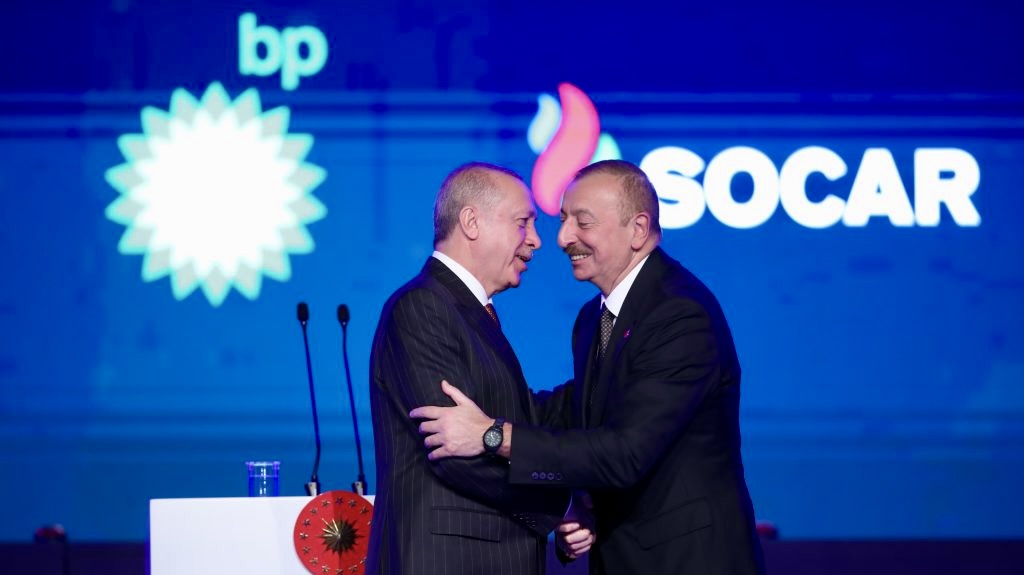
BAKU (Realist English). Turkey and Azerbaijan have announced the signing of a new 15-year contract for the supply of 33 billion cubic meters of gas from the “Absheron” field in the Azerbaijani sector of the Caspian Sea.
The agreement between Turkey’s Botas and Azerbaijan’s SOCAR, with the participation of France’s TotalEnergies and the UAE’s ADNOC, concluded on the sidelines of the Baku Energy Forum in the presence of dictator Ilham Aliyev, outwardly looks like another step toward diversification.
In reality, Ankara and Baku, acting in tandem, are trying to quietly take strategic positions in Europe’s energy market, pushing out the Russian supplier.
Energy Expansion at the Expense of Neighbors
The deal is accompanied by pompous rhetoric about strengthening regional energy security. Behind these statements lies an undisguised attempt to reshape the market in their favor. From 2029, 2.25 billion cubic meters of gas per year will be supplied via the Baku–Tbilisi–Erzurum pipeline.
The project is part of Ankara’s plans to create a gas hub in Turkey and increase exports to Europe.
At the same time, Turkey announced new drilling in the Black Sea and seismic exploration off the coast of Somalia, as well as plans to launch the first unit of the Akkuyu nuclear power plant, which is being built with funds received from Gazprom’s payments.
Turkey’s Double Game: Russian Gas and Azerbaijani Gas
Ankara and Baku are squeezing Russia not by rejecting its energy resources, but by creating political competition. In parallel with developing alternative routes, Turkey is negotiating with Gazprom to extend contracts after 2026.
Turkish Energy Minister Alparslan Bayraktar does not hide that Moscow is considered a reliable supplier.
Turkey remains Gazprom’s second-largest market after China (21.2 billion cubic meters were supplied in 2025).
This double game is bearing fruit: Russia’s share of the Turkish market fell from 60% to 37% in 2025. At the same time, Azerbaijan increased its supplies to 8.66 billion cubic meters over the same period.
Geopolitical Subtext
The duo’s main goal is to take the vacated place on the European route. Under the guise of saving Europe from an energy collapse and reducing dependence on Russian gas, supplies through the Southern Gas Corridor began to increase as early as 2022.
By 2026, Azerbaijani gas had even reached Germany and Austria. Brussels fears substitution — that in reality, re‑branded Russian gas is flowing through the pipelines.
By concluding the Absheron deal, Aliyev and Recep Tayyip Erdoğan are demonstrating that they are ready to serve the interests of the collective West while simultaneously keeping cheap Russian gas for themselves.
The Price of the Matter
The joint energy project of Baku and Ankara is part of a plan to finally push Russia out of the European energy market (Gazprom’s supplies to the EU had fallen from 150 to about 36 billion cubic meters by 2025). It cannot be ruled out that this is a link in a strategy to shut down TurkStream, which remains the last route for Russian gas to Europe.