


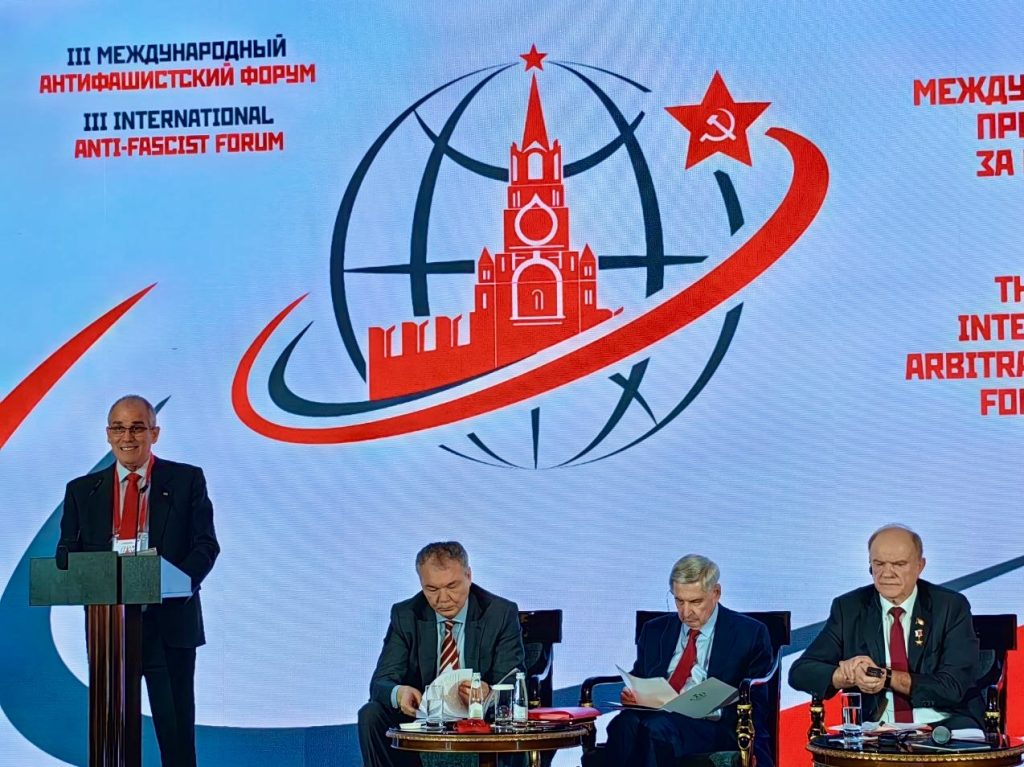
MOSCOW (Realist English). The Cuban people are ready to defend the life and dignity of Venezuela’s leadership, just as 32 Cubans gave their lives for President Nicolás Maduro. This was stated by the Ambassador of the Republic of Cuba to the Russian Federation, Enrique Orta González, speaking at the 3rd International Anti-Fascist Forum in Moscow, organized by the Communist Party of the Russian Federation (CPRF).
“If 32 brave Cubans gave their lives on Venezuelan soil, defending the life of the kidnapped elected president of Venezuela, Nicolás Maduro, what can you say about an entire people ready to defend the life and physical integrity of the army general of Venezuela?” the diplomat said, as quoted by Realist English.
In his speech, he thanked the organizers, addressed the issue of Cuba’s unfair inclusion on the US list of state sponsors of terrorism, and also commented on recent US accusations against Raúl Castro and the policy of the blockade.
On the goals of the forum and the unity of left‑wing forces
The Cuban diplomat stressed the importance of uniting progressive forces in the face of global threats.
“We believe that this forum will be an excellent opportunity to continue strengthening the unity of ideas and actions between political forces and progressive movements in the face of the many and complex current challenges that threaten global peace and seriously endanger the very existence of the human race,” the ambassador said.
Cuba – a victim, not a sponsor of terrorism
Speaking about Cuba’s inclusion on the US list of state sponsors of terrorism, Orta González called the decision unfair and contradictory.
“Cuba knows this horror well – not because it sponsors it, as some claim, but because our people have been the victims of terrorist attacks, incursions and terrorist actions organized from outside. Dozens of lives and families have been lost. This experience obliges us to speak firmly and with direct knowledge,” he said.
According to the ambassador, calling victims guilty distorts the truth and weakens serious mechanisms for counter‑terrorism cooperation. He called for such designations to be based on real evidence, not political motivations.
Accusations against Raúl Castro: an act of political provocation
Orta González devoted special attention to the recent statement by the US Department of Justice on May 20, which he described as a “vile accusation” against Army General Raúl Castro. The ambassador called the accusation a “despicable and vile act of political provocation” linked to the 1996 incident, when the Cuban Air Force shot down two aircraft belonging to the terrorist organization “Brothers to the Rescue”, which had repeatedly violated Cuban airspace.
“Cuba’s response to this violation of its airspace was an act of legitimate self‑defense,” the diplomat stressed.
He also recalled the inaction of the US government in response to Havana’s warnings, which in his view proves US complicity in planning terrorist acts against Cuba.
Fighting fascism and remembering the USSR’s feat
The ambassador touched on the revival of fascist ideas in the modern world.
“Today we also face another, increasingly tangible threat – the resurgence of fascist ideas. These are not vestiges of the past; they reappear in hate speech, exclusionary nationalism and practices that criminalize difference,” he said.
Orta González recalled the decisive role of the Soviet Union in defeating Nazism. He called for preserving the memory of the victims of the Great Patriotic War and using all available tools – education, culture, historical memory and international cooperation – to prevent the resurgence of fascism.
The blockade of Cuba is a form of aggression
The Cuban diplomat also spoke about the economic blockade that the US has maintained against the Island of Freedom for more than six decades.
“The long economic, commercial and financial blockade imposed by the United States against Cuba is a form of aggression that limits development, undermines public health and affects the basic rights of citizens. Condemning terrorism also means condemning the policy of siege that punishes entire peoples and creates unnecessary suffering,” he said.
Response to Marco Rubio and commitment to principles
Concluding his speech, Orta González referred to recent statements by US Secretary of State Marco Rubio, who linked the tightening of the blockade to Cuba’s friendship with Russia, China, Venezuela and other countries.
“We can answer Mr. Rubio: Cuba does not change its principles. It will be wherever the dignified are. And for Cuba, independence and sovereignty are sacred. In Cuba, there is a single consciousness,” the ambassador said.
He thanked the forum organizers for the documentary shown during the event and reaffirmed Cuba’s readiness to share its experience in the fields of healthcare, education and resistance to external aggression.
CPRF and Cuba
Political support for Cuba from the CPRF in 2024–2026 was not merely a tribute to traditional rhetoric, but developed along several key lines: the party provided diplomatic assistance to Havana, organized humanitarian actions, held major international conferences and consistently issued official statements condemning the US blockade.
The CPRF, at the highest level, reaffirmed its strategic alliance with Cuba by regularly holding meetings with its leadership and providing full political support.
- Visit of the Cuban Foreign Minister (February 2026): Talks were held in Moscow with the participation of Gennady Zyuganov and the party leadership. Zyuganov called on the international community to stand together, stating: “The tighter and more friendly the resistance to this aggression from all countries… the better and safer the world will be.” He described the blockade as “barbarism” comparing it to the siege of Leningrad. The parties discussed forms of support for the Island of Freedom, and the Cuban counterparts expressed hope for expanded assistance.
- Meeting with the head of the Cuban National Assembly (March 2025): The guest thanked the CPRF deputies for their “effective support” and confirmed the delegation’s participation in the Moscow Anti-Fascist Forum. Zyuganov also awarded senior Cuban leaders commemorative medals “80 Years of Victory”.
- Culmination (May 2026): At the 3rd International Anti-Fascist Forum and the associated conference, the Cuban delegation was given a platform to expose Washington’s provocations.
Seeking to mobilize the broad masses, the CPRF held public actions and used the information space to defend Cuba’s interests.
- Action “Fidel – the inspirer of Victory…” (April 2026): An event was held jointly with the Cuban Embassy in Moscow, with the participation of party leaders and the diplomatic corps, where support for the island’s sovereignty was expressed to the sounds of the anthems of the USSR and Cuba.
- Media activity: Deputy Chairman of the CPRF Central Committee Yuri Afonin on Rossiya 1 TV channel criticized Trump’s policy, characterizing it as the “quintessence of American cynicism”, and noted that Cuba endured a difficult period after Yeltsin’s betrayal but survived.
- Position at the UN: Dmitry Novikov, Deputy Chairman of the CPRF Central Committee and First Deputy Chairman of the State Duma Committee on International Affairs, presented an address in the State Duma demanding an end to the blockade. He warned of the threat of a “narrow market approach” to cooperation with Cuba, which contradicts the national‑state interests of Russia itself.
All these events have not only supported Cuba in word and deed, but have also integrated its struggle into the broad context of the international anti‑fascist agenda. The CPRF considers Havana a bastion of resistance to global hegemonism.