


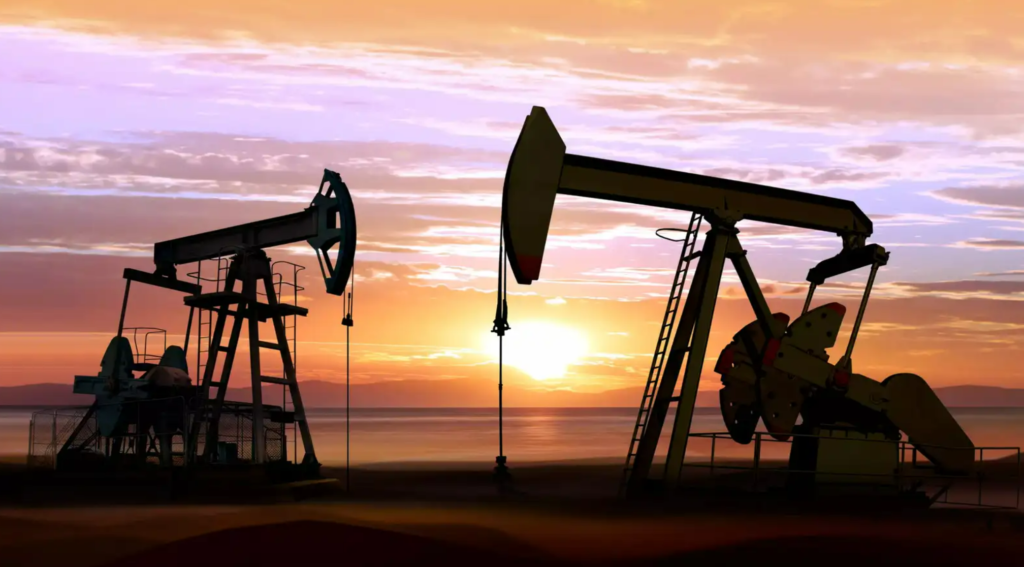
LONDON (Realist English). Global energy prices are showing a sharp drop at the start of the new trading week.
The key driver of the decline was the achievement of a peace agreement between the United States and Iran, which opens up the prospect of restoring transit through the Strait of Hormuz.
Oil plunges to lows not seen since March
On the morning of June 15, the price of August futures for Brent crude on the London ICE Futures exchange fell to $83.24 per barrel. The drop from the previous close was $4.09, or 4.68%. WTI crude oil for July delivery on NYMEX traded at $80.61 per barrel (-5.03%).
Both benchmark grades hit their lowest levels since March 10. At one point, Brent reached $83.82, while WTI fell to $80.53 — 5.12% below Friday’s close.
Gas in Europe loses 5%
The European gas market reacted with a synchronous decline. Near-term futures for gas according to the Dutch TTF index fell 5% to €44.43 per MWh, hitting a more than five-week low. In dollar terms, the price fell to $534 per thousand cubic meters, 4.6% below Friday’s close of $559.7.
Dollar weakens, risk currencies rise
The US dollar index DXY, which measures the American currency against a basket of six major currencies, fell to 99.395 points — its lowest since June 5. The decline was 0.1%.
The euro strengthened to $1.1622 (+0.5%), the British pound to $1.3459 (+0.4%). High-yielding currencies also rose: the Australian dollar climbed to $0.7087 (+0.7%), the New Zealand dollar to $0.5863 (+0.6%).
Lifting the blockade of the Strait of Hormuz
The reason for the market shock was a statement by Pakistan, which acted as a mediator in negotiations between Washington and Tehran. Prime Minister Shehbaz Sharif announced that the final text of a peace agreement had been reached, with a signing ceremony scheduled for June 19 in Switzerland.
US President Donald Trump said the Strait of Hormuz would be opened for ship passage without any fees, and the American blockade of Iranian ports would be lifted immediately after the document was signed.
At the same time, the most acute issues, including Iran’s nuclear program, have been postponed to a later stage. According to Iran’s Deputy Foreign Minister Kazem Gharibabadi, 60 days have been allotted for this.
Market removes ‘risk premium’
“The geopolitical risk premium built into oil prices is disappearing quite quickly as traders factor in the prospects for supply recovery,” noted Tim Waterer, analyst at KCM Trade.
Piyanka Sachdeva, analyst at Philip Nova, added: “The conflict may have ended, and oil supplies through the Strait of Hormuz will gradually return to normal levels. However, the damage caused by the war cannot be repaired overnight. This applies not only to physical damage to oil infrastructure but also to the economic consequences for importing countries.”
According to Nick Twidale, chief market strategist at ATFX Global in Sydney, a real recovery in supply volumes will take months rather than weeks.
“I think we will see the dollar fall over the next few sessions. We will likely see some strengthening of risk currencies such as the Australian dollar and the yen. But I don’t expect major moves. There will be a lot of wait-and-see: how quickly the strait actually opens and how long it will take for oil flows to return to normal.”
Fed keeps rate as inflationary risks subside
This week, traders’ attention is also focused on meetings of major central banks. The Federal Reserve is expected to keep its base interest rate in the range of 3.5–3.75% following its meeting on June 17-18.
Before the US-Iran peace deal was reached, the market estimated the probability of a rate hike in December at more than 70%. By June 15, those expectations had fallen to about 50%.
Investors are betting that reduced geopolitical tensions will help contain inflationary pressure.
“Negotiations on aspects of the deal continue, but central bankers will no doubt breathe a sigh of relief, at least for now, as upside risks to inflation appear to be receding and not becoming the central scenario,” noted Prashant Newnaha, senior rates strategist at TD Securities in Singapore.
Outlook
The market continues to price in news of reduced geopolitical tension in the Middle East. The key factor in the coming days will be the actual signing of the memorandum on June 19 and the speed at which shipping through the Strait of Hormuz is restored.