


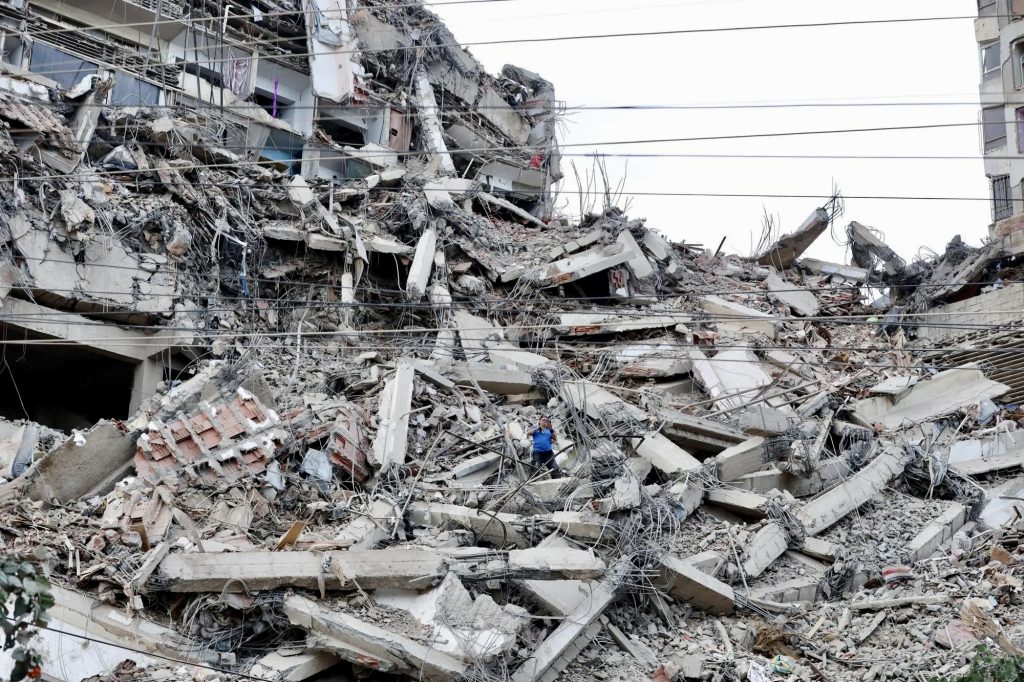
CARACAS (Realist English). For the third day, rescue teams are clearing rubble in northern Venezuela after two of the most powerful earthquakes in the country’s history struck on the evening of June 24.
According to the latest figures, the death toll has reached 235, with more than 4,300 injured and 157 still listed as missing.
Hundreds of people remain trapped under the debris of collapsed buildings. The international community has launched a major relief operation, but the “golden window” for rescuing survivors is rapidly closing.
Chronology and Scale of the Disaster
Two tremors, less than a minute apart, hit the central part of the country on the evening of June 24. According to the U.S. Geological Survey (USGS):
- The first tremor, magnitude 7.2, struck at 18:04 local time, with its epicentre near the city of San Felipe, the administrative centre of Yaracuy state.
- The second tremor, magnitude 7.5, struck 39 seconds later near the town of Yumare, also in Yaracuy state.
The second earthquake was the most powerful to hit Venezuela in over a century. At least 138 aftershocks have been recorded so far.
President of the National Assembly Jorge Rodríguez reported that at least 346 buildings have been damaged, including eight hospitals. Early USGS models warn that the final death toll could range from 10,000 to 100,000 people, with economic losses amounting to 2 to 10 percent of the country’s GDP.
Worst‑Hit Areas
La Guaira state, north of Caracas, is one of the worst‑affected areas. Acting President Delcy Rodríguez described the situation there as a “true tragedy”: dozens of buildings have been destroyed and infrastructure severely damaged. Simón Bolívar International Airport, which serves Caracas, has been closed due to structural damage.
In the Chacao municipality (Greater Caracas), 11 deaths have been confirmed after three buildings collapsed. Mayor Gustavo Duque said 23 people have been rescued from the rubble, while four remain trapped. In the San Bernardino district, three buildings completely collapsed.
In Miranda state, schools will remain closed until at least June 29 pending damage assessments.
Rescue Operation
Rescue efforts are hampered by darkness and poor visibility. In La Guaira, local residents are clearing debris by themselves in search of loved ones while waiting for official help to arrive.
The authorities have declared several areas, including La Guaira state, disaster zones. State broadcaster Venezolana de Televisión continues to broadcast despite serious damage to its studio.
International Assistance
The coordination of international rescue operations has been taken over by the UN Office for the Coordination of Humanitarian Affairs (OCHA) through the International Search and Rescue Advisory Group (INSARAG).
UN humanitarian chief Tom Fletcher stated: “In the coming days, major collective efforts will be needed to support the government‑led response and help communities.” Even before the earthquake, around 8 million people in Venezuela were already in need of humanitarian aid.
- The United States has deployed search‑and‑rescue teams from Virginia and Los Angeles. Secretary of State Marco Rubio stressed that “search‑and‑rescue operations are the most urgent need right now.”
- Spain sent a military aircraft with 57 military search‑and‑rescue personnel and 40 firefighters from Madrid, and also plans to deploy a field hospital.
- El Salvador prepared 300 rescuers and paramedics, as well as 50 tonnes of medical supplies.
- Mexico dispatched a team of rescuers and medics and is ready to assess the need for further assistance.
- Italy is sending an advance team to coordinate the arrival of additional rescuers.
- Germany has pledged six military transport aircraft.
- Pope Leo XIV transferred €100,000 ($114,000) from the Vatican’s charitable fund. **World Central Kitchen**, run by chef José Andrés, began distributing hot meals in Caracas and allocated $1 million.
- Delcy Rodríguez announced the creation of a $200 million recovery fund for damaged hospitals and housing.
Venezuela in Crisis
The disaster struck at a time of deep political and economic crisis. Venezuela, already suffering from a severe humanitarian crisis, now faces an unprecedented blow from the natural disaster. Earlier this year, a US special forces operation took place in the country to detain former President Nicolás Maduro.
The double earthquake in Venezuela is a rare seismic phenomenon known as a “doublet.” Nearly 60 earthquakes of magnitude 6.0 and above have been recorded in the region since 1900.