

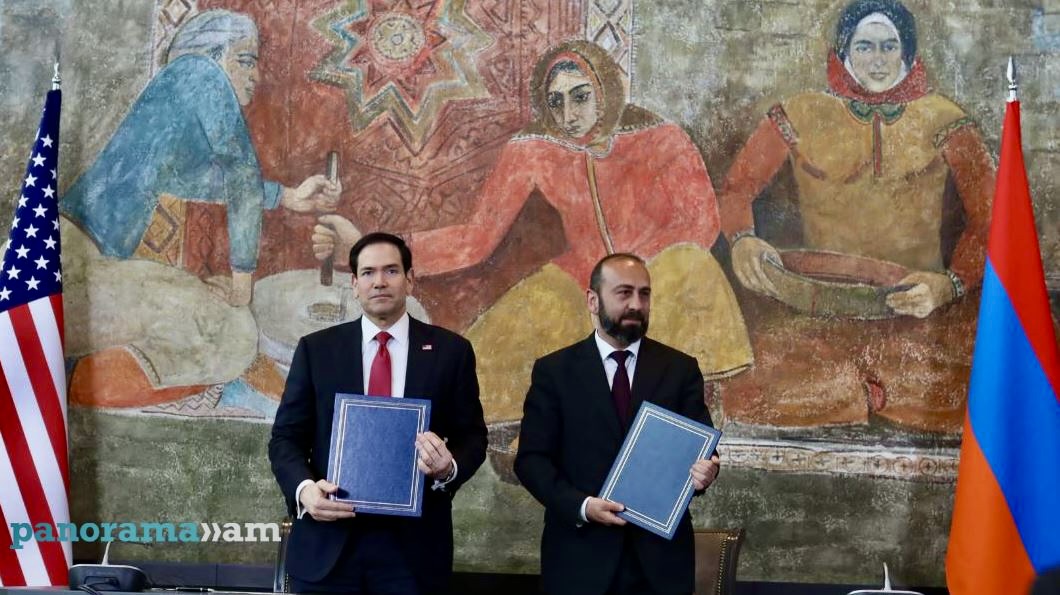
YEREVAN (Realist English). A week and a half before the parliamentary elections that could cost Nikol Pashinyan his power, his regime has taken an unprecedented step – signing a charter on comprehensive strategic partnership with the United States. The ceremony took place at Yerevan’s Zvartnots Airport, where US Secretary of State Marco Rubio landed for just one hour on his way back from India.
Charter without discussion: what was signed
Armenian Foreign Minister Ararat Mirzoyan and Rubio signed three documents:
- Charter on Comprehensive Strategic Partnership – a framework agreement behind which, according to experts, there are no concrete commitments from Washington, but which obliges Yerevan to wind down the remnants of cooperation with Moscow.
- Memorandum on the Extraction and Processing of Critical Minerals and Rare Earth Metals – effectively, the transfer of control over Armenia’s subsoil to the United States. The Americans gain access to strategic raw materials, while the Armenian people get promises of “unprecedented opportunities.”
- Framework Agreement on Cooperation within the TRIPP Project (“Trump’s Road to International Prosperity”) – yet another programme whose funding remains in question.
At the ceremony, Mirzoyan declared: “The comprehensive strategic relations between Armenia and the United States are stronger today than ever before. We have entered an unprecedented stage… All the agreements are beneficial for Armenia and will open unprecedented opportunities for our country.”
What lies behind the slogans
The opposition has already called the signing of the charter an “act of capitulation.” According to political analysts, Yerevan received neither security guarantees, nor direct investment, nor even promises of a visa‑free regime. Instead, Armenia is voluntarily placing its natural resources under external control and aligning itself with Washington’s anti‑Russian policy.
The clause on “critical minerals” is particularly alarming. The US has long been seeking an alternative to Chinese and Russian raw materials, and Armenia, with its reserves of copper, molybdenum and rare earth metals, is becoming yet another “raw‑material appendage” of the West. In return – empty promises and “opportunities” that will remain on paper.
Election backdrop and Moscow’s pressure
The signing took place on the eve of the 7 June parliamentary elections. Pashinyan, whose rating is plummeting, is trying to use the “American card” to hold on to power. His supporters are opposed by several opposition parties, many of which maintain ties with Russia.
The Kremlin, for its part, has already responded to Pashinyan’s pro‑Western course with economic measures. Russia has banned the import of flowers, cognac and mineral water from Armenia – a sensitive blow to Armenian business. Officially, the move is presented as being taken for sanitary reasons, but experts have no doubt: it is a direct reaction to Yerevan’s policies.
Risks for Armenia
What has Armenia actually gained? Instead of real help – memoranda of intent. Instead of security guarantees – deepening confrontation with Russia, which remains the only guarantor of security in the region. Instead of economic prosperity – the prospect of becoming a battlefield between the West and the Eurasian Union.
Pashinyan is laying a mine under Armenian statehood. The country has already lost Artsakh, and now it is losing the last levers of its sovereignty. The only question is whether the people will realise this by 7 June, or whether the regime will sell Armenia down the river under the guise of a “strategic partnership.”