

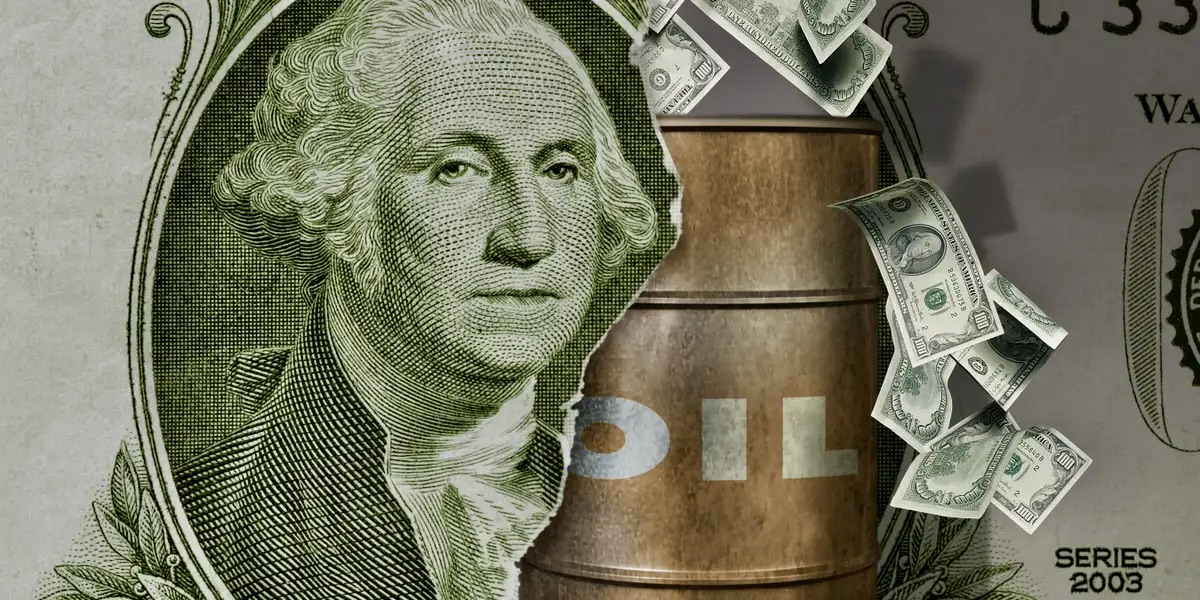
LONDON (Realist English). The standoff in the Strait of Hormuz, writes the Financial Times, may become the moment when one of America’s most powerful geopolitical tools — control over the global dollar system — has shown its weakness. The threat of limiting access to the dollar no longer looks as fearsome as before.
First cracks: Russia and Swift
The first signs of this appeared back in 2022, when Russian banks were disconnected from the Swift system. Even then, it was understood that this would be more of an inconvenience than an economic death sentence. However, the extent to which Russia continues to wage war and sell oil has likely disappointed sanctions supporters. The weapon has not worked at full strength.
Iran: sanctions are no obstacle
Iran is one of the most sanctioned places in the world, where US restrictions cover the entire country. But that has not prevented it from selling oil even while at war with America. Moreover, Tehran freely charges fees for passage through the Strait of Hormuz.
According to Lloyd’s List Intelligence, some ships have paid Iran up to $2 million for safe transit. After the ceasefire announcement, an Iranian official stated that the country would demand shipping companies pay tolls in cryptocurrency — equivalent to $1 per barrel of oil transported.
Why the dollar stick is weakening
The problem is that the threat of disconnection from the dollar system only works against open economies integrated into global supply chains. But such countries rarely merit threats. Sanctioned states, on the other hand, get used to making do.
Iran sells part of its oil for yuan, since most of its imports come from China. There is also a network of banks and shadow financial companies willing to risk US extraterritorial enforcement and launder dollar payments.
Cryptocurrencies — a new workaround
However, these workarounds may become barely necessary in a world where anonymous money can be sent over the internet. The US does not control the flow of payments made in bitcoin or stablecoins transmitted over decentralized networks.
While intrusive US money laundering rules cause inconvenience for allies, countries at odds with America gain access to a separate, barely regulated parallel crypto-dollar system — the same one used by criminals and other bad actors.
A predictable outcome
As the Financial Times notes, all this was quite predictable. Henry Farrell, one of the political scientists who coined the term “weaponized interdependence,” predicted earlier this year in a co-authored paper that the dollar system, long a source of global stability, would evolve into a source of instability as it becomes more weaponized. “As the US ratchets up pressure, other countries will look to escape dollar power, likely provoking the US to double down in response.”
Targeted sanctions work better
The isolation of North Korea from the mainstream global financial system shows that this does not leave a mark. Targeted sanctions on individuals appear to be more effective than general sanctions on countries. “Bad actors” shunned from the dollar banking system still have to turn to inferior alternatives like crypto payment technologies.
Better to threaten than to use
But global finance, writes the FT, is becoming less a geopolitical weapon for the US and more a force multiplier for its enemies. As the central bankers in the history of the Bank of England knew, it is much better to threaten dire consequences than to put yourself in a situation where you have to actually use the big stick. It may break.
Short-term surge
Over the five weeks of the conflict, the US dollar became the main beneficiary among currencies. The DXY index rose 2.2% in March, driven by two key factors: US energy self-sufficiency (the country is a net energy exporter, reducing its vulnerability to oil price shocks and strengthening the dollar) and safe-haven demand (geopolitical uncertainty traditionally drives demand for the dollar).
At their peak, the USD/KRW and USD/JPY pairs also showed significant gains, reflecting a flight to safe assets. Analysts called the dollar a “wrecking ball” for risk assets, including emerging market currencies.
The minutes of the FOMC meeting on March 17–18, published on April 8, showed a split among Fed officials: Hawks warned that the war could fuel inflation, potentially requiring rate hikes; Doves feared that a prolonged conflict could hurt the labor market, potentially requiring rate cuts. Ultimately, the base rate was kept at 3.5–3.75%. The forecast for one rate cut in 2026 remained unchanged.
However, markets remain skeptical of this scenario, and expectations of Fed easing (which reached 50%) will influence the dollar’s future dynamics.
The month of war clearly demonstrated how the conflict accelerates the transition to a multi-currency system and undermines the long-term hegemony of the dollar. Key factors include:
- Yuan transactions: Iran (since January 2026) and Saudi Arabia (40% of settlements with China by the end of March) are actively using yuan for oil. Iraq also officially allowed settlements in CNY since late February. This is a serious blow to the petrodollar system.
- Parallel payment systems: BRICS+ unites countries responsible for more than 40% of global oil production, seeking to formalize bypassing the dollar.
- Dollar vulnerability: Deutsche Bank analysts called the conflict a “catalyst” for replacing the petrodollar, and The Guardian warns that de-dollarization is reshaping the global economy, reducing US power.