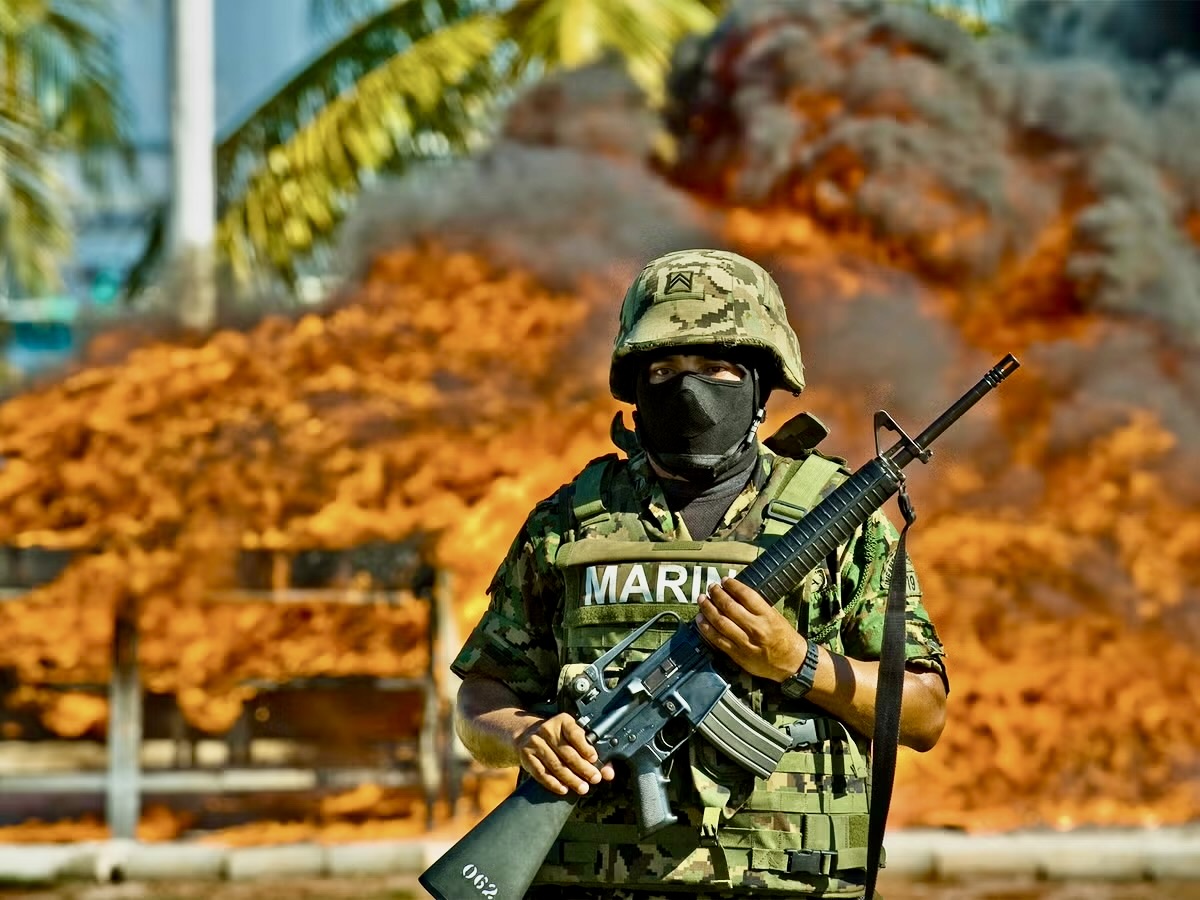
MEXICO CITY (Realist English). Mexico has been engulfed in bloody clashes for several days. After the elimination of drug lord El Mencho, made possible through the joint efforts of relevant official structures in Mexico and the United States, unrest broke out in at least several Mexican states. According to various media reports, members of the Jalisco New Generation cartel, founded and led by El Mencho, are blocking roads, setting fire to cars, buses, gas stations, looting businesses and police stations.
To stabilize the situation and protect the population, joint forces of the army, the National Guard and local police have been deployed in the states. But in principle, there is nothing unusual about this situation for Mexico. Bloody wars between drug cartels and between cartels and the police have long become a routine part of life in Mexican states.
Some experts far removed from drug trafficking and Latin America in general ask: where did drug cartels come from in Mexico? Some even write that Colombia supplies cocaine there for “subsequent sale.” Colombia long ago ceded its leadership in processing harmless coca into deadly cocaine to Mexico. And this did not happen without the “help” of drug kingpins from the United States. All the main chemical laboratories for cocaine production are located in Mexico. And have been for a long time. And the profits flow to offshore banks in Panama, and not only there.
Only the owners of those accounts should be sought not in the capitals of Latin America, but in the corridors of power and luxurious offices of US business companies. Therefore, the US should better fight its own drug mafia rather than lecture others on how to do it. And I would particularly note that coca and cocaine should not be confused.
Why do the countries of Latin America, especially in mountainous regions, call coca nothing other than “mother coca”? The production of coca is not only traditional but also vitally important for the indigenous population of the Andean countries. It is part of the culture of South American peoples living in high-altitude conditions. Coca is used by the local population as a stimulant during difficult treks, saves them from malnutrition, and helps them overcome altitude sickness. The indigenous people of the Andean countries have long known coca recipes that treat cancer.
However, with the arrival of Europeans, especially in the early years of the 20th century, a derivative of coca – cocaine – appeared in a different guise. As renowned researcher Miguel Palacio writes, “cocaine became known as a narcotic substance, the use of which invariably leads to the emergence of an irresistible addiction and severe bodily dysfunctions. Cocaine took its special place in the series of misfortunes and tragedies brought to humanity by the 20th century.”
Thirty years ago, the congress of the Indigenous Regional Council of the Colombian department of Cauca resolved: “Coca should be preserved as one of the indigenous agricultural crops, given its usefulness for medicine, as a means of alleviating the hardship of labor, restoring strength, etc. However, trade in this commodity with whites must cease – coca must be respected, while they are causing this crop to be used in a completely inappropriate manner.” But the concepts of “respect for other peoples” and even for their own are not in the vocabulary of American drug traffickers!
Will the elimination of the leader of Mexico’s largest drug cartel solve the problem of ridding the country of the drug business? Definitely not. The drug business in Mexico is a huge system embedded in all structures of power. Possessing far greater resources, and often influence in all spheres of life, than the official government. And the security forces are no exception.
The threads from Latin American drug cartels lead not only to the offices of Panamanian banks, where money is laundered in the accounts of some prominent US congressmen, senators, and big businessmen, but also to the corridors of US power – to those who are involved in drug trafficking as one of the most profitable types of business, far more profitable than selling oil. And where there is drug trafficking, there is also human trafficking, including children for sexual exploitation, etc. And Trump, as a big businessman devoid of illusions, cannot fail to understand this.
Personally, it is not yet clear to me whether US anti-drug structures actually participated in the elimination of El Mencho (by providing intelligence data) in order to “neutralize” the criminal, or whether they were clearing the way for another drug trafficker, as was the case with the elimination of Escobar in Colombia.
The experience of the US “fight” against drug mafia, which I studied well during my trips to Colombia, provides grounds for the following conclusions. At that time, the US, with the help of the Cali Cartel, eliminated the Medellín Cartel led by Pablo Escobar. And then the Cali Cartel as well. Now in Colombia, drug trafficking within the country is under the control of illegal armed groups, and its export is under the control of US military bases.
During my frequent trips to Latin American countries, I have had to talk to various people, including those actually involved in the drug business. Such individuals are found among governors, leading politicians, and cultural figures. There are plenty of them among university rectors. It is precisely investments in social spheres, education, and culture that are a means of laundering proceeds from drug trafficking. Even the presidents of many countries in the region are an important link in the drug networks. A former president of Paraguay once had a whole plane loaded with cocaine land on his estate.
And what? The police could do nothing. Mexico’s President Claudia Sheinbaum is one of the few presidents of that country who has openly entered into a fight with the drug cartels. Yet Mexico has for many years appeared on lists of countries with the highest rates of killings of opposition politicians. The perpetrators of such crimes are often members of drug cartels. And the traces of those who order the elimination of undesirable party and movement leaders often lead to the corridors of power of the Big Northern Neighbor.
Furthermore, during her election campaign, Sheinbaum clearly and unequivocally stated that her country would never again stand before the United States “in a posture of subordination.” By agreeing to participate in the joint operation to eliminate El Mencho, Sheinbaum has now saved her country from US military operations on its territory, which Trump had threatened several times. And recent events involving a US ship shelling Cuba’s coastal territory once again prove that international law means little to Trump. So the night is still young.
Tatiana Poloskova, Doctor of Political Science, State Counselor of the Russian Federation, 1st class, exclusively for Realist English