
Realist: news and analytics

Русский / English / العربية

  • News
  • Russia
  • Caucasus
  • Opinion
  • Interviews
  • Experts
No Result
View All Result
Realist: news and analytics
  • News
  • Russia
  • Caucasus
  • Opinion
  • Interviews
  • Experts
No Result
View All Result
Realist: news and analytics

83% of Russians consider themselves believers: share of atheists fell from 70% to 5%, share of Orthodox among youth grew from 25% to 45%

Religiosity or tradition? Two-thirds of Russians believe in higher powers, every second believes in a house spirit.

     
April 8, 2026, 15:03
People & Culture
83% of Russians consider themselves believers: share of atheists fell from 70% to 5%, share of Orthodox among youth grew from 25% to 45%

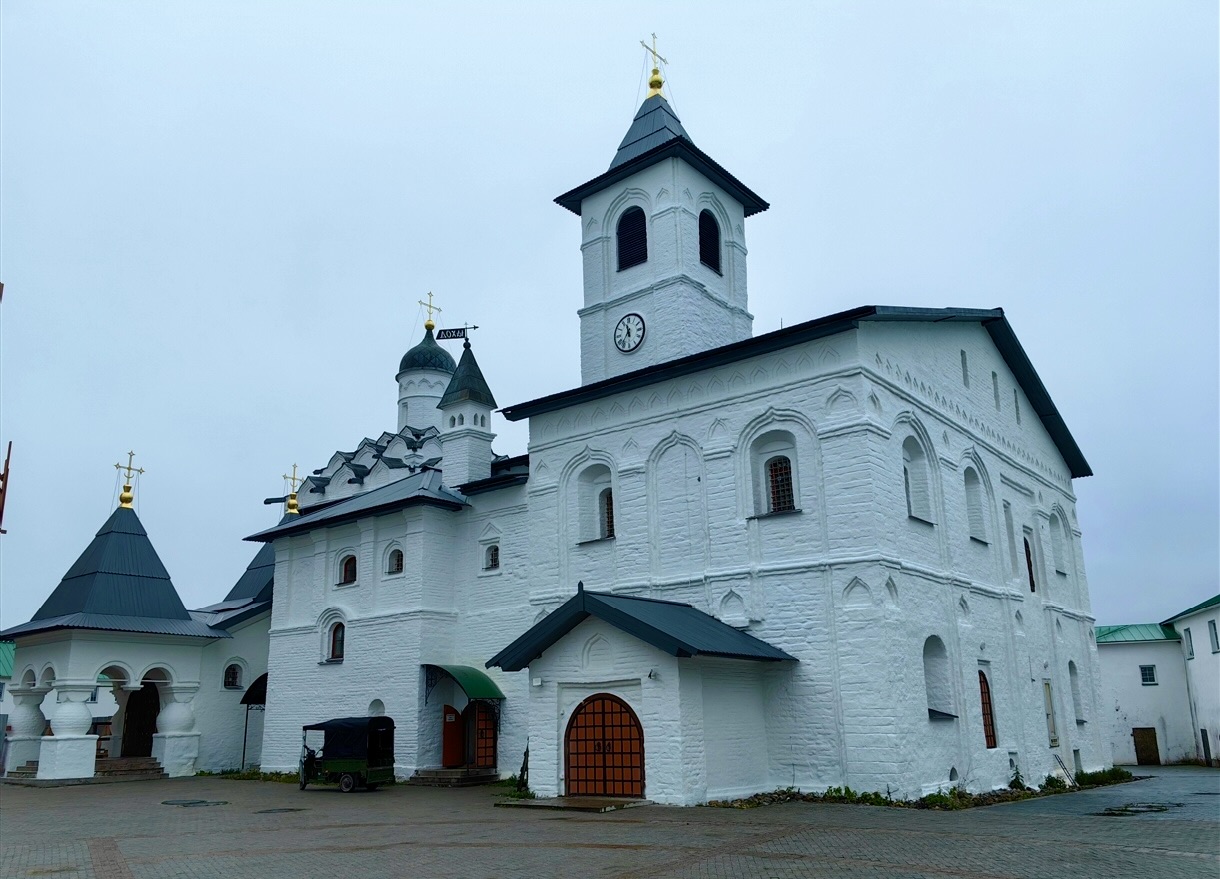
Church of the Intercession of the Most Holy Theotokos. Holy Trinity Alexander-Svirsky Monastery. Photo: Realist English

MOSCOW (Realist English). Religiosity in Russia continues to grow at record rates. According to a VTsIOM poll conducted in 2025 among 1,600 adult Russians in 80 regions of the country, 83% of citizens consider themselves believers — 7 percentage points higher than four years ago.

Maria Grigorieva, an expert from the Department of Political Research at VTsIOM, called this trend “stable”: “Since 2021, the share of those who consider themselves believers has been steadily increasing.” Data from FOM, published in May 2025, also confirms the high level of religiosity — 79% of Russian residents called themselves believers.

Growth of religiosity among youth: from 25% to 45%

Sociologists record the most dramatic changes among young people. According to Maria Grigorieva, the share of young people aged 18 to 24 who consider themselves Orthodox has nearly doubled — from 25% to 45%.

Vladimir Shapovalov, head of projects at the Expert Institute for Social Research, called this indicator “a sensation and a symptom of ongoing fundamental changes.” In his opinion, in an era of turbulence, an increase in the number of wars and ideological conflicts, “the younger generation sees in faith an opportunity and a chance to get through difficult times.”

Orthodoxy, Islam, and atheism: numbers and proportions

67% of Russians call themselves Orthodox — 5 percentage points higher than four years ago. Among respondents aged 46–60, this figure reaches 74%. The share of Muslims remains stable at 6–8%, but in the age group of 18–30, 12% of respondents profess Islam.

The share of atheists, according to Levada Center (foreign agent), fell from 70% in December 1989 to 5% in September 2025. Another 13% of respondents do not identify with any religion.

Religion as tradition, not salvation

Sociologists note that for most Russians, religion is primarily a national tradition (35%) and adherence to moral and ethical norms (34%). Only 28% perceive it as personal salvation and communion with God. At the same time, the number of those who believe that religion helps in everyday life is growing: from 55% in 2015 to 62% in 2025. Religious symbols are worn by 46% of respondents, and 45% live according to the commandments of their faith.

Church attendance: 72% attend, but only 16% do so regularly

Despite the high level of declared religiosity, actual church attendance remains low. According to VTsIOM, 72% of respondents attend church, but only 16% do so regularly (at least once a month). According to Levada Center (foreign agent) data for February 2026, the share of those who never attend religious services exceeded half for the first time since 1998, reaching 55%. Those who most often do not go to church are men (60%), youth under 25 (68%), and students (71%).

“The growth of religious identity among youth from 25% to 45% is a sensation,” emphasizes Vladimir Shapovalov. “But the level of active church involvement in different age groups ranges from 6% to 11% of believers.”

Belief in the supernatural: house spirits, wood goblins, and holy warriors

In March 2026, VTsIOM published a survey on Russians‘ belief in the supernatural. Two-thirds of Russians (66%) allow for the existence of higher powers or saints that protect a person in danger — on the road, in battle, and in other difficulties. More than half (57%) believe in spirits or deities that protect warriors. About 50% of respondents said they believe in the existence of a house spirit (domovoi), 48% — in spirits that protect children and animals, and 47% consider it possible that people with the gift of foresight or magical abilities exist.

One in three (34%) admits the existence of a wood goblin (leshii), while only one in five (22%) believes in rusalkas (water nymphs). According to VTsIOM analysts, the survey results indicate that “an unwritten but durable agreement on the inviolability of a person’s inner, spiritual world has formed” in the consciousness of Russians.

Atheism recedes into the past: 70% → 5% over 35 years

Levada Center (foreign agent) records a historic decline in the share of atheists. While in December 1989, 70% of USSR citizens declared disbelief in God, by September 2025 this share was only 5%. The share of those who do not identify with any religion is also declining — from 18% in 2023 to 13% in 2025. At the same time, institutional trust in the church and religious organizations stands at 62%. Experts attribute this trend to the search for a worldview anchor amid geopolitical instability and a reassessment of values in the post-Soviet period.

AtheismChristianityPublic OpinionReligionRussian Orthodox ChurchSociology
Previous Post

Ukraine prepares supersonic ballistic missiles

Next Post

Hezbollah excluded from the ceasefire: Lapshin explains why Iran agreed to the pause

Related Posts

Easter unites millions as Armenian, Catholic and Protestant churches celebrate together
People & Culture

Israeli rabbi sparks outrage after condemning court over Western Wall restriction

5 April, 2026
Easter unites millions as Armenian, Catholic and Protestant churches celebrate together
People & Culture

Easter unites millions as Armenian, Catholic and Protestant churches celebrate together

5 April, 2026
Lavrov says SCO “holding firm” amid global instability
People & Culture

US adds 178,000 jobs in March despite rising economic uncertainty

4 April, 2026
“Turn to the East” cannot replace Europe for Russia — expert
People & Culture

European real wages still lag pre-pandemic levels

31 March, 2026
Georgia reassures UK on sanctions amid scrutiny of transit role
People & Culture

Israel blocks senior cleric from Holy Sepulchre amid tensions

30 March, 2026
Georgia reassures UK on sanctions amid scrutiny of transit role
People & Culture

US shows higher poverty despite higher incomes, research says

30 March, 2026
Most Popular
Most Popular
“Armenians are the autochthonous people of the South Caucasus”: geneticist Levon Yepiskoposyan on the Armenian gene pool and its neighbors

“Armenians are the autochthonous people of the South Caucasus”: geneticist Levon Yepiskoposyan on the Armenian gene pool and its neighbors

8 April, 2026

YEREVAN (Realist English). Levon Yepiskoposyan – Doctor of Biological Sciences, head of the Laboratory of Evolutionary Genomics at the Institute of...

“The main Russophobes are the enemies of communists”: Dmitry Novikov responds to attacks on the Communist Party

“The main Russophobes are the enemies of communists”: Dmitry Novikov responds to attacks on the Communist Party

8 April, 2026

MOSCOW (Realist English). In an article published in the newspaper Soviet Russia on April 4, 2026, Deputy Chairman of the CPRF Central Committee...

Oleg Morozov: Mintimer Shaimiev is a sage with political genius

Oleg Morozov: Mintimer Shaimiev is a sage with political genius

8 April, 2026

MOSCOW (Realist English). Oleg Morozov, Chairman of the State Duma Committee on Control and a member of the United Russia party,...

US and Iran agree two-week ceasefire as Strait of Hormuz reopens

US and Iran agree two-week ceasefire as Strait of Hormuz reopens

8 April, 2026

WASHINGTON (Realist English). The United States and Iran have agreed to a two-week ceasefire, with U.S. President Donald Trump suspending...

Opinion

“Playing the Kurdish card isn’t working for the CIA and Mossad”: expert on the position of Kurds amid the war in Iran

“Playing the Kurdish card isn’t working for the CIA and Mossad”: expert on the position of Kurds amid the war in Iran

8 April, 2026

MOSCOW (Realist English). The war between the United States and Israel against Iran has not led to the activation of Kurdish...

Star Wars without fiction: how space became the next battlefield

Star Wars without fiction: how space became the next battlefield

27 January, 2026

MOSCOW (Realist English). “Star Wars” stopped being science fiction long ago. Unfortunately, over ten thousand years of civilisation, humanity has...

Armenian monastery Dadivank

Dadivank: The Legacy of Christ’s Apostles in Artsakh

17 December, 2025

YEREVAN (Realist English). In Artsakh, before the ethnic cleansing and forced deportation – simply put, genocide – carried out by...

An unusual phenomenon at the Church of the Holy Savior in Shushi

An unusual phenomenon at the Church of the Holy Savior in Shushi

3 November, 2025

YEREVAN (Realist English). In the distant year 1979, as a third-year university student, I used to visit the Church of...

All rights reserved.

© 2017-2026

  • About Us
  • Mission and Values
  • Contact Us
  • Privacy Policy

Follow Realist English

No Result
View All Result
  • News
  • Russia
  • Caucasus
  • Opinion
  • Interviews
  • Experts

Русский / English / العربية