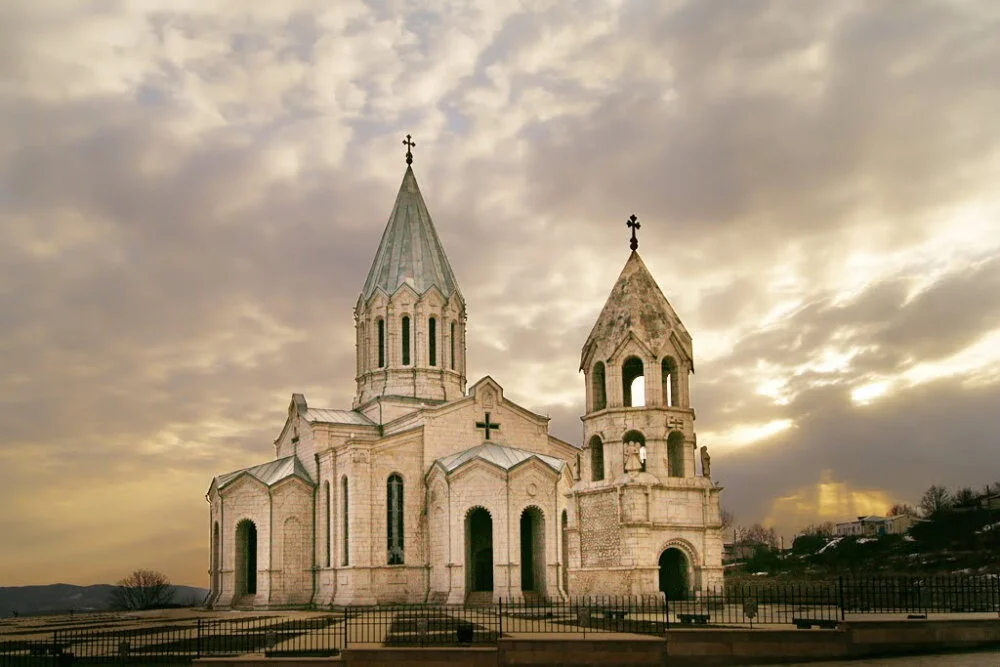
YEREVAN (Realist English). In the distant year 1979, as a third-year university student, I used to visit the Church of the Holy Savior in Shushi every Tuesday. The dome of the church was destroyed, the cross had been removed, and the statues of angels on the four sides of the bell tower were half-ruined. Yet the cross itself had survived. The inner walls of the church bore inscriptions written in red and black paint with various messages.
The church’s caretaker, Ali, was a thin, middle-aged man dressed in a faded black suit, wearing a wrinkled hat. He did not keep the church clean.
I met the caretaker during my third visit. He approached me and asked in Azerbaijani: “I have seen you here three times now. Are you a believer?” I let him know that I understood Azerbaijani but spoke it poorly. Ali repeated his question and said he understood a little Armenian. I replied, “Yes, I am a believer, but not a Christian — I am a pagan.” He did not understand what “pagan” meant, so I explained that Armenians have their own gods, Armenian gods, and I worship them.
The caretaker was surprised and asked, “Then why do you come here every time and clean this church if you are not one of its followers?” In my broken Turkish, I explained that the church is one of our national treasures, and I am obliged to respect the faith of my ancestors.
After that, we agreed that when I was in the church, he could go home for two hours to rest.
A week later, I asked him why the Tamiryants family’s tombstone on the church grounds was cleaner than the others. He smiled and said, “Every time I come to work, I clean Uncle Tadevos’s grave first, because he helped our large family a lot — he brought running water to our neighborhood.”
On the eve of the New Year, I came to the church and told the caretaker to go home and rest, since I would stay late to finish cleaning. Taking me by the hand, he said: “Amin gurban, every time you come, you do me good. I want to tell you something interesting about this church — why it was not destroyed like the others.”
He led me to the eastern wall of the church and said: “Down there stood another church called Aguletsi. One Russian soldier — our people had paid him — planted explosives in the church and ran the wires up to this wall, hiding behind it. When he detonated the charge, a large stone fragment flew back and struck him on the head. He died instantly.
Our mullah, seeing the dead Russian, said: ‘The reason is that this Russian giaour (infidel) did not remove the cross from the church before blowing it up. The cross has protective power. Before destroying any church, you must remove the cross. Those who remove crosses and destroy churches will be punished by the Almighty.’”
Then the caretaker took me inside the Church of the Holy Savior itself. Standing between the church and the bell tower, he said: “Look at the dome — there used to be a cross, just like the one on the bell tower. Following the mullah’s advice, they paid two Armenian brothers to remove it with their own hands. They brought a long rope and tools, climbed up, tied the rope around the cross, and tried to lift it. It did not work. With an iron crowbar, they loosened the base, pulled again, and the cross fell — dragging the brothers down with it, since the rope was wrapped around their hands. They died. The mullah, seeing their bodies, said that anyone who harms this church will meet the same fate. The rest you know yourself…”
I asked the caretaker why the sphere at the base of the bell tower cross was pierced. He replied that their askyars (soldiers) had shot at the cross and the sphere — there were 24 bullet holes in it.
At the end of March 1980, when I again visited Shushi, I saw poplar trees planted ten meters from the northern and western walls of the church, spaced three meters apart. I asked who had planted them. The caretaker said that the Shushi City Council had organized a “community clean-up” and youth volunteers planted the trees. After spending only a few minutes inside, I went to the bus station and returned to Stepanakert.
It was clear to me why the city council had shown such “care” for the Church of the Holy Savior. The goal was obvious: within ten years, the tall poplars would hide the church from view — much like Nikol Pashinyan’s idea of planting trees and building walls to avoid seeing the face of the Turk.
My goal became to destroy or dry out those saplings by any means possible, to thwart the enemy’s plan.
I told my friends and my father. My father said the trees could be dried out with hydrochloric acid, which his friend Artush the motorcyclist could obtain.
After meeting Uncle Artush, the problem was solved. He brought a three-liter glass bottle of acid to our house and explained how to handle it safely. After mixing it with two liters of water in a five-liter container, the “weapon” was ready.
I placed the container in a cloth bag, took it to my institute, and after classes went to Shushi. Sending the caretaker home, I carried out my plan. A month later, the withered saplings forced poor Ali to uproot them.
In September 2023, after the ethnic cleansing and forced deportation of the Armenians of Artsakh, only two half-ruined churches remained out of the five that once stood in Shushi — Agulecots Surb Astvatsatsin, Meghrecots Surb Astvatsatsin, the Church of St. John the Baptist (the Green Church), the Virgin’s Monastery, and the Church of the Holy Savior (Ghazanchetsots).
The Church of St. John the Baptist has been completely destroyed by Azerbaijani vandals, while the Church of the Holy Savior is being “repaired” in the Turkish style so that the “gloomy” Pashinyan-era city of Shushi can properly welcome visitors who have betrayed Christ.
Yet I remain convinced that through the unity, faith, and strength of the Armenian people — and with God’s help — Shushi will once again become Armenian, and the bells of its five churches will ring once more in the fortress city.
Ashot Sargsyan — Member of the National Assembly of the Republic of Artsakh (1st and 2nd convocations), former head of the Department for Religious and Ethnic Minority Affairs in the Government of Artsakh — exclusively for Realist English