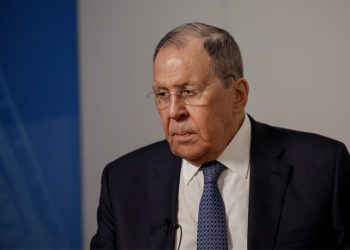


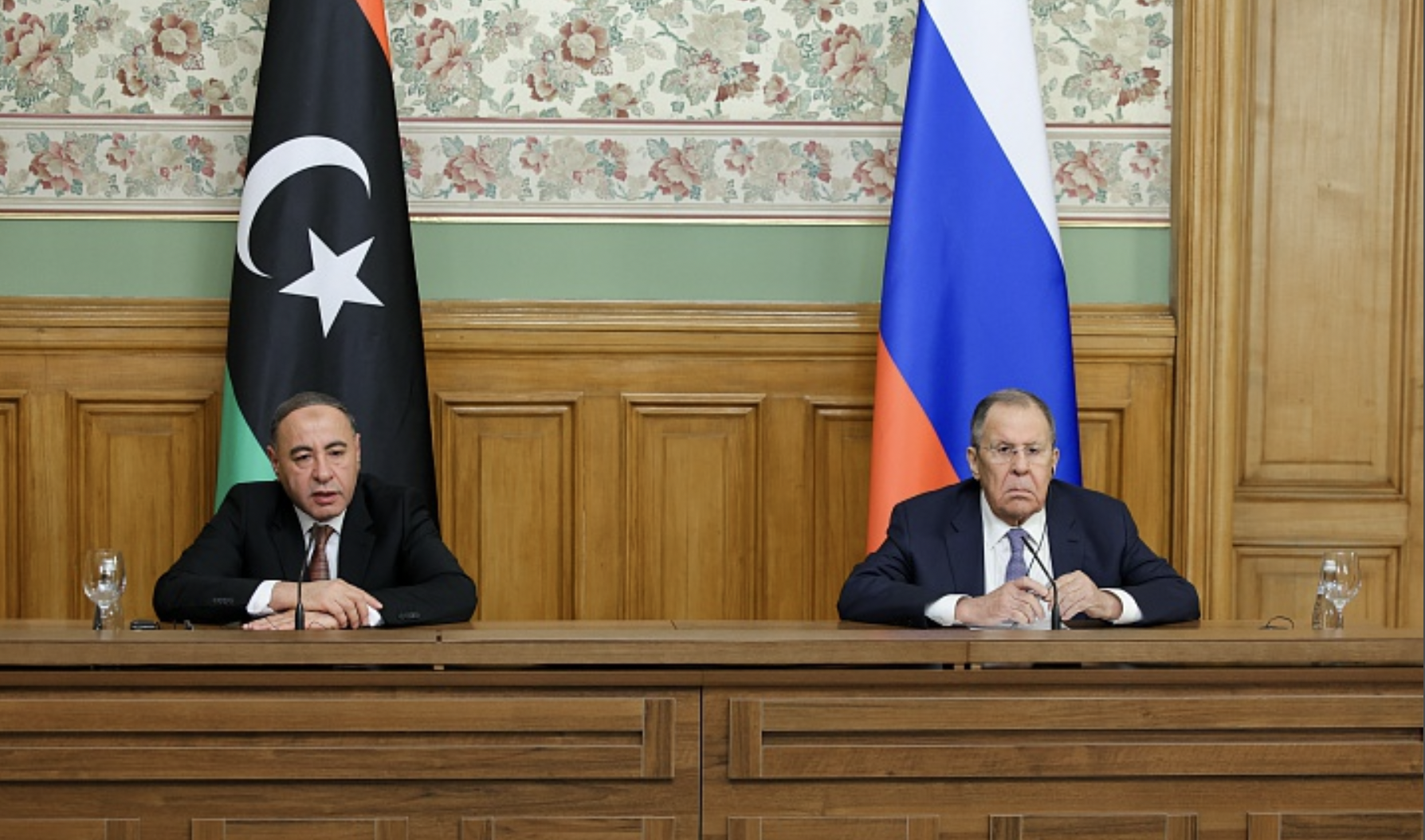
MOSCOW (Realist English). On April 21, Russian Foreign Minister Sergei Lavrov held talks with the Minister of Foreign Affairs and International Cooperation of the Government of National Unity of Libya, Taher Al-Baour, and the Minister of Transport, Mohammed Shehoubi.
Following the meeting, the head of Russian diplomacy said the sides had agreed to resume the work of the intergovernmental commission on trade, economic, scientific and technical cooperation, as well as to open a Russian Consulate General in Benghazi (resuming the work of the consulate, which had been suspended in 1993).
Russia’s position on Libya: no external interference
Lavrov reaffirmed Moscow’s principled position in support of overcoming Libya’s internal political problems through a national dialogue involving all political forces, with the leading role of the UN. He recalled that the country had been “dismantled” as a result of the 2011 “Arab Spring”, when the government was overthrown under the leadership of Western countries.
“We are convinced that the Libyans themselves must make the main decisions about the future of their country without outside interference, overcome disagreements between different parts of Libya and restore the unity and territorial integrity of the country,” the minister said.
Answering a question about US attempts to unite rival forces in Libya to push Russia out, Lavrov said: “If such attempts are being made, we do not notice them. Therefore, they are not effective.” He stressed that Russia maintains contacts with all political forces in Libya — with Tripoli, Benghazi, Marshal Khalifa Haftar, and the Chairman of the Presidential Council.
Iran: ‘We have learned from the bitter experience’ of the Minsk agreements
Speaking about US-Iran talks, Lavrov said that Russia always favours diplomatic methods, but warned that Moscow had “learned from bitter experience” when agreements were used only to mislead. He recalled the Minsk agreements and the “paper” signed in Kyiv in 2014 between the opposition and the then President of Ukraine, Viktor Yanukovych.
“As they say, we have learned from bitter experience, but we remain optimistic. Probably, diplomats cannot do without that either,” the minister said.
He noted that after each round of talks on Iran (in June 2025 and February 2026) there were positive comments, but aggression immediately followed. “Unprovoked, even somewhat treacherous, because it all happened in the midst of negotiations,” Lavrov stressed.
The Russian Foreign Minister also pointed out that the main issue now being raised by US President Donald Trump — that Iran should not have nuclear weapons — had already been resolved by the 2015 Joint Comprehensive Plan of Action (JCPOA), approved by the UN Security Council. “From which the Americans themselves withdrew,” Lavrov added. In his opinion, if it is possible to “steer” towards something close to that 2015 agreement, “that would already be a great success.”
The Middle East and the Palestinian problem
Lavrov stated that the root cause of many troubles in the Middle East is the unresolved nature of the Palestinian-Israeli conflict. He criticised attempts to push this problem into the background, as well as statements that UN resolutions on the creation of a Palestinian state would not be implemented. “This is another ‘mine’, and a very dangerous one — a delayed‑action mine, and perhaps not even very delayed,” the minister warned.
The Ukrainian crisis
Lavrov also said that the talks had assessed the current stage of the Ukrainian crisis. He thanked his Libyan colleagues for their balanced, neutral position in UN votes.
Results of the visit
The minister called the results of the Libyan delegation’s visit “very fruitful.” In addition to opening the consulate general in Benghazi, the sides agreed to resume the work of the intergovernmental commission, which will allow Russian companies to return to the Libyan economy once the security situation stabilises. Lavrov also confirmed that he was expecting a Libyan delegation at the third Russia-Africa summit, scheduled for the second half of 2026 in Moscow.
The overthrow of Gaddafi and the split in the country
After the overthrow and killing of Libyan leader Muammar Gaddafi in 2011 with the active participation of the US and NATO, the country effectively ceased to function as a single state, plunging into chaos, anarchy and civil war. A dual power structure emerged in Libya:
- Western part (Tripoli): Came under the control of the UN- and EU‑backed Government of National Accord (GNA), which later transformed into the internationally recognised Government of National Unity (GNU), based in Tripoli.
- Eastern part (Tobruk): Came under the control of the elected parliament — the House of Representatives, sitting in Tobruk. This authority is supported by the Libyan National Army (LNA) under the command of Marshal Khalifa Haftar, which controls vast territories in the east and south of the country.
Moscow has from the very beginning maintained working relations with both opposing sides. The basis of Russia’s approach to resolving the Libyan crisis is the principle of facilitating an inclusive dialogue that takes into account the interests of all political forces and regional groups in the country.
Key aspects of Russian policy include:
- Relations with the Government of National Unity (GNU) in Tripoli: Moscow officially recognises the GNU as the representative of the Libyan state and people at the UN and maintains regular high‑level contacts with it. In April 2026, Sergei Lavrov held talks in Moscow with GNU Foreign Minister Taher Al-Baour and Prime Minister Abdul Hamid Dbeibah.
- Relations with the House of Representatives and Haftar’s LNA in Tobruk: Moscow maintains close ties with the eastern government and its armed forces, which it considers an important part of the Libyan political spectrum. In August 2025, Marshal Khalifa Haftar paid an official visit to Moscow, where he was met by Russian Deputy Defence Minister Yunus-Bek Yevkurov. The meetings discussed military cooperation and the political and economic development of Libya.
- Role as a mediator: Russia has repeatedly acted as a key mediator between the conflicting parties. The most famous initiative was that of Moscow and Ankara in January 2020, which led to the introduction of a ceasefire. Russia actively participated in the Berlin Conference on Libya in January 2020 (the first Libya conference at which Russia was represented at the presidential level), supporting the development of a “road map” out of the crisis and the creation of a “5+5” military committee. Moscow also offered to provide a platform for direct talks between Haftar and the GNA, but in January 2020 Haftar left Moscow without signing an agreement.
Lavrov told the Libyan delegation on April 21, 2026, that Russia was in favour of restoring Libya’s unity and was ready to contribute to these efforts. Moscow welcomed the conduct of the Flintlock 2026 military exercises in Sirte with the participation of forces from both sides as a step towards unification.