

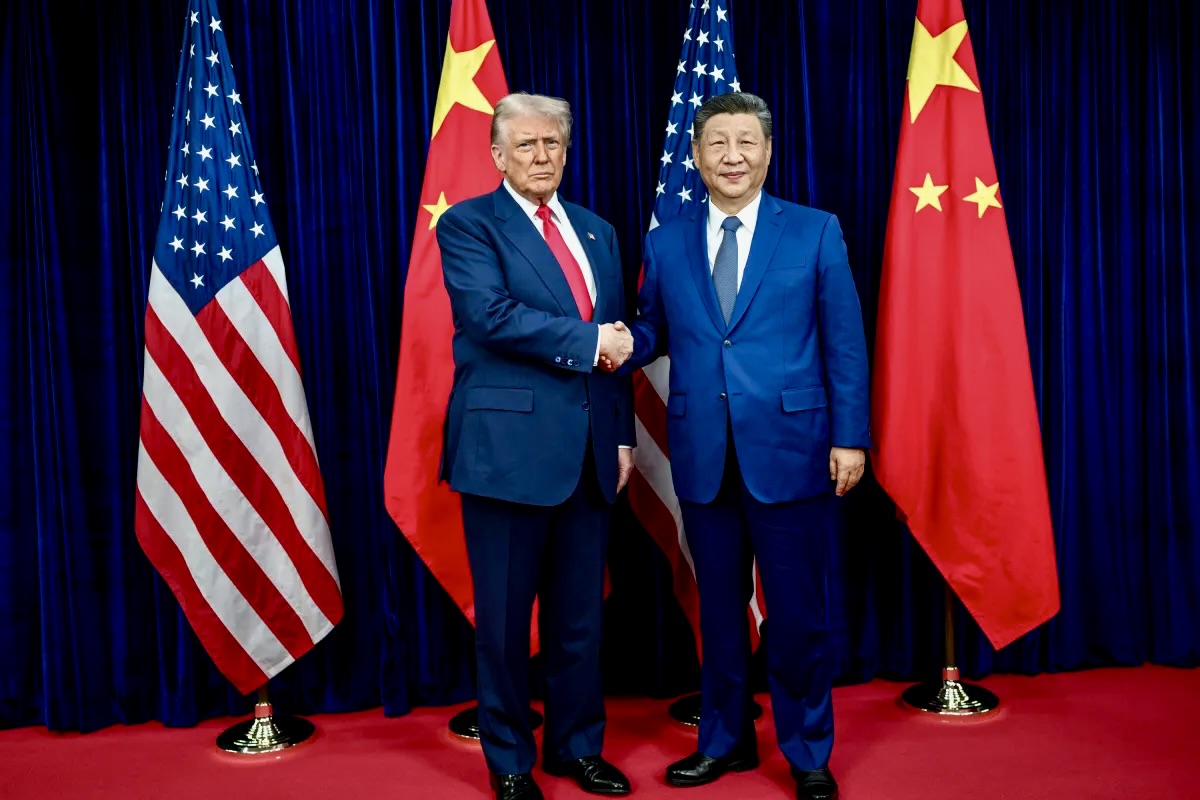
BEIJING (Realist English). Relations between the United States and China in May 2026 can best be described as an “armed truce” combined with preparations for a new stage of trade confrontation.
Following Donald Trump’s return to the White House, U.S. foreign policy has taken on a more aggressive tone. However, both sides continue to avoid direct military confrontation, focusing instead on domestic development and technological competition.
Economy and Tariffs
Economic rivalry remains the main arena of competition.
Tariff Trends
After a sharp increase in tariffs in early 2025 — reaching peaks of up to 145% — average tariff rates stabilized in 2026 at approximately:
- 20% on Chinese goods entering the United States
- 10% on American goods entering China
Trade Volume
In 2025, trade turnover between the two countries declined by nearly 19%, falling to approximately $560 billion.
Despite this decline, China demonstrated economic resilience by maintaining a record trade surplus and proving its ability to continue growing despite reduced access to the U.S. market.
New Measures
Beijing continues to call on Washington to remove what it describes as “unilateral tariffs” and is reviewing recent U.S. court decisions related to Trump-era trade duties. In early May 2026, China blocked several U.S. sanctions targeting Chinese companies.
Impact of the Middle East Conflict
The war involving the United States and Israel against Iran, which began in February 2026, has significantly reshaped the geopolitical balance.
For Washington
The conflict has become a strategic distraction, consuming political attention and military resources. Analysts argue that this weakens the United States’ ability to focus on the Asia-Pacific region and Taiwan.
For Beijing
China officially condemns the escalation, describing it as harmful to global stability.
However, analysts note that Beijing may benefit from the situation by strengthening its image as a reliable partner for countries in the region and by taking advantage of Washington’s diverted attention to expand its influence across Asia.
Some experts believe the United States lacks sufficient political and military resources to maintain strong engagement in Asia while managing instability in the Middle East.
Trump and Xi: Pressure and Pragmatism
Trump continues to portray China as America’s primary geopolitical rival, referring to Beijing as a “revisionist power” and accusing it of unfair trade practices and cyber espionage.
He has repeatedly used the threat of 100% tariffs as leverage in negotiations.
Chinese President Xi Jinping, meanwhile, has adopted a more pragmatic approach, strengthening ties with U.S. allies that have grown frustrated with Trump’s policies.
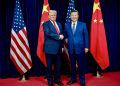
In October 2025, Trump and Xi met in Busan, where Trump described the talks as “12 out of 10.”
Later, he acknowledged that tariffs as high as 145% were excessive and said they should “come down substantially, but not to zero.”
China’s share of U.S. imports reportedly fell by half in 2025, declining from 14.7% to 7%.
Despite harsh rhetoric in the media, both leaders continue to maintain communication channels. Xi has repeatedly emphasized cooperation: “China and the United States should be partners and friends. History has taught us this.”
According to Xi, “there can be no winners in tariff wars,” and acting against the rest of the world risks international isolation. “Planet Earth is large enough to support the shared development and prosperity of both countries.”
Trump, by contrast, has continued to rely on pressure tactics.
Referring to Chinese export controls, he remarked: “I always felt they were lying low and waiting — and once again, I turned out to be right.”
In May 2026, Trump reportedly requested that the next bilateral meeting be postponed by one month due to domestic matters in the United States.
China’s Foreign Ministry has stated that 2026 could become a “major year” for bilateral relations if Washington abandons what Beijing calls a “toxic atmosphere” in the relationship.
Preparations for a Summit
Both leaders are preparing for a meeting that Trump has described as “potentially historic.”
The U.S. president confirmed plans to visit China in May 2026. “Our meeting in China will be special and possibly historic. A lot will be accomplished.”
The summit had previously been delayed because of the escalation in the Middle East.
Xi has placed the Taiwan issue at the top of the summit agenda. During a recent phone conversation, he emphasized that Taiwan remains China’s “main red line” and warned against additional U.S. arms sales to the island.
Xi also expressed satisfaction over the reopening of the Strait of Hormuz.
Risk of Conflict and the Future Global Order
The likelihood of a full-scale military conflict between the United States and China in 2026 remains relatively low, largely because both countries are focused on domestic economic priorities.
However, Taiwan continues to represent the most dangerous flashpoint. Recent personnel changes within China’s military leadership suggest Beijing may be preparing for a potential escalation by 2027.
Analysts argue that the old system of global governance is weakening and that the U.S.–China relationship is increasingly shaping the future world order. Experts at the Hudson Institute predict that China could surpass the United States economically within the next decade despite rising global instability.