MOSCOW (Realist English). Iranian sources claim that Azerbaijan has provided its territory for strikes against the Islamic Republic, and this information is completely true. This was stated in an interview with Realist English by Dr. Shayato Mussallam, director of the Moscow bureau of Al Mayadeen TV channel.
Azerbaijan acts in the interests of the Anglo-Saxons
Answering a question about whose interests the Azerbaijani regime serves today, Mussallam stressed that Baku is fully oriented towards the Anglo-Saxon world.
“Azerbaijan acts in the interests of the Anglo-Saxons. They are closely linked to the Americans and the British. Even the operation in Nagorno‑Karabakh could not have been successful without the help of the United States, Britain, Israel and Turkey,” Mussallam said.
According to him, Azerbaijan feels powerful solely because of the weakness of its neighbours.
“Armenia is weak, Georgia is weak, and Russia is busy with war,” the expert listed.
Dream of taking a “piece” of Iranian territory
Mussallam also revealed Baku’s geopolitical ambitions, which, in his opinion, go far beyond the Karabakh settlement.
“The leadership of Azerbaijan has a dream — to take a ‘piece’ of territory from Iran. This is not their project, but an Anglo-Saxon one: to connect the Caspian with the Mediterranean,” the interlocutor of Realist English said.
He explained that this refers to a strategic region covering Iranian Azerbaijan and territories adjacent to Iraq, which have huge reserves of oil and gas, and the Shiite population of the region forms a single community.
Anglo-Saxons overestimate their capabilities
According to Mussallam, the Anglo-Saxons believe that with the help of Azerbaijan they will be able to lay a corridor from the Persian Gulf to the Caspian.
“Personally, I believe this is unrealistic — they overestimate their capabilities,” the director of Al Mayadeen’s Moscow bureau concluded.
The US-Azerbaijani tandem against Iran
Earlier, on 29 January 2026, Baku’s Foreign Minister Jeyhun Bayramov in a telephone conversation with his Iranian colleague assured that “Azerbaijan will never allow its territory or airspace to be used for strikes on Iran.” However, reality turned out to be different.
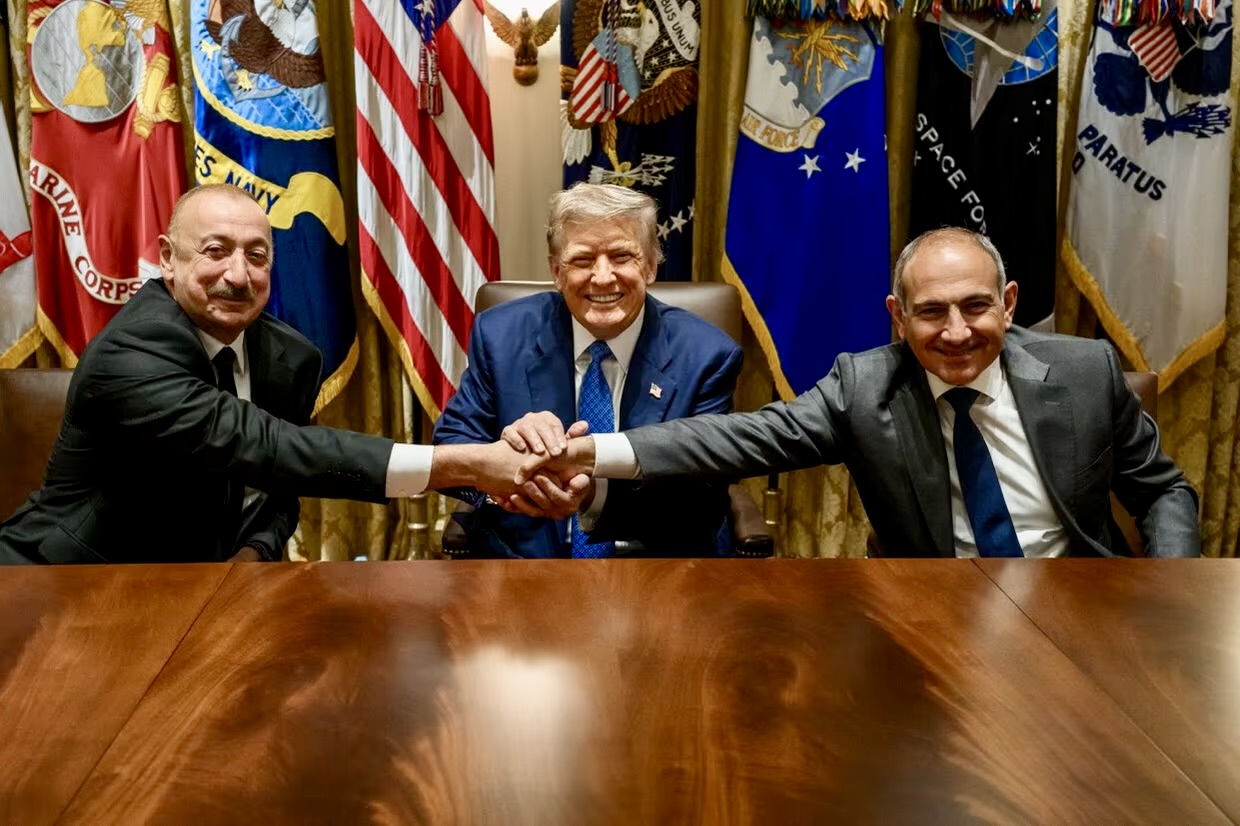
US-Azerbaijani relations are experiencing a marked activation against the backdrop of the “Zangezur Corridor” project (renamed “Trump’s Route”), which Tehran views as a direct threat to its national security. In recent years, Baku has not only drawn closer to Washington in the economic and transit spheres but has also taken a tough anti-Iranian rhetorical stance, bordering on direct accusations of terrorism.
Tehran views “Trump’s Route” not as a transport project but as a geopolitical project aimed at weakening Iran and Russia. Ali Akbar Velayati, adviser to Iran’s Supreme Leader, said the corridor is a “geopolitical scheme of the United States and the Zionist regime,” the main goal of which is to weaken the “axis of resistance,” break Iran’s link with the Caucasus, and impose a land blockade on Iran and Russia.
Later, on 18 April 2026, Velayati reiterated that the corridor makes possible the presence of NATO near Iran’s borders.
Iranian parliament deputy Ebrahim Rezaei on X called the Baku regime led by Ilham Aliyev “Northern Azerbaijan” and noted that “Trump’s show” does not matter, and foreign interference only complicates the region’s problems.
And Azerbaijani parliament deputy Fazil Mustafa in March 2026 said that Iran’s strikes on occupied Armenian Nakhichevan are “unforgivable” and that “compatriots inside Iran should also not be stingy in supporting sovereign Azerbaijan.”
In fact, the so‑called Zangezur corridor under US control has become a key tool for putting pressure on Iran, squeezing it out of transit projects, and creating a military foothold on its borders. At the same time, Baku consistently supports American initiatives, takes an active rhetorical stance, accusing Tehran of “terrorism” and demanding apologies.
In response, Iran officially warns that it will not allow the implementation of a project threatening its national interests and views the actions of the US‑Azerbaijani tandem as part of a broad geopolitical operation.