

ANKARA (Realist English). Turkey’s authorities are moving from suppressing the opposition to forcibly reshaping it. This is argued by Salim Çevik, a fellow at the Center for Applied Turkey Studies at the German Institute for International and Security Affairs, in an article for Foreign Policy.
Court annuls CHP congress and returns Kılıçdaroğlu
The statement that Turkey has crossed yet another authoritarian threshold has become almost a cliché, but the ruling by an Ankara appeals court on May 21, 2026, may prove to be genuinely different. The author notes that previous measures were aimed at weakening, intimidating, or removing opposition actors, whereas the current decision targets the reshaping of the opposition itself.
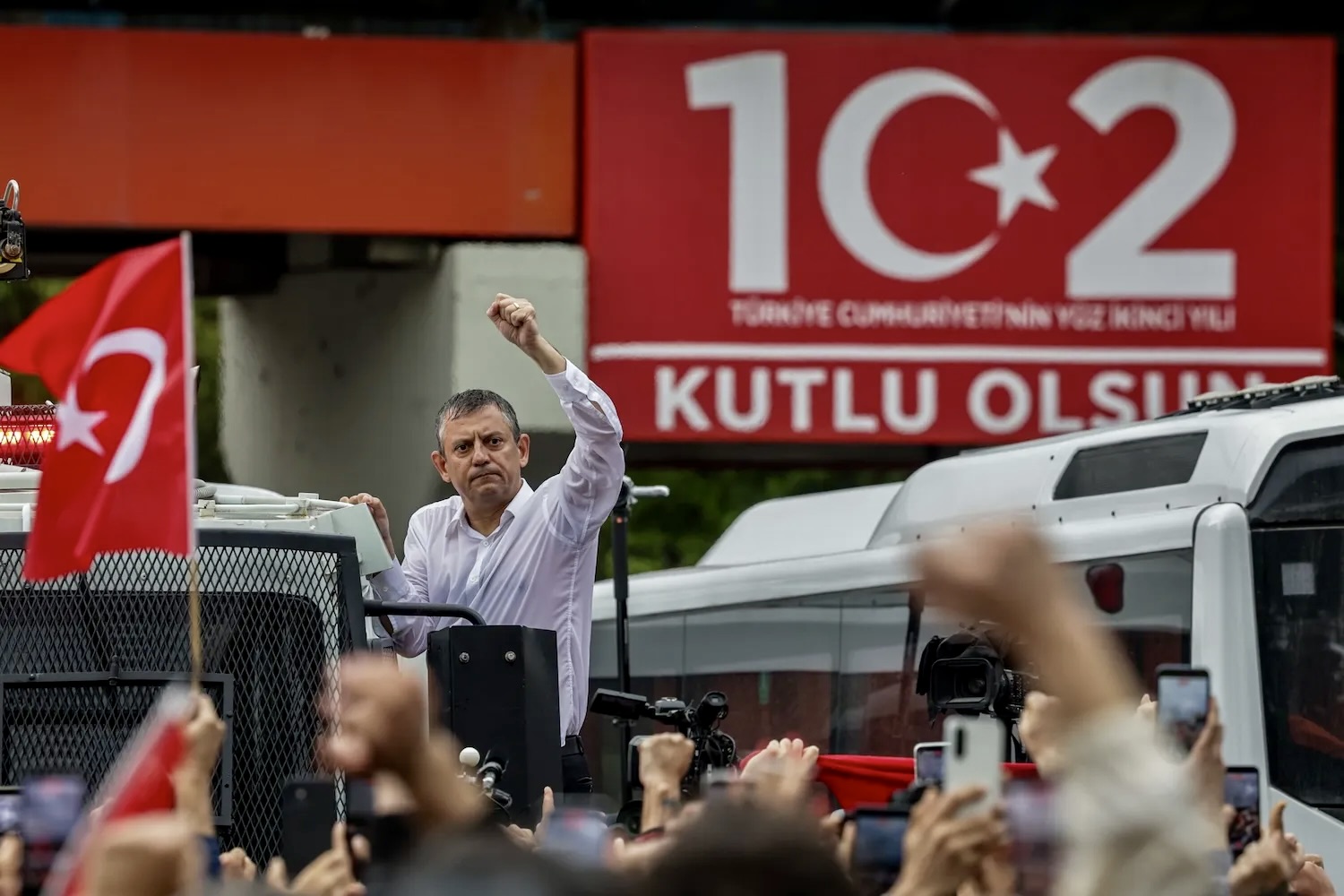
The court annulled the 2023 congress of the Republican People’s Party (CHP), Turkey’s main opposition, citing alleged vote-buying among delegates. The judges suspended the party’s leadership and ordered the reinstatement of former leader Kemal Kılıçdaroğlu.
In the author’s view, the ruling itself exceeds the court’s legal authority. Yet what makes it significant is not simply that the state has intervened in the opposition, nor that the rule of law has been violated. Turkey has a long history of judicial intervention in politics, including the closure of opposition parties. What is truly new is the aim.
From repression to reshaping
The author recalls the milestones of Turkey’s authoritarian descent over the past decade: the post-2016 purges; the imprisonment of Selahattin Demirtaş, then co‑leader of the pro‑Kurdish Peoples’ Democratic Party (HDP); the systematic takeover of municipalities run by pro‑Kurdish parties; the prosecution of CHP mayors; and the jailing of Istanbul Mayor Ekrem İmamoğlu in March 2025.
As Çevik writes: “All of these, however damaging, shared a common logic: They were about repressing the opposition—disabling actors, constraining the institutions, and narrowing the space within which opposition could operate.”
The sharpest version of that logic was the imprisonment of İmamoğlu. By jailing the figure most likely to defeat him in the next presidential race, Erdoğan made clear that he was no longer content to make opposition difficult; he wanted to ensure that no credible rival could win. That was a threshold of its own.
The May 21 ruling goes even further
The author stresses that the target now is no longer an individual, a mayor, or a municipality. The target is the party itself, the institutional vehicle through which any future challenge to Erdoğan would have to be mounted.
Çevik draws a parallel with 2016, when Devlet Bahçeli, leader of the Nationalist Movement Party (MHP), faced an internal challenge. A sequence of court rulings blocked a planned extraordinary congress and protected his leadership. The party soon entered an alliance with the government.
Why this is more insidious than party bans
The author explains that such judicial interventions are even more pernicious than outright party bans, which have been a regular feature of Turkish politics. A banned party usually re‑emerges under a new name with the same cadres and the same voters. Banned parties also tend to acquire the political capital of victimhood, which can make them stronger in their next incarnation than before.
Under the May 21 ruling, the CHP nominally remains intact: its name, its parliamentary group, its hundreds of municipalities, its members, and its voters all remain in place. What changes is who runs it.
The political meaning of this change is transparent: the leadership that now‑ousted CHP head Özgür Özel built since 2023 — more combative and electorally successful — has been removed by judicial order, while the leadership that Erdoğan spent years describing as harmless has been restored.
Direct quote: Erdoğan on Kılıçdaroğlu
The author quotes directly from Erdoğan’s Twitter post in 2012, when Kılıçdaroğlu had just been elected as the new CHP leader. Erdoğan wrote at the time: “As long as this gentleman is at the head of the CHP, our work is easy.”
Çevik notes that this forecast proved accurate. Over a 13‑year tenure as CHP leader, Kılıçdaroğlu — uncharismatic and politically inept — never managed to challenge Erdoğan effectively. Even in 2023, under conditions that gave the opposition its best chance in years, he ran as the joint opposition candidate and lost.
CHP’s electoral revival and the ensuing pressure
Everything changed in late 2023. Özel defeated Kılıçdaroğlu at the November congress, and the CHP rapidly recovered its political footing. In the March 2024 municipal elections, the party finished first in a nationwide vote for the first time since 1977.
It was after this electoral revival that the heaviest waves of state pressure followed: the prosecution of CHP mayors; the appointment of trustees to CHP‑run municipalities; and, in March 2025, the imprisonment of İmamoğlu.
Yet, as the author writes, none of this broke the party. Opinion polls continued to show the CHP running neck and neck with the Justice and Development Party (AKP). Repression had reached its limits, and closing the party would only generate a sense of martyrdom.
Captured opposition as the perfect tool
In Çevik’s view, a captured opposition serves Erdoğan’s goals perfectly. Under Kılıçdaroğlu, the CHP will presumably continue to contest elections, occupy parliamentary seats, and supply the regime with visible evidence of political pluralism — the appearance of competition without its substance.
The author reminds that in April 2026 Erdoğan announced that Turkish democracy would soon attain “the kind of main opposition it deserves.” A month later, the court delivered it.
What remains for Özel: courses of action
After the court ruling, Özel and his team had two broad options:
- Negotiate with Kılıçdaroğlu, stay inside the party, and force a swift extraordinary congress to retake the leadership through a vote.
- Outright refuse the verdict and continue running the party in defiance of the imposed leadership.
As Çevik writes, Özel initially tried both at once: he opened lines of communication with Kılıçdaroğlu while occupying the party’s central headquarters. However, Kılıçdaroğlu responded by having the police forcibly clear the building and signal that no early congress was forthcoming. The path of internal accommodation was closed.
What Özel still has is the loyalty of the CHP’s voters — the overwhelming majority sides with him. But, as the author stresses, “voter support alone cannot substitute for an institutional vehicle.”
Founding a new party — the last resort
One final option remains: founding a new party. On paper, the obstacles are familiar — funding, organization, building a network of provincial branches. In ordinary circumstances, they are difficult but manageable. Today, however, they are made prohibitive, according to the author, by the reach of state pressure toward the private actors who would have to support such a project: even landlords are reluctant to rent premises for fear of government retaliation.
Özel himself faces an additional risk: a parliamentary file requesting the lifting of his immunity is already pending. Breaking from the CHP would expose him to prosecution without the political shield that the position still affords. For all these reasons, a new party is a last resort — an option Özel is unlikely to pursue unless every other path is closed.
Parliamentary consequences
The ruling’s most immediate effect is parliamentary. A bloc of CHP deputies — those most closely tied to Kılıçdaroğlu — is likely to side with the reinstated leadership. Their votes, as Çevik writes, could bring the government within reach of the supermajority required for constitutional amendments, including provisions that would allow Erdoğan to run for another term.
Long‑term consequences and erosion of legitimacy
The author believes the long‑term consequences matter more. Erdoğan’s authority has rested for a decade less on his own popularity than on the opposition’s inability to consolidate against him. Even in 2023, against a candidate as weak as Kılıçdaroğlu, he won by a margin that was too close for his comfort.
The May 21 ruling, in the author’s view, will further erode Erdoğan’s already dwindling electoral legitimacy. Erdoğan is betting that this won’t matter much:
- Domestically — committed opposition voters are already lost to him, while middle‑of‑the‑road voters will be happy with the continued veneer of multiparty politics.
- Abroad — the US president is openly sympathetic to authoritarian leaders, while the European Union treats Turkey primarily as an external partner on migration and security. Shared values have been losing weight as a principle in international relations more broadly, and they have long ceased to anchor Turkey’s relations with the West in particular. Turkey’s authoritarian drift is already treated as an established fact; Western governments know what they are dealing with and proceed anyway.
The sad reality
Çevik concludes with a bitter observation: the ruling will only matter for the dwindling constituency of people who care about Turkish democracy — which is precisely what makes it possible.