BERLIN (Realist English). In Germany, more than 80 years after the end of the Second World War, a new social crisis has erupted — this time in the private lives of hundreds of thousands of families.
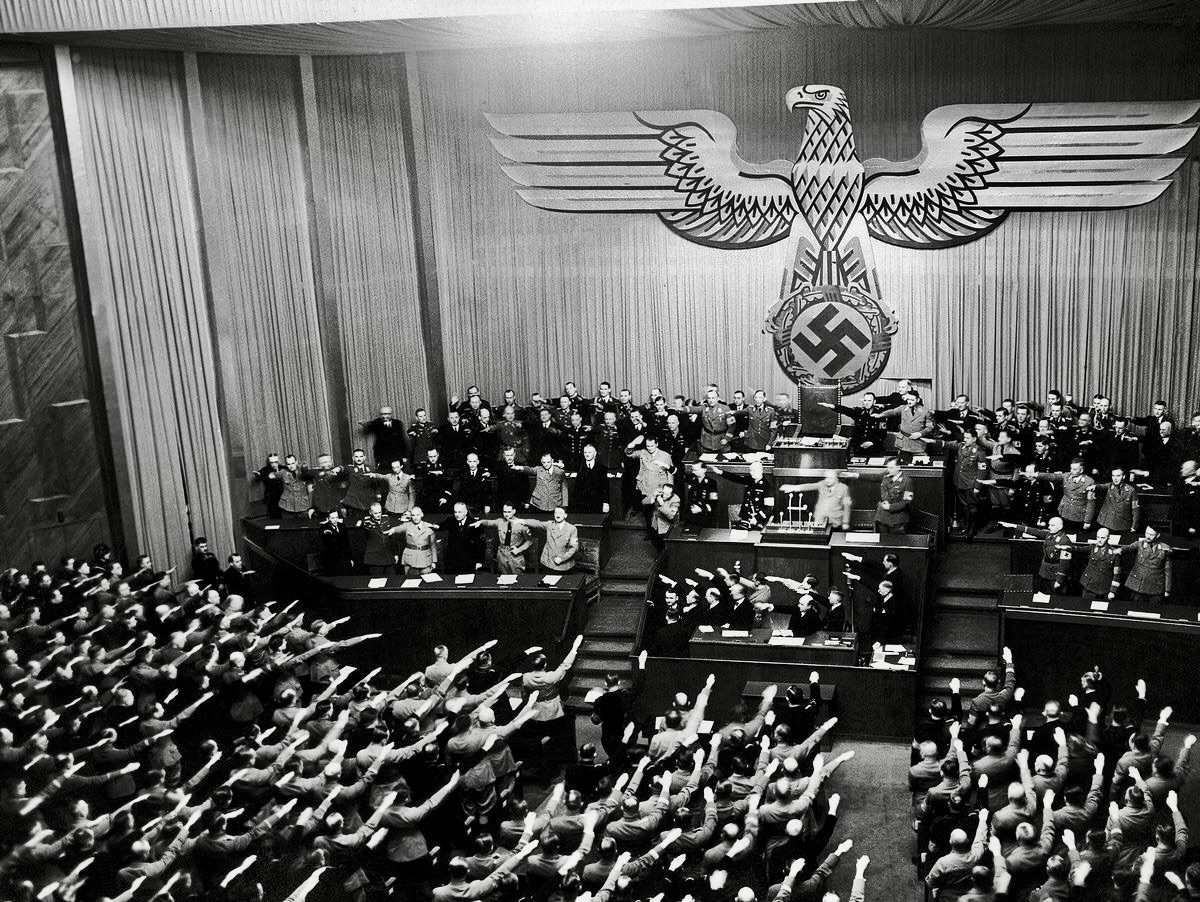
In March 2026, the US National Archives and Records Administration digitised and made publicly available some 12 million membership cards of the National Socialist German Workers’ Party (NSDAP), captured by American troops at the end of the war.
Since then, a “quiet revolution” has begun in the country: millions of Germans have rushed to search the archives for their ancestors’ names, and for many, the results have been devastating.
German publications Die Zeit and Der Spiegel quickly created user‑friendly search engines based on these data, allowing users to check the name, date and place of birth of a potential relative. Within weeks, the number of database queries exceeded 1.5 million, and the servers of the US National Archives repeatedly crashed due to overload.
As historian Christian Staas, who heads Die Zeit’s history department, notes: “There is a gap between official memorial culture and knowledge of what happened within the family. Our tool can help to close that gap a little.”
The Gap Between Public Memory and Family Secrets
After the war, Germany created one of the most developed systems of “memorial culture” (Erinnerungskultur) in the world: the Holocaust and Nazi crimes are widely covered in schools, museums and commemorative events. However, at the level of individual families, silence reigned for decades.
As historian Johannes Spohr notes, many former Nazis after the war “did not simply remain silent, as is often claimed, but told a different version of history” — often portraying themselves as victims of Nazism or even as participants in anti‑Nazi resistance.
According to a Die Zeit survey conducted in 2025, only 3% of respondents believed their family actively supported the Nazi regime; 21% described their ancestors as “fellow travellers”; and 26% were convinced their family had opposed the regime. These figures stand in stark contrast to historical facts: by 1945, one in five German adults — about 8.5 million people — was a member of the NSDAP.
“Statistically, this means that any German family has one, two or more members who joined the party,” says Staas.
Shocking Discoveries and the Collapse of Family Legends
The new databases have forced many Germans to confront the truth that their relatives had carefully concealed. Margret Breig‑Kinzl, 77, was shocked to find her father’s name on the NSDAP lists.
“My first thought was: this can’t be true,” she says.
Her father, who came from a working‑class family, joined the party at 21 and had long been considered in the family as “politically unreliable.”
“When he talked about the Nazi era, it always sounded as if he had been a victim,” added Margret, admitting that she felt “betrayed” by her father.
Olaf Koendgen, 64, a European human rights expert, learned that his father Ernst had joined the NSDAP on the very day the Second World War began — 1 September 1939. Previously, Koendgen had convinced himself that his father, who had lost his own father at an early age, was simply trying to escape home by joining the Wehrmacht.
“Now I understand that his main motive may have been ideology. Perhaps at 17 he was genuinely convinced that this was a just war,” he admitted.
Political scientist Jürgen Falter, who has devoted much of his career to studying NSDAP membership, was “more than surprised” to find his mother’s name in the archives — a secret she had apparently concealed even from her family.
“Given my mother’s character, mentality and political convictions as a liberal Catholic, it was simply unthinkable that she could have joined the NSDAP,” said Falter. He added that if his father, an anti‑fascist imprisoned by the Gestapo, had found out, “he would probably have broken off the engagement.”
Volker, 75, a retired criminal investigator from Bremen, discovered that almost his entire family had belonged to the NSDAP.
“I found all of them. My grandfather and great‑uncle, my grandmother and all her family. My grandmother’s father, her mother, my mother — all of them were in the party. I had no idea. In our family, we always said that only grandfather was the bad one,” he said.
Now, according to him, “the biggest case of my life is still ahead of me: my family’s crimes.”
Political Context: Memorial Culture vs. Calls to ‘Move On’
The launch of the search engines comes amid growing support for the right‑wing Alternative for Germany (AfD) party, which actively campaigns against the post‑war “culture of guilt.”
Elon Musk, speaking at an AfD rally last year, said that Germany is “too focused on past guilt” and that children should not bear responsibility for the “sins of their great‑grandparents.” The new databases work against these calls, encouraging Germans to look more closely at their own family histories.
Limitations and Criticism
Historians caution that party membership should not be overestimated as the sole criterion for moral judgment: it “tells us little about a person’s actual behaviour in the Third Reich.” Moreover, the database is incomplete — the absence of a record does not prove that a person was not a party member.
The artificial intelligence used for indexing may have made errors. Nevertheless, as historian Felix Lieb of the Munich Institute of Contemporary History notes, “many myths will probably not withstand scrutiny.”
Thus, the digitisation of the NSDAP archives has become a powerful catalyst for the revision of family history in Germany. It shatters decades of silence and false narratives, forcing Germans to reassess not only their country’s past but also their own ancestors’ personal responsibility.
For thousands of families, the answer to the question “What did grandfather do during the war?” turned out to be quite different from what they had expected to hear.