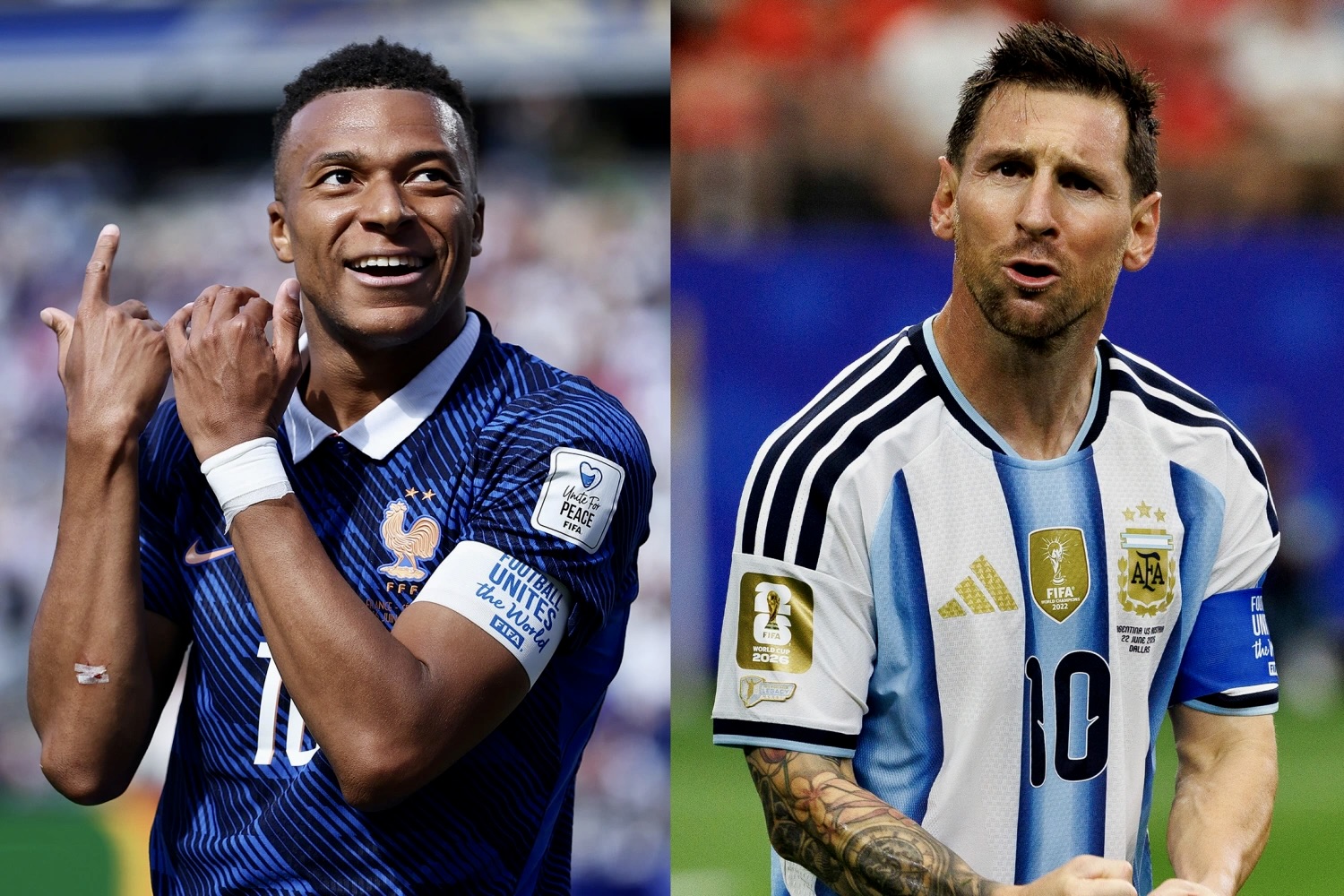
NEW YORK (Realist English). The World Cup, taking place across the fields of the United States, Canada and Mexico, has once again become the stage for the greatest individual rivalry in the history of sport.
Lionel Messi and Kylian Mbappé, who already gave the world one of the most dramatic finals in Qatar, have once again come together in a battle for the title of the world’s best player. And while the stars settle their differences on the pitch, an equally intense legal dispute has erupted off it: Adidas is fighting to retain the design rights to the tournament’s official ball, the Trionda®.
The Race for Immortality: 18 vs 16
38-year-old Lionel Messi, playing in his sixth and likely final World Cup, has already written his name in golden letters in history. After two group-stage matches, he has five goals to his name, bringing his total number of World Cup goals to 18.
He has officially become the top scorer in World Cup history, breaking the record of Miroslav Klose, which had stood since 2014. In the match against Austria, the Argentine scored two goals and moved into sole possession of first place.
Right behind him, literally breathing down his neck, is Kylian Mbappé. The 27-year-old captain of the French national team, who has already become the top scorer in his country’s history, scored a brace against Iraq to take his tally to 16 goals. This allowed him to draw level with Klose and trail Messi by just two goals.
Mbappé, according to analysts, is in his prime and has every chance not only to catch up with but also to surpass the Argentine in the future.
The whole world is watching this duel with interest. As Reuters notes, “if there is anything America loves, it is the gravitational pull of the superstar, where an individual, armed with talent and charisma, can rise above the rest and carry the entire show.”
Other greats have also joined the race: Erling Haaland, making his World Cup debut, has already scored four goals, while Harry Kane and young Lamine Yamal are also starting the tournament in spectacular fashion.
Team Spirit vs Personal Ambition
Despite his pursuit of the record, Mbappé never tires of repeating that team success is more important to him than personal statistics. “I would play the entire World Cup without scoring if France won the trophy,” he said before the tournament.
His words are reflected on the pitch: in the match against Iraq, he demonstratively celebrated his goal together with Ousmane Dembélé, highlighting his teammate’s contribution. “There is no saga (with Messi). Leo also scores, he will always score. I don’t look at what he does, otherwise I’d have to do more. I only look at my team,” the French captain said.
Messi, for his part, also tries to distance himself from the pursuit of numbers. After breaking Klose’s record, the Argentine noted: “It’s a great honour for me to be alongside Klose and all these players. I’m proud to compete with them, but statistics mean little to me.”
The Legal Ball: Battle for Trionda®
While the stars settle their differences on the pitch, an equally heated battle is unfolding in courtrooms and patent offices. The official World Cup ball, the Trionda®, designed by Adidas, has become the centre of a scandal over intellectual property rights.
The world-famous sports equipment manufacturer, which has supplied balls for World Cups since 1970, decided to revolutionise the design. The Trionda® consists of just four panels — the fewest in the history of World Cup balls. The company registered this design with the European Union Intellectual Property Office (EUIPO).
However, Adidas has been challenged by former amateur footballer and designer firm owner Marius Dittmar, whose company is called 142k. He has filed a formal request to invalidate the patent protection, claiming that he himself developed four-panel balls and that Adidas allegedly stole his concept. Dittmar also cites a 2008 US patent describing a similar design.
As the German Börsen-Zeitung writes, the dispute has entered a stage of “escalation.” If the EUIPO declares the Trionda® design invalid, competitors will be allowed to produce and sell structurally identical four-panel balls on the European market. This could have far-reaching consequences not only for the World Cup but also for other tournaments where Adidas uses this technology.
Adidas CEO Bjørn Gulden called the Trionda® “the most beautiful and technically perfect football product of all time.” The company publicly states that even if it loses the patent in Europe, its commercial position will not be affected, as it holds numerous other patents on panel shapes, colours and surface textures. Nevertheless, the EUIPO’s decision will set an important precedent in the world of sports design.
The 2026 World Cup has become the stage for two gripping rivalries. On the pitch, Messi and Mbappé are fighting for a place in eternity, once again proving that football is not just a game but an art.
Off it, Adidas is desperately defending its right to that art, trying to maintain a monopoly on the design of a ball that may well become the symbol of this tournament. The fate of both records and patents will be decided in the coming weeks, and it will determine whether this World Cup is remembered as a benefit for great players or as a turning point in the history of the sports industry.