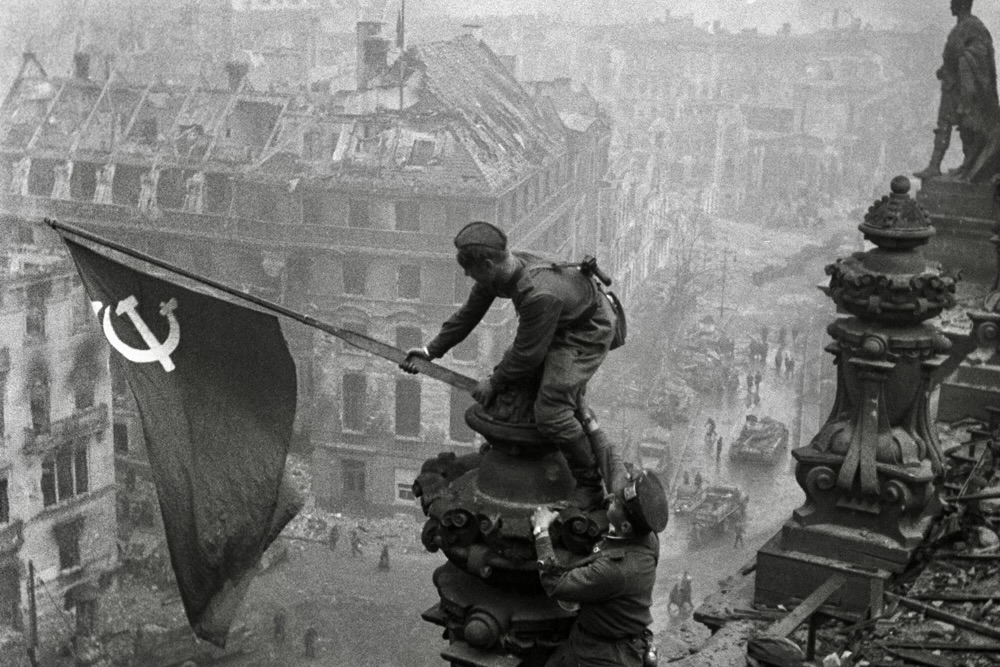
BERLIN (Realist English). On 30 April 1945, as Soviet troops stormed the centre of Berlin, a red flag flew over the Reichstag for the first time.
That day became a symbol of the impending defeat of Hitler’s Germany, yet the circumstances surrounding the raising of the Victory Banner remain disputed.
We examine the chronology of those hours, the biographies of the heroes and the reasons why official history long kept silent about one of them.
Historical context
The Berlin offensive operation began on 16 April 1945. By 20 April, Soviet forces had encircled the capital of the Third Reich. Particular importance was attached to the capture of the Reichstag – the parliament building that Nazi propaganda had declared the main symbol of the “thousand‑year Reich” and its impregnability.
For the raising of banners, the 3rd Shock Army produced nine assault flags – one for each division. Banner No.5, which later became the Victory Banner, was given to the 756th Rifle Regiment of the 150th Rifle Division.
Chronology of the raising
14:25, 30 April 1945. Scouts of the 674th Regiment – Grigory Bulatov and his commander Lieutenant Rakhimzhan Koshkarbayev – were the first to break through to the main entrance of the Reichstag and attached a red flag to the sculptural group on the pediment. The incident was immediately reported to the army headquarters. However, their flag was not the official assault banner.
Night of 30 April – 1 May. The storming of the Reichstag continued. A group consisting of Lieutenant Alexei Berest, Sergeant Mikhail Yegorov and Junior Sergeant Meliton Kantaria fought their way to the roof of the building. At about 3 a.m. on 1 May (Berlin time), they hoisted the Victory Banner – Flag No.5 – onto the glass dome of the Reichstag.
2 May 1945. The German garrison surrendered. That day, military photographer Yevgeny Khaldei took the famous photograph of Yegorov and Kantaria posing in front of the red banner on the dome of the Reichstag. By that time the banner had been moved there from the main entrance.
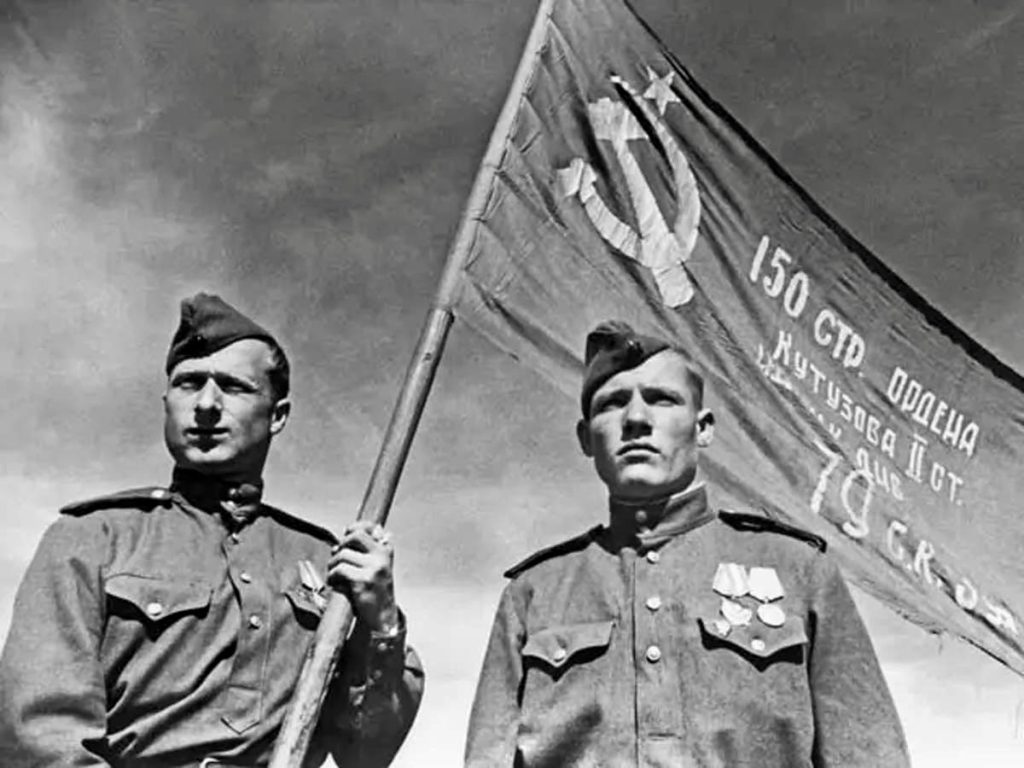
8 May 1946. For raising the Victory Banner, Mikhail Yegorov and Meliton Kantaria were awarded the title of Hero of the Soviet Union.
Biographies of the heroes
Grigory Bulatov (1925–1973) – “Grishka‑Reichstag”
Born in the village of Cherkasovo, Sverdlovsk region. Drafted into the army in 1943. On 30 April 1945 at 14:25, together with Lieutenant Koshkarbayev, he was the first to raise a red flag on the Reichstag. He was nominated for the title of Hero of the Soviet Union but received only the Order of the Red Banner. After the war he lived in his homeland and worked at a factory. He died tragically in 1973. Among the people he was called “Grishka‑Reichstag”. In the post‑Soviet period his feat was recognised and monuments were erected to him.
Mikhail Yegorov (1923–1975) – the official standard‑bearer
Born in Smolensk region. During the occupation he joined the partisans. From December 1944 he served in the active army. On the night of 1 May 1945, together with Kantaria and Berest, he raised the Victory Banner onto the dome of the Reichstag. Hero of the Soviet Union. After the war he returned to his homeland and worked as a collective farm chairman. He died in a car crash in 1975.
Meliton Kantaria (1920–1993)
Born in Georgia, in the village of Jvari. In the Red Army from 1939. He took part in combat operations from December 1941. On the night of 1 May 1945, together with Yegorov and Berest, he raised the Victory Banner. Hero of the Soviet Union. After the war he lived in Sukhumi, then in Moscow. He died in 1993.
Alexei Berest (1921–1970)
Born in Sumy region. An officer who led the flag‑raising group. Despite his key role, he did not receive the title of Hero (only orders). He died tragically while saving a girl from under a train. In 2005 he was posthumously awarded the title of Hero of Ukraine.
Why Bulatov remained in the shadows
The Soviet leadership preferred to make representatives of the two main union republics – the Russian Yegorov and the Georgian Kantaria – the symbols of Victory. The young, “non‑status” private Bulatov, who also had conflicts with the command, did not fit the propaganda canon. His nomination for the title of Hero was rejected, and the story of his feat was hushed up for many years.