COPENHAGEN (Realist English). Chinese Foreign Minister Wang Yi called on European businesses to further deepen cooperation with China during his visit to Scandinavia.
Meetings with the leadership of Denmark and Sweden, as well as representatives of the influential Wallenberg industrial family, formed part of the Chinese foreign minister’s week-long tour of four Nordic countries.
“China and Europe Are Partners, Not Rivals”
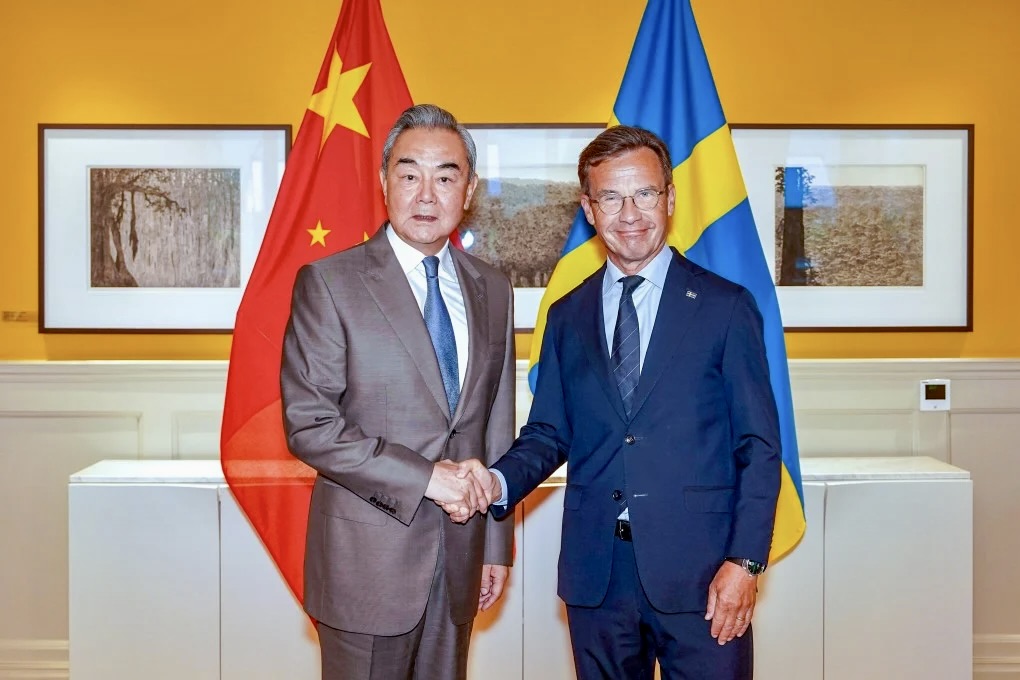
On July 2 in Copenhagen, Wang Yi held talks with Danish Foreign Minister Lars Løkke Rasmussen. China’s top diplomat stressed that “China and Europe are partners, not rivals, and cooperation should remain the defining and fundamental feature of China–EU relations.”
According to Wang, China remains Denmark’s largest trading partner in Asia. Beijing is prepared to expand trade and investment cooperation, launch negotiations on an updated green partnership program, and deepen collaboration in innovation, green shipping, and healthcare.
Wang expressed hope that Danish businesses would maintain confidence in China and continue investing in the country, while urging Copenhagen to provide Chinese companies with an “open, fair, and predictable business environment.”
Rasmussen, for his part, said that Danish-Chinese relations are experiencing “strong and steady growth,” adding that Danish companies remain fully confident in China’s prospects and intend to strengthen their long-term presence in the Chinese market.
Meeting the Wallenbergs: “Investing in China Means Investing in the Future”
On July 4 in Stockholm, Wang Yi met Jacob Wallenberg, Chairman of Investor AB, representing the influential Wallenberg industrial dynasty. The Wallenberg family was among the first European business groups to enter the Chinese market following the launch of China’s reform and opening-up policy, making what Wang described as a unique contribution to the development of China–Sweden relations.
Wang said China would continue pursuing high-quality development, stimulating domestic demand, expanding high-level opening-up, and defending the principles of free trade.
“Embracing China means embracing opportunities; investing in China means investing in the future,” the minister said.
He urged Swedish and broader European business communities, including the Wallenberg family, to strengthen cooperation with China on the basis of mutual benefit and win-win outcomes.
Jacob Wallenberg said his family entered the Chinese market in the 1970s and 1980s and had witnessed China’s reform and opening-up process firsthand. He emphasized that “deepening cooperation with China is of vital importance both for Sweden and for Europe.”
Wallenberg reaffirmed his confidence in China’s future and his family’s commitment to continued investment in the country.
Dialogue with Sweden and Talks Ahead of the China–EU Summit
Later the same day, Wang Yi held talks with Swedish Foreign Minister Maria Malmer Stenergard. China’s foreign minister said Beijing is ready to strengthen cooperation with Sweden in safeguarding the international system centered on the United Nations.
He also welcomed broader participation by Swedish companies in the Chinese market, highlighting its vast size, comprehensive industrial supply chains, and diverse commercial opportunities.
Stenergard said that the European Union is “more united than before” in its approach to trade relations with China and that “we agree that competition must take place on a level playing field.” She also raised the issue of the war in Ukraine, noting that China and Europe continue to hold different views on the conflict.
Preparing for the China–EU Leaders’ Summit
The diplomatic tour comes ahead of the expected China–EU leaders’ summit, scheduled for later this month.
China and the European Union remain major trading partners, with bilateral trade exceeding $1 trillion. A new trade and investment consultation mechanism launched on June 30 is intended to provide a regular platform for addressing bilateral economic disputes.
Wang Yi’s Scandinavian tour forms part of Beijing’s broader strategy to stabilize relations with its European partners amid a challenging global economic and geopolitical environment.
China is offering European businesses expanded access to its market and new investment opportunities, while European governments continue seeking a balance between economic engagement and unresolved issues, including market access, technology exports, and the war in Ukraine.