TORONTO (Realist English). The 2026 World Cup continues to deliver surprises: on one side, the fairytale journey of debutants from Cape Verde; on the other, the cold machine of Argentina led by Lionel Messi.
Meanwhile, a technological drama unfolded in Toronto that could change attitudes toward VAR for years to come.
A Fairytale That Knows No Bounds
In the Round of 32 at the stadium in Miami, perhaps the most decorated player in history will face a team that few had heard of just a month ago. Argentina — three-time world champions, the defending title holders, a team with a rich history. Cape Verde — debutants, an archipelago with a population of just over 500,000, reaching the knockout stage for the first time in their history.
The “Blue Sharks” didn’t just get out of the group — they did so without suffering a single defeat. Three draws: 0-0 with reigning European champions Spain, 2-2 with Uruguay, and 0-0 with Saudi Arabia. A team that wasn’t even allowed to play in the Africa Cup of Nations until 2013, they emerged from a group featuring two former world champions.
The central figure of this matchup is 40-year-old Cape Verde goalkeeper Vozinha, who was a complete unknown three weeks ago and is now preparing to face Lionel Messi. Defender Roberto “Pico” Lopes, according to his mother Judy, “will enjoy the challenge” — the hero’s mother works as a school secretary in Dublin and returned to work for a few days before heading back to America for the match.
Argentina enters the match with six goals from Messi at this tournament and 19 in total over his World Cup career. According to supercomputers and bookmakers, this could be the biggest mismatch in World Cup knockout history. However, Cape Verde has already proven it knows how to write fairytales.
Tech Drama in Toronto: How a Microchip Killed Croatia’s Hopes
While one fairytale was preparing to continue, another ended in Toronto. The Round of 32 match between Portugal and Croatia turned into a real drama, with the main protagonist being not a footballer but a microchip.
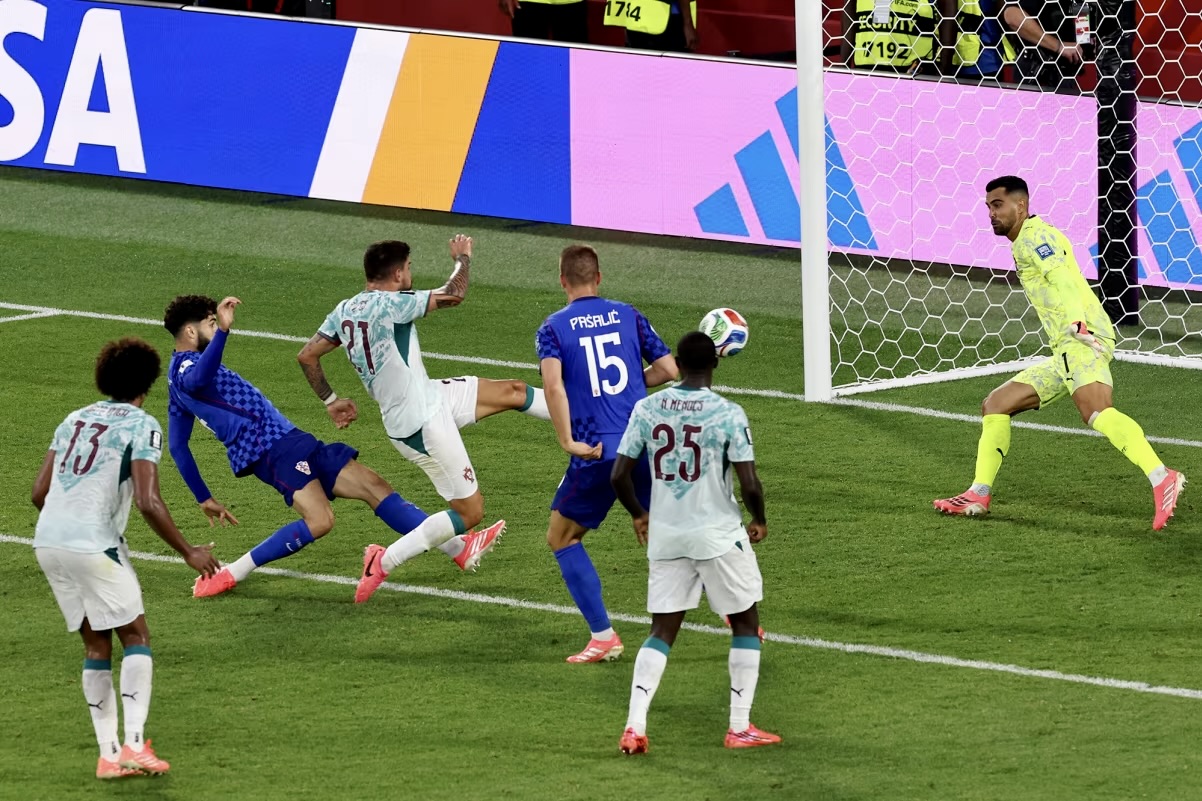
Regular time ended with a 2-1 victory for Portugal, but the denouement came in stoppage time. In the 103rd minute, Joško Gvardiol pushed the ball into the net — it seemed Croatia was heading for extra time. The stands erupted, the Croatians celebrated. But then a message appeared on the screen: VAR was checking the goal for offside.
The game was interrupted for long minutes. Referee Espen Eskås reviewed the replays, but visually determining the touch was impossible. That’s when technology stepped in.
The official World Cup ball, the Trionda from Adidas, is equipped with an Inertial Measurement Unit (IMU) sensor that operates at 500 Hz and records data 500 times per second. The “Snicko” system (similar to cricket) detected a microscopic touch of the head by forward Igor Matanović, invisible even on slow-motion replays.
Since Matanović was in an offside position at the moment of the touch, and Mario Pašalić, who received the ball, was also in an offside position, the goal was correctly disallowed.
“The message is very clear: the balls now have a chip, and it very clearly shows that the touch was there. This is not a subjective opinion,” said Portugal head coach Roberto Martínez after the match. “It’s unfortunate that one team had to lose, but it wasn’t a bad decision — it was a clear one. Technology helped.”
Croatia head coach Zlatko Dalić was categorical: “VAR kills emotions, kills everything inside you. It takes the joy out of football.” His team exits the tournament at the Round of 32 stage, and for 40-year-old Luka Modrić, this is likely his last World Cup.
The Round of 32 at the 2026 World Cup gave fans two completely different but equally captivating stories.
On one side — the romance of debutants who will challenge the most decorated team in the tournament.
On the other — the cold precision of technology, which once again proved that in modern football, even the most microscopic touch can decide the fate of an entire nation. The question remains: is football ready for this, as it loses its living soul?