
Realist: news and analytics

Русский / English / العربية

  • News
  • Russia
  • Caucasus
  • Opinion
  • Interviews
  • Experts
No Result
View All Result
Realist: news and analytics
  • News
  • Russia
  • Caucasus
  • Opinion
  • Interviews
  • Experts
No Result
View All Result
Realist: news and analytics

The Pakistani military is mired in corruption no less than politicians

The overthrow of Imran Khan was the latest episode in a long saga about the intervention of the Pakistani military in politics. What is new in the current situation is that the attitude of the military itself to the former Prime Minister has divided. This may provoke new waves of political instability in Pakistan, says Ayesha Siddiqa, a researcher at the South Asia Institute.

   
August 20, 2022, 00:46
World
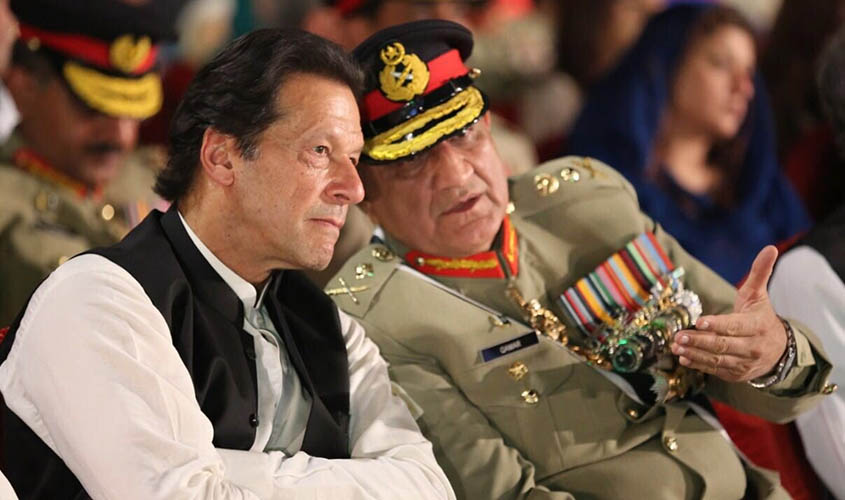
Former Prime Minister of Pakistan Imran Khan and Chief of Staff of the Pakistani Army Qamar Javed Bajwa. Image: thecurrent.pk

Former Prime Minister of Pakistan Imran Khan and Chief of Staff of the Pakistani Army Qamar Javed Bajwa. Image: thecurrent.pk

ISLAMABAD (Realist English). Pakistan is mired in a serious political and economic crisis. The change of government in April this year, with the removal of Imran Khan from his role as prime minister, has not improved economic confidence. The country’s situation may be marginally better than that of its near-neighbor Sri Lanka, but not hugely so. In fact, the ruling elites in both states are guilty of similar recklessness and myopia, Ayesha Siddiqa, a Pakistani political scientist and researcher at the South Asia Institute, writes about this in a column for the Jacobin.

“Khan’s ouster was the latest episode in a long saga of intervention by the Pakistani military in the country’s politics. What is novel about the current situation is that the military itself appears to be divided in its attitude toward Khan. This is likely to fuel new cycles of instability in Pakistan,” she points out.

The Pakistani political scientist has no doubt that the army played an important role in the overthrow of Imran Khan, although the opposition parties, which have now returned to power, attribute to themselves the political victory over the former prime minister.

“The army uses the proclaimed fight against corruption to delegitimize political figures, and not to combat inefficient financial management. The upper echelons of the army initially promoted Khan because of their dissatisfaction with the traditional parties of Pakistan. There was a deliberate plan to weaken the traditional two-party system after the end of Musharraf’s rule, as one former intelligence chief acknowledged.

“Those who spoke about empowering the middle class and shifting power away from the representatives of dynastic politics used Khan’s personal charisma as a tool to reclaim space from the existing parties. This does not mean that the PTI actually represents middle-class interests; indeed, it is as elite oriented as the other parties,” Ayesha Siddiqa explained.

Despite their success in removing Khan through a no-confidence move in Parliament, the new government has not emerged as a winner from the political confrontation.

“Khan continues to dominate the public debate with a populist narrative that depicts him as a figure with clean hands who is fighting a corrupt political elite.”

In her opinion, “the army has begun to pay a price for its power games, as it has become more acceptable for people from across the party spectrum to accuse its commanders of manipulating the political processes — although the parties are still unwilling to publicize the exploitation of national resources by the generals.”:

“Ultimately, this is a story of elite capture in which Pakistan’s civil and military leadership are in partnership with each other. There may eventually be a real confrontation between them if the size of the financial pie available for plunder shrinks, obliging the two sides to struggle over who gets a greater share of the spoils. However, Pakistan has not reached that point yet, and until it does, the country is likely to lurch from crisis to crisis.”
AsiaElitologyImran KhanPakistanPakistan’s Domestic Policy
Previous Post

Lebanon records major spike in murders and suicides in 2022

Next Post

The Russian economy needs not dollars, but technologies and development of its own production — expert

Related Posts

Merkel or Draghi: Who will become Europe’s voice in dialogue with the Kremlin?
World

Merkel or Draghi: Who will become Europe’s voice in dialogue with the Kremlin?

20 May, 2026
US and Israel balance on brink of new war with Iran
World

US and Israel balance on brink of new war with Iran

20 May, 2026
Trump gives Iran a reprieve, but strikes could resume at any moment
World

Trump gives Iran a reprieve, but strikes could resume at any moment

19 May, 2026
Netanyahu and Trump Discuss New Round of Pressure on Tehran
World

Netanyahu and Trump Discuss New Round of Pressure on Tehran

18 May, 2026
US and Iran fail to reach Hormuz deal as Trump threatens new strikes
World

US and Iran fail to reach Hormuz deal as Trump threatens new strikes

18 May, 2026
Trump issues ultimatum to Iran: “If they don’t reach a deal, it will be very bad for them”
World

Trump issues ultimatum to Iran: “If they don’t reach a deal, it will be very bad for them”

17 May, 2026
Most Popular
Most Popular
India resumes Iranian oil imports and prepares convoy through Hormuz

India resumes Iranian oil imports and prepares convoy through Hormuz

20 May, 2026

NEW DELHI (Realist English). India is preparing to send its own tankers through the Strait of Hormuz for the first time...

“Restrictions Alone Are Not Enough — Children Need to Be Engaged”: Paata Amonashvili on Meaningful Alternatives to Gadgets

“Restrictions Alone Are Not Enough — Children Need to Be Engaged”: Paata Amonashvili on Meaningful Alternatives to Gadgets

18 May, 2026

TBILISI (Realist English). Restrictions alone are not enough to overcome children’s dependence on gadgets — children must be offered meaningful...

US and Iran fail to reach Hormuz deal as Trump threatens new strikes

US and Iran fail to reach Hormuz deal as Trump threatens new strikes

18 May, 2026

WASHINGTON (Realist English). The United States and Iran remain far from reaching an agreement to end the war and reopen...

Israel prepares for new war with Iran – from bombing to commando landings

Israel prepares for new war with Iran – from bombing to commando landings

17 May, 2026

TEL AVIV (Realist English). With US‑Iran talks deadlocked, the Israeli leadership has stepped up preparations for a resumption of full‑scale hostilities....

Opinion

NATO Anchors at Hormuz? IRGC Warns of Retaliation

NATO Anchors at Hormuz? IRGC Warns of Retaliation

20 May, 2026

TEHRAN (Realist English). On May 20, the Islamic Revolutionary Guard Corps (IRGC) issued an uncompromising statement: if the United States undertakes...

Replacing Baathists with Islamists: why Kurds and other minorities in Syria have not seen equality

Replacing Baathists with Islamists: why Kurds and other minorities in Syria have not seen equality

19 May, 2026

HASAKAH (Realist English). The overthrow of Bashar al‑Assad and the rise to power in Damascus of radical Islamist groups has not...

Russia seeks its place in China’s new transport corridor

Russia seeks its place in China’s new transport corridor

17 May, 2026

MOSCOW (Realist English). Ahead of Russian President Vladimir Putin’s official visit to Beijing, experts are increasingly discussing the hidden contradictions...

From Hormuz to Solar Panels: How Iran Accelerated the Global Shift to Renewables

From Hormuz to Solar Panels: How Iran Accelerated the Global Shift to Renewables

16 May, 2026

WASHINGTON (Realist English). An analytical article by Benjamin Bradlow, professor of sociology and international affairs at Princeton University, published in...

All rights reserved.

© 2017-2026

  • About Us
  • Mission and Values
  • Contact Us
  • Privacy Policy

Follow Realist English

No Result
View All Result
  • News
  • Russia
  • Caucasus
  • Opinion
  • Interviews
  • Experts

Русский / English / العربية