

WEST PALM BEACH (Realist English). US President Donald Trump said on Saturday that Washington will impose a 10% import tariff from February on goods from eight European countries, citing their opposition to American control of Greenland and setting up a potentially serious rift with long-standing US allies.
According to Trump, the tariffs would apply to Denmark, Norway, Sweden, France, Germany, the United Kingdom, the Netherlands and Finland. Writing on his Truth Social platform from his golf club in Florida, he warned that the rate would rise to 25% on June 1 unless a deal is reached for what he called the “complete and total purchase of Greenland” by the United States.
The president signalled that the tariff threat is intended as leverage to force negotiations with Denmark and other European states over the status of Greenland, a semi-autonomous territory of NATO member Denmark that Trump has repeatedly described as vital to US national security.
“The United States of America is immediately open to negotiation with Denmark and/or any of these countries that have put so much at risk, despite all that we have done for them,” Trump said.
The move risks a major rupture in transatlantic relations, further straining the NATO alliance established in 1949. Trump has frequently used trade penalties as a foreign policy tool, pressing both allies and rivals to extract concessions, a strategy that has drawn resistance from Europe and China alike.
Trump is due to attend the World Economic Forum in Davos on Tuesday, where he is expected to encounter several of the European leaders now facing the threatened tariffs.
Denmark’s foreign minister Lars Lokke Rasmussen said the announcement came as a surprise, citing what he described as a constructive meeting with senior US officials in Washington earlier in the week.
In a joint statement, Ursula von der Leyen and Antonio Costa warned that the tariffs would “undermine transatlantic relations and risk a dangerous downward spiral,” stressing that Europe would remain committed to defending its sovereignty.
European diplomats have also questioned how the White House could practically impose country-specific tariffs, given that the European Union operates as a single customs and trade bloc. In the United States, the legal basis for the move is also unclear, though Trump could attempt to invoke emergency economic powers that are currently under review by the Supreme Court.
Trump has long argued that the US should control Greenland, pointing to its strategic Arctic location and mineral resources. He intensified those claims earlier this month, shortly after a US military operation in Venezuela that removed President Nicolas Maduro from power.
He has suggested that limited European troop deployments to Greenland undermine US interests, arguing the island is critical to the planned “Golden Dome” missile defence system and warning that Russia and China could otherwise seek control there.
Under a 1951 defence agreement, the US already maintains access to Greenland. American troop levels have fallen from thousands across multiple bases after World War Two to around 200 personnel stationed at the Pituffik Space Base, which supports missile warning, missile defence and space surveillance for NATO.
Opposition to Trump’s Greenland ambitions has grown across Europe. French President Emmanuel Macron likened the tariff threat to coercive tactics used by Russia, saying that “no intimidation or threats” would influence Europe “in Ukraine, Greenland or anywhere else”.
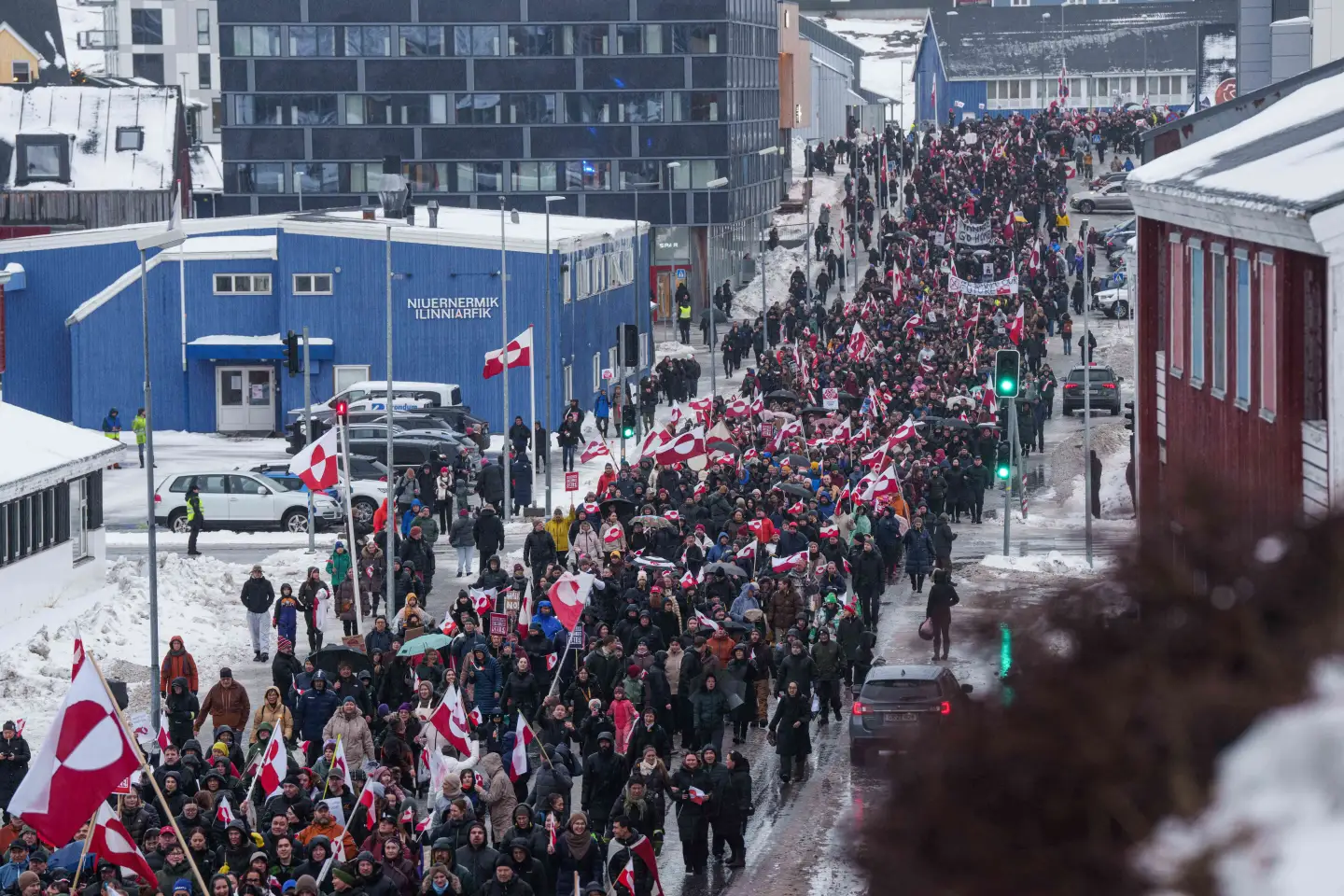
On Saturday, hundreds of demonstrators rallied in Greenland’s capital, Nuuk, in support of self-governance, while thousands marched in Copenhagen carrying Danish and Greenlandic flags. Similar protests followed a visit by a bipartisan group of US lawmakers seeking to reassure Denmark and Greenland of continued congressional support.
Danish Major General Soren Andersen, head of the Joint Arctic Command, said Copenhagen does not expect the US to attack Greenland or any NATO ally. He confirmed that European troops were recently deployed to Nuuk for Arctic defence training and said Danish forces would nonetheless be obliged to resist any use of force on Danish territory.
US lawmakers have also voiced concern. Senator Chris Coons said Denmark is “almost no better ally” to the United States, warning that undermining trust with Copenhagen could weaken Washington’s credibility with allies worldwide.