

WARSAW (Realist English). Polish Finance Minister Andrzej Domański has dismissed as a “mirage” the president’s plan to sell central bank gold reserves to fund the military instead of tapping cheap EU loans intended for the same purpose.
In an interview with the Financial Times during a trip to Washington, Domański said Warsaw would seek to access the EU’s €150 billion “Security Action for Europe” (SAFE) defence fund despite a presidential veto, even if it meant reduced “flexibility” in using the loans for non-military investment.
He pushed back against suggestions by President Karol Nawrocki and National Bank of Poland Governor Adam Glapiński to use proceeds from gold sales as an alternative way to finance military expenditure.
“I refuse to accept the [idea of] modernising the Polish army based on the mirage of future profits of the central bank — I refuse,” Domański said.
While it is for the central bank to decide how to use its reserves, the institution will not have a final picture of its annual earnings until the spring of 2027, he noted. “We need resources to modernise the Polish army now. I see no point in waiting, and this is why we will use SAFE as quickly as possible.”
Poland’s gold reserves and the dispute over SAFE
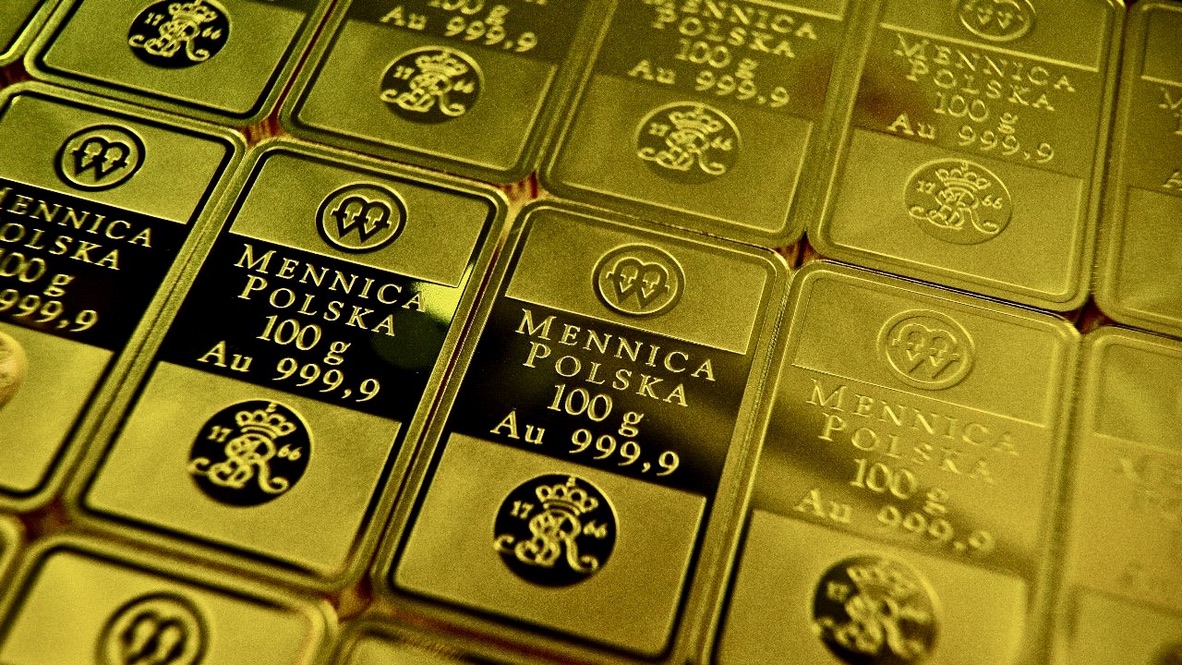
In 2025, Poland was among the largest gold buyers among central banks, ending the year with approximately 550 tonnes of the metal, accounting for more than a quarter of its total reserves. In January 2026, Glapiński set a new target for the National Bank of Poland to increase reserves to 700 tonnes.
Two months later, Glapiński sided with Nawrocki in his conflict with the pro‑EU government of Prime Minister Donald Tusk over the SAFE programme. Glapiński and Nawrocki are nominees of the right‑wing opposition Law and Justice party.
While Nawrocki vetoed the government’s SAFE bill, Glapiński suggested that Polish gold could be sold and perhaps later repurchased as an alternative to EU loans under the SAFE programme.
However, Domański noted that any gains from selling reserves could be offset by foreign‑exchange fluctuations during the financial year, and that the central bank had recently been making losses.
Tusk’s government opposes the use of gold reserves. It is in talks with the European Commission about channelling SAFE loans into an existing Polish army fund, which has some spending restrictions but does not require presidential approval.
Alternative defence financing mechanisms
Domański said his team is also in talks over another international defence funding proposal, the so‑called Multilateral Defence Mechanism (MDM). The initiative is supported by countries including the United Kingdom, the Netherlands and Finland. The MDM would issue debt backed by guarantees from its members and use the proceeds for defence procurement, achieving economies of scale and lowering borrowing costs for member countries.
“It might be an interesting option for Poland,” Domański said. “My top priority right now is SAFE, but my team is also participating in the MDM.”
The fight for G20 membership
Domański and Glapiński also used their trip to Washington for the IMF spring meetings to promote Poland’s bid for G20 membership. The United States, which holds the G20 presidency in 2026, has invited Poland to attend the group’s December meeting in Miami as a guest nation.
Between gold, loans and guns
Poland is at a crossroads: while boosting its gold reserves to record levels and investing a record 4.8% of GDP in its army, the country is simultaneously facing rising public debt (60% of GDP by the end of 2025) and a budget deficit (6.9% in 2025). The military build‑up remains a priority: deliveries of Abrams and K2 tanks are underway, K9 self‑propelled howitzers have been ordered, F‑16s are being modernised and missiles are being purchased. Yet civil defence and shelter systems have been ignored for decades, and the financing gap is being covered by debt instruments.
Warsaw has become one of the world’s largest gold buyers. As of the end of March 2026, Poland’s gold reserves stood at 583 tonnes (worth about $84.4 billion). In February, 20 tonnes were acquired, and in March another 13 tonnes, despite a correction in global gold prices (gold fell from $5,400 to $4,100 per ounce).
Glapiński directly linked the acceleration of purchases to the start of the special military operation in Ukraine.
“We radically accelerated the process of increasing our gold reserves after the war began. Since then, the amount of gold has grown significantly,” he said in March 2026.
According to him, gold is an element of foreign exchange reserves alongside dollar and euro assets and is subject to current management.
Poland has been living with a growing budget deficit for several years and is increasing military spending at a pace that raises questions about long‑term sustainability. The figures speak for themselves:
| Indicator | Value | Period |
| Public debt increase | +322.6 billion zlotys ($89 billion) | over 2025 |
| Total public debt (end‑2025) | 1,951.9 billion zlotys (60% of GDP) | December 2025 |
| Debt forecast end‑2026 | + another 350 billion zlotys | Ministry of Finance estimate |
| Long‑term forecast (2036) | 107% of GDP | Ministry of Finance forecast |
| Budget deficit (2025) | 6.9% of GDP (vs planned 5.5%) | 2025 |
| Budget deficit (2026) | 6.5% of GDP (forecast) | 2026 |
| Debt service (2026) | 90 billion zlotys ($24 billion) — half of Poland’s entire 2005 budget | 2026 |
Military spending in 2026 will reach a record 200 billion zlotys ($54.6 billion), equivalent to 4.8% of GDP. Of this, 36.7% (approximately $20.2 billion) will be covered by debt instruments of the Armed Forces Support Fund (FWSZ). By the end of 2026, the fund’s debt could reach $46.9 billion, and its repayment will fall on the state budget in 2027‑2031, which risks limiting future investments in the technical modernisation of the army.