

MOSCOW (Realist English). Over the past seven days, Russian diplomacy has remained highly dynamic: key areas included coordination with Iran, strengthening the CSTO, preparation for the BRICS summit in India, and sanctions-related confrontation with the West. On the foreign trade front, statistics recorded a continued decline in the surplus amid falling exports and rising imports.
Foreign policy: key events
Iran and the Middle East
Russia is closely monitoring the progress of US‑Iranian negotiations, but so far sees no real results.
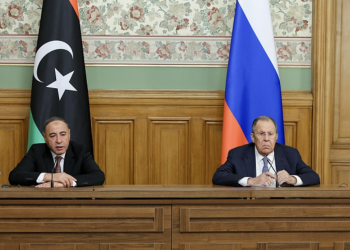
On 20–21 April, Russian Foreign Minister Sergey Lavrov, during telephone consultations with his Iranian counterpart Abbas Araghchi and at a press conference following talks with the acting Foreign Minister of Libya, said that Moscow only registers “threats and promises” from the United States. “We see no facts yet. We see threats, we see promises, we see assurances that if you do this, you will prosper,” Lavrov stressed.
Nevertheless, the Russian side welcomed the extension of the truce between the United States and Iran, calling it “a step in the right direction.” At the same time, the Russian Foreign Ministry stated that the United States “has no right to dictate terms to Iran” and described the American naval blockade as “an act of intimidation.”
Polish Prime Minister Donald Tusk said on 21 April that Russia is the main beneficiary of the Middle East crisis. “The clear beneficiary of the war has become Russian President Vladimir Putin and Russia,” the Polish prime minister noted.
CSTO
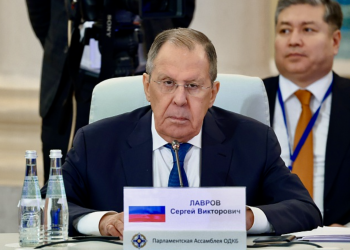
On 20 April, Lavrov took part in a meeting of the CSTO Parliamentary Assembly Council in Moscow. The minister informed parliamentarians about the implementation of Russia’s CSTO chairmanship priorities for 2026 and about foreign policy coordination in the context of a multipolar world order.
Earlier, on 16 April, a meeting of the CSTO Military Committee was held in Moscow under the leadership of Chief of the General Staff of the Russian Armed Forces Valery Gerasimov. Participants discussed the military-political situation in the organisation’s areas of responsibility and outlined measures to strengthen collective security.
BRICS
Preparations for the BRICS summit, which will take place in India in September 2026, remain in Moscow’s focus. Kremlin spokesman Dmitry Peskov confirmed on 15 April that Vladimir Putin will take part in the event. India will host the 18th BRICS summit in September 2026 as part of its chairmanship of the association, bringing together leaders of key developing countries amid global uncertainty.
Earlier in April, Russia, as BRICS chair, advocated the creation of an independent platform for settlements in national currencies, which should reduce dependence on the dollar and the euro.
Sanctions confrontation
On 23 April, the Russian Foreign Ministry announced a response to the 20th package of EU sanctions. Deputy Foreign Minister Alexander Grushko said the new sanctions would be “fruitless”, but Russia would prepare a response after a thorough analysis.
Russian Foreign Ministry spokeswoman Maria Zakharova said on 24 April that “attempts to isolate Russia have failed”, citing data on an 18% increase in trade with Asian countries in the first quarter of 2026.
Foreign trade: statistics for the first two months
The Federal Customs Service of Russia published data for January–February 2026. Russia’s trade turnover amounted to $99.3 billion, which is 4% lower than in the same period of 2025.
- Exports — $56.7 billion (-9% yoy)
- Imports — $42.6 billion (+3.5% yoy)
- Positive balance — $14.1 billion (down 33.3% yoy)
The Central Bank of Russia estimated the foreign trade surplus for two months at $11.8 billion (down 36%). In February, the surplus amounted to $5.4 billion, a decline of 51.8% year-on-year.
In the structure of exports, mineral products accounted for 50.4% (mainly oil, gas and coal). In imports, machinery and equipment led with 48.5%.
Geographical structure:
- Asian countries — 74.8% of turnover (-1.6% yoy)
- European countries — 18.3% (-7.8% yoy)
- America — 3.8% (-9.6% yoy)
- Africa — 3.3% (-22.4% yoy)
On 21 April, data for the first quarter of 2026 appeared: exports of Chinese goods to Russia amounted to $27.7 billion, which is 22% higher than a year earlier.
Forecasts
According to the conservative forecast of the Bank of Russia, exports in 2026 will amount to $399 billion with imports of $309 billion (surplus — $90 billion). The forecast of the Ministry of Economic Development is higher — exports of $431.5 billion, imports of $308.5 billion, surplus of $123 billion.
The baseline scenario assumes oil prices at $59 per barrel. However, if the Middle East crisis is prolonged, Urals prices could rise to $81.6 per barrel, which would bring additional revenues to the budget, but at the same time strengthen the rouble to 70–73 per dollar, offsetting part of the gain.
Expert opinions
Russian experts
Vladimir Kireev, political scientist:
Russia today is one of the main political and military centres of the world, which even those who until recently ignored its interests will be forced to reckon with in 2026.
Alexey Naumov, expert at the Russian International Affairs Council (RIAC):
The key challenges for Russia’s foreign policy in 2026 will be related to sanctions policy — pressure on third countries, intermediary banks and the “shadow fleet”.
Vladimir Sedalishchev, Gaidar Institute:
Raw material exports may remain at the 2025 level or grow slightly due to supplies to Asia and the Middle East, but they will be constrained by sanctions, logistics and world prices.
From the IMEMO RAS forecast “Russia and the World: 2026”:
Russia is accelerating the reorientation of trade towards developing economies, but the risk of falling into a “middle-income trap” remains if the raw material structure of exports persists.
Foreign experts
Glenn Diesen, professor at the University of South-Eastern Norway:
The refusal of Western countries to engage in dialogue with Moscow for the sake of Kyiv is an act of mass psychosis.
Bloomberg (following the video conference meeting of BRICS finance ministers and central bank governors on 21 April):
During the discussions, Moscow proposed the creation of an independent platform for settlements in national currencies; the question of returning to dollar settlements following the Alaska talks remains open.
Centre for Macroeconomic Analysis and Short‑Term Forecasting:
There is a high probability of “Dutch disease” — the gains from rising oil prices are concentrated in a narrow group of rent‑receiving sectors, hardly spreading to the rest of the economy.
Bank of Finland Institute for Emerging Economies (BOFIT):
Over the entire forecast period of 2026–2028, a further divergence of Russian economic trajectories is expected: military industries will grow, while the civilian economy will stagnate.
Results of the week
Over the past seven days, Russian diplomacy has maintained activity on all key fronts — from Middle East settlement and strengthening the CSTO to preparing for the BRICS summit. On the foreign trade front, statistics recorded a continued contraction of the surplus: the reasons were falling export revenues due to sanctions and simultaneous import growth.
Experts are divided in their assessments: some see sanctions pressure as the main threat, while others point to the successful reorientation to Asian markets as a factor mitigating the consequences.