

MOSCOW (Realist English). Russia’s foreign policy activity in April 2026 was characterized by two contrasting trends.
On the one hand, Moscow made diplomatic efforts to de-escalate the situation regarding Ukraine, linking hopes for peace agreements to U.S. President Donald Trump.
On the other hand, there was a continued deepening of the multipolar pivot: a strategic strengthening of relations with China and countries of the Global South against the backdrop of sharp confrontation with Western alliances over the war in the Middle East and growing sanctions pressure.
Geopolitical Background and Conceptual Statements
The strategic course toward reshaping the world order was outlined by President Vladimir Putin at the end of April. In a video address to participants of the “Open Dialogue” forum on April 28, he spoke of a profound transformation of international relations.
“Previous approaches and established norms are gradually losing their force, including due to the actions of Western states, which are losing their leadership positions and giving way to new centers of growth — countries of the Global South,” the Russian leader emphasized.
At the same time, official Moscow sought to ease concerns about a direct military threat to Europe. Deputy Chairman of Russia’s Security Council Dmitry Medvedev stated on April 30 that Russia has “no aggressive intentions toward European countries.” He linked the military buildup in European states to their own internal rhetoric rather than to Moscow’s actions.
Meanwhile, in the eastern part of the continent, Russia continues to advocate for a new security architecture. Deputy Foreign Minister Alexander Grushko said in an interview with the Serbian newspaper Politika on the same day that Russia is ready for “open and honest dialogue” with the West, but only on equal terms, without ultimatums or bloc-based principles.
Ukrainian Settlement: Focus on Negotiations with the United States
April became a month of intensive attempts to return U.S.–Russia dialogue on Ukraine to the level of substantive negotiations. The key event was a phone call between Putin and Trump on April 30, lasting more than an hour and a half.
According to the Kremlin, the result of the conversation was Moscow’s proposal to declare a ceasefire in the special military operation zone during Victory Day celebrations. Trump reportedly supported the initiative, calling the holiday “our shared victory over Nazism.”
The American president expressed confidence that a settlement agreement was close, while Putin stated that the main condition for peace was the consent of the Kyiv government to terms previously proposed by Moscow.
Supporting this line, Foreign Minister Sergey Lavrov stated at a press conference in Astana on April 30 that Russia “remains interested in resuming the negotiation process.” According to him, previous understandings achieved through the Russian-American track should form the basis for dialogue.
Moscow thus signals that it continues to keep the “door open” for diplomacy while placing responsibility for progress on Washington and Kyiv.
Middle East Crisis: Iran, Syria, and the Israeli Factor
The Middle East remained a focus of attention in connection with the war involving the United States and Israel against Iran. Moscow consistently called for preventing further escalation.
During phone conversations on April 13 and 14, Lavrov reaffirmed to Iranian Foreign Minister Abbas Araghchi Russia’s readiness to assist in resolving the crisis, emphasizing that it has no military solution. The importance of preventing a “renewed armed confrontation” was highlighted.
As part of these efforts, Moscow continues to promote its own Gulf Security Concept.
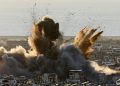
Russia reacted sharply to attacks in the Caspian region. On April 30, Lavrov issued a strong statement about the negative impact of the conflict on the Caspian Sea. He described strikes by the anti-Iran coalition on the Iranian port infrastructure of Enzeli as “unacceptable and inadmissible,” noting that the port serves the trade interests of all five Caspian states.
According to the minister, the Caspian region must remain a zone of peace and cooperation, and such strikes should not occur.
Earlier, on April 15, commenting on the roots of Middle Eastern tensions, Lavrov described as one of the main causes “Israel’s unwavering belief that Iran must be destroyed.”
CIS and the South Caucasus: Balancing Between Allies
In relations with key partners in the Commonwealth of Independent States, Russian diplomacy demonstrated a pragmatic approach.
On April 30, Lavrov and Kazakhstan’s Foreign Minister Yermek Kosherbayev held talks in Astana, confirming the allied nature of bilateral relations and coordination on a broad range of international issues.
In the South Caucasus, Moscow seeks to preserve its role as a stabilizing force. On April 1, following talks in Moscow with Armenian Prime Minister Nikol Pashinyan, Putin noted a “noticeable stabilization” in relations between Armenia and Azerbaijan.
Russia’s position was to support direct dialogue between Yerevan and Baku and to encourage further diplomatic engagement.
Russian Ambassador to Armenia Sergey Kopyrkin stated on April 3 that Moscow is prepared to assist in normalization “to the extent requested by the parties.”
Russia’s stance on the recognition of Karabakh as part of Azerbaijan was clearly expressed on April 5. Kremlin spokesperson Dmitry Peskov emphasized that the decision had been made by Armenia’s leadership “independently, without Russia’s participation.”
In the context of upcoming parliamentary elections in Armenia, Putin expressed interest in seeing political forces friendly toward Russia represented in parliament, noting that Russia has “many friends” in the republic.
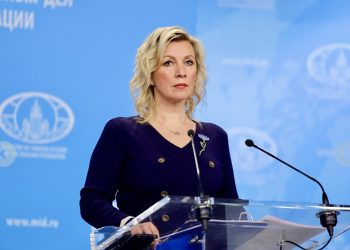
On April 8, Foreign Ministry spokesperson Maria Zakharova commented that the process of achieving “irreversible normalization” in Armenian-Azerbaijani relations is not yet complete. It includes signing a peace agreement, border delimitation, and restoration of transport links.
Russia says it remains ready to provide assistance across all these tracks whenever requested.
Strategic Partnership with China and the G20
Strengthening ties with China remained an unquestionable priority.
On April 14–15, Lavrov paid an official visit to Beijing, where he held talks with Chinese President Xi Jinping and Foreign Minister Wang Yi. The “negotiation marathon” reportedly lasted a total of four hours.
The central topic of discussion was the formation of a new Eurasian security architecture amid what was described as the “most serious challenges” facing the international system.
Lavrov stated that Western countries are using the Ukrainian crisis to create a new “aggressive bloc” in Europe involving Kyiv and directed against Russia.
Special attention was also given to the risks of escalation in East Asia and around Taiwan.
Following the visit, both sides confirmed the need for close coordination within international platforms such as the United Nations, BRICS, and the Shanghai Cooperation Organization.
Sanctions Confrontation with the West
April saw another escalation in the sanctions conflict.
On April 23, the European Union adopted its 20th package of sanctions against Russia, targeting several major companies, politicians, and cultural figures, including performer Timur Yunusov (Timati) and Hermitage Museum Director Mikhail Piotrovsky.
The restrictions also affected the Moscow Institute of Physics and Technology (MIPT) and transactions involving the Russian cryptocurrency RUBx.
Moscow’s Response Measures
Russia’s response, announced on April 24 by Foreign Ministry spokesperson Maria Zakharova, followed quickly.
On April 27, Russia “significantly expanded” its stop-list of European institutions’ representatives and EU member-state officials banned from entering the country.
The list includes individuals involved in military support for Ukraine, undermining Russia’s territorial integrity, or harming Russian assets.
At the same time, the Foreign Ministry announced work on economic countermeasures aimed at supporting domestic producers.
“We are examining economic instruments that will allow us to strengthen sovereignty and support our manufacturers,” explained Dmitry Birichevsky, director of the Foreign Ministry’s Department of Economic Cooperation.
Africa and the Global South: Expanding Relations
Developing ties with Africa remained an important priority.
The third Russia–Africa Summit is scheduled to take place in Moscow on October 28–29, and preparations were actively underway throughout April.
On April 29, Kremlin spokesperson Peskov said that the summit would focus on economic and humanitarian issues, strengthening sovereignty and promoting cooperation.
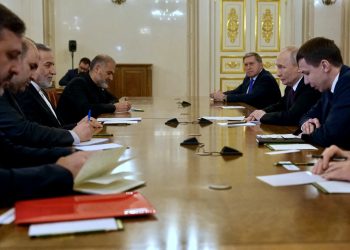
As part of this agenda, Putin held talks in the Kremlin on April 29 with President Denis Sassou Nguesso of the Republic of the Congo, who was making his first foreign visit since reelection.
The discussions covered cooperation in geological exploration, logistics, energy, and agriculture.
Economic Diplomacy and Energy
One notable example of the new economic reality was the discussion of settlements in national currencies.
During Lavrov’s visit to Beijing, this issue was a central topic alongside strengthening technological sovereignty.
“BRICS countries support a truly multipolar world order based on the rule of international law,” the president had previously stated, emphasizing the course toward de-dollarization.
Energy diplomacy also remained a key component of Moscow’s foreign policy.
This was underscored by reports on April 30 that Lavrov had drawn international attention to strikes on infrastructure in Enzeli, directly affecting regional energy-export logistics.
Results of the Month
April 2026 demonstrated that Russian foreign policy is entering a new phase characterized not only by adaptation to sanctions but also by the construction of a long-term multipolar model.
Negotiation efforts with the United States over Ukraine are combined with criticism of U.S. policy in the Middle East, while stronger ties with China and countries of the Global South are becoming the foundation for shaping a new economic and political architecture.