

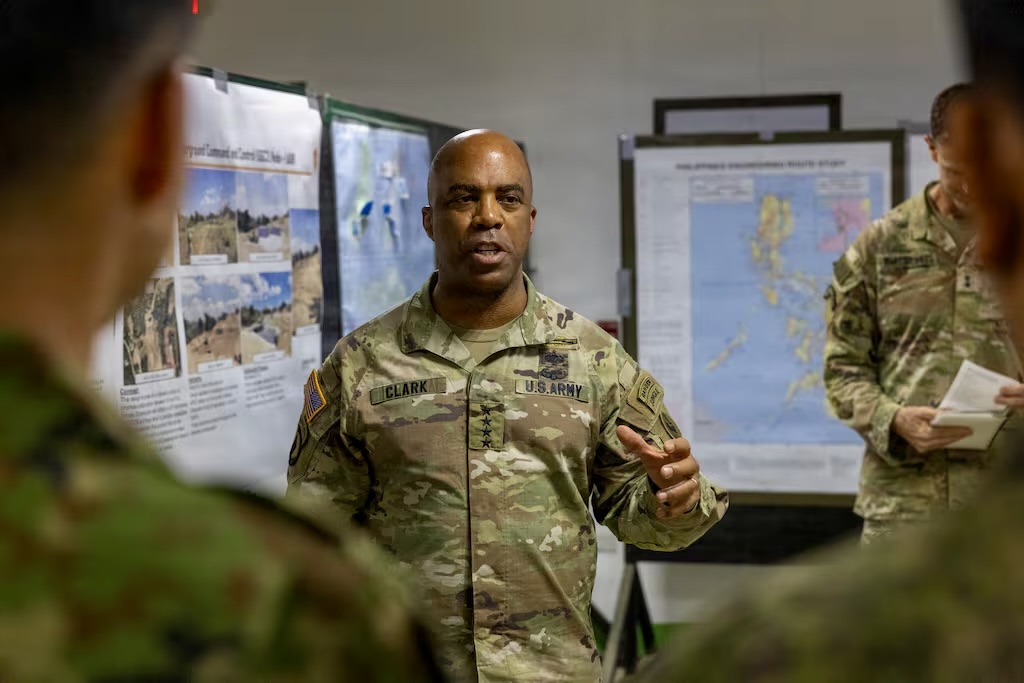
MANILA (Realist English). The commander of U.S. Army Pacific (USARPAC), General Ronald Clark, has emphasized that the primary mission of the military is to prevent war — and that deterrence depends on readiness for any scenario.
Speaking to Defense News, Clark made his remarks as the Balikatan 2026 exercises unfold in the Philippines from April 20 to May 8. This year’s drills are the largest in the exercise’s history, involving forces from seven countries: the United States, the Philippines, Australia, Canada, France, Japan, and New Zealand.
Notably, Canada, France, Japan, and New Zealand have deployed ground troops for the first time, signaling a significant expansion in both scale and strategic ambition.
Shift Toward Large-Scale Warfare
Clark, who first took part in Balikatan in 1994 as a young officer, described the current drills as a “full-circle moment.” He underscored the importance of alliances, calling them the “secret sauce” of U.S. military operations.
“We never go into a conflict alone,” he said.
The focus of the exercises has evolved dramatically. Where earlier iterations centered on counterterrorism and insurgency, Balikatan now prioritizes large-scale combat operations and territorial defense.
This year’s program includes amphibious live-fire exercises and simulated seizures of key maritime terrain on remote islands in the Luzon Strait — a strategically vital area just south of Taiwan.
U.S. forces also rehearsed rapid deployment of HIMARS rocket systems and NMESIS anti-ship missiles, capabilities designed to counter naval forces in a potential Taiwan contingency.
Building Trust Before Crisis
Clark stressed that joint exercises are critical for building trust among allies before a crisis emerges.
“Anything we can do to strengthen trust before conflict is invaluable,” he said.
Balikatan is part of the broader Operation Pathways framework, under which USARPAC conducts more than 50 exercises annually. The program is designed to improve operational readiness across key strategic zones, particularly within the First and Second Island Chains.
U.S. Army Modernization
The exercises also highlight the transformation of U.S. ground forces in the Indo-Pacific.
The 25th Infantry Division, based in Hawaii, is one of the Army’s flagship “Transformation in Contact” units. It is being equipped with next-generation systems, including:
- M7 rifles
- M250 machine guns
- Unmanned aerial systems
- Infantry Squad Vehicles
According to Clark, it is currently the only U.S. infantry division equipped with HIMARS.
Alongside the 4th Infantry Division, it is also testing advanced command-and-control systems aimed at accelerating battlefield decision-making and improving situational awareness.
“This is the Army’s most lethal and technologically advanced mobile infantry force,” Clark noted.
The U.S. Army is also expanding its Multi-Domain Task Forces (MDTFs) — specialized units designed to operate across land, sea, air, space, and cyber domains. Two of the Army’s three MDTFs are already assigned to the Indo-Pacific.
Clark confirmed that the next step will be the creation of a two-star multi-domain command, with the 7th Infantry Division set to take on this role at Joint Base Lewis-McChord in June 2026.
Coordination with the Marine Corps
Clark dismissed suggestions that the Army is duplicating Marine Corps capabilities, instead emphasizing complementarity.
During Balikatan, for example, the Marines operated without an aviation wing and relied on Army aviation support.
“Our goal is to combine strengths and solve complex operational challenges together,” he said.
On logistics, Clark highlighted a shift away from permanent bases toward pre-positioned supply networks, allowing allies to access equipment quickly in a crisis.
“Preparing the theater is one of our core responsibilities,” he added.
Rising Tensions Around Taiwan
The exercises come amid growing tensions in the Taiwan Strait.
Over April and early May 2026, U.S.–Taiwan relations have deepened, particularly in the military sphere, while friction with Beijing has intensified ahead of a planned U.S.–China summit in June.
Washington has approved $11.1 billion in arms sales to Taiwan, including:
- HIMARS systems
- Javelin anti-tank missiles
- Altius drones
In addition, the Pentagon has requested $2 billion from Congress for further military support, split between strengthening Taiwan’s defenses and replenishing U.S. stockpiles.
Meanwhile, Chinese Coast Guard vessels have repeatedly entered restricted waters near Taiwan’s Kinmen islands, with incidents recorded on April 21, 24, and 28.