
Realist: news and analytics

Русский / English / العربية

  • News
  • Russia
  • Caucasus
  • Opinion
  • Interviews
  • Experts
No Result
View All Result
Realist: news and analytics
  • News
  • Russia
  • Caucasus
  • Opinion
  • Interviews
  • Experts
No Result
View All Result
Realist: news and analytics

The United States and Iran Exchange Strikes over the Strait of Hormuz: Kuwait and Bahrain Under Fire Again

Drones, missiles, and stalled negotiations: the Pentagon confirms a new escalation in the Persian Gulf.

     
June 6, 2026, 10:59
World
The United States and Iran Exchange Strikes over the Strait of Hormuz: Kuwait and Bahrain Under Fire Again

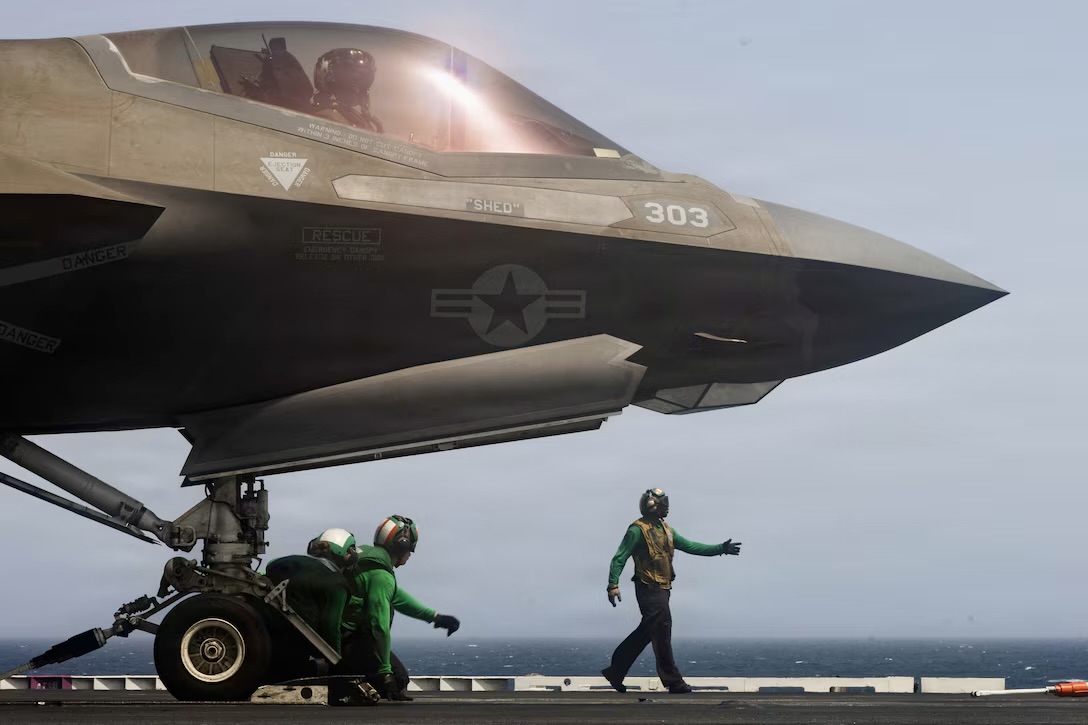
Photo: Pentagon Press Service.

TEHRAN (Realist English). The United States and Iran exchanged fresh strikes overnight on June 6, jeopardizing an already fragile ceasefire. Ballistic missiles also struck the territories of Kuwait and Bahrain — Gulf states that host major US military bases. The Financial Times reports, citing official representatives of the Pentagon and Iran’s Islamic Revolutionary Guard Corps.

Timeline of the exchange

Evening of June 5, 2026. US Central Command (CENTCOM), responsible for military operations against Iran, reported that its forces intercepted four Iranian kamikaze drones over the Strait of Hormuz.

According to the command, the drones posed an “immediate threat to regional maritime traffic.” In response, US forces struck “Iranian coastal surveillance radar sites” in Goruk and on Qeshm Island.

Simultaneously, Iran, following a pattern similar to the attacks on June 3, launched missiles at US bases in Kuwait and Bahrain. CENTCOM said six missiles were intercepted and a seventh failed to reach its target. Reports that Iranian missiles had struck the headquarters of the US Fifth Fleet in Bahrain were called “false” by the Pentagon.

The Islamic Revolutionary Guard Corps explained the drone launch by saying that four vessels had attempted to leave the Gulf without Iran’s permission. Since the start of hostilities on February 28, Tehran has established control over the strategic waterway, demanding that all passing vessels pay a fee and follow shipping lanes close to the Iranian coast. The IRGC accused the vessels of acting under the guidance of the US military.

Strikes on Kuwait and Bahrain

Kuwait, where air raid sirens sounded five times overnight, confirmed that its air defences had been intercepting missiles and drones. Bahrain also declared an air raid alert and urged residents to take shelter.

In response to the strikes, Kuwaiti authorities announced the expulsion of two Iranian diplomats within 24 hours, condemning the “flagrant violation” of its territorial integrity and the attack on civilian infrastructure. India, whose citizen was killed in the attack, called on the parties to cease violence.

Two days earlier, on June 3, 2026, Iranian strikes on Kuwait’s main international airport killed one person (an Indian citizen) and injured more than 60. Tehran claimed at the time that the damage was caused by a malfunctioning US interceptor missile, but Washington categorically denied this version.

Negotiations at an impasse

The escalation comes amid prolonged attempts to extend the fragile truce reached in early April and reach a long-term agreement. Under its terms, Iran would gradually reopen the Strait of Hormuz, and the US would ease its naval blockade of Iranian ports. A second phase would involve negotiations on the future of Iran’s nuclear programme.

However, Tehran is demanding access to $24 billion of its oil revenues held abroad and significant sanctions relief. US President Donald Trump is not yet ready to agree to these terms.

Despite the mutual strikes and seemingly stalled negotiations, Trump said on June 5 in an interview with NBC News that “the situation with Iran seems to be going quite well.” He added that it would take time for Iran to sign a deal on terms acceptable to Washington.

“They are strong. They are proud. There are things they never thought they’d be doing that they’re going to have to do, they’ve got no choice, and it takes a little time,” the US president said.

Trump, who is under growing domestic pressure to resolve the crisis with Iran ahead of the midterm elections in November, appears to be betting that economic pressure and military strikes will eventually force Tehran to give in.

A senior adviser to Iran’s Supreme Leader, Mohsen Rezaei, told CNN that progress on a peace plan depends entirely on the unfreezing of assets, calling it a “test of trust” and adding that “the ball is in Trump’s court.”

The outcome depends on Washington’s ability to reach an agreement with Tehran while simultaneously restraining its ally Israel, whose actions remain the main irritant for the Iranian side. For now, diplomacy remains on hold, giving way to escalation on the battlefield.

The exchange of strikes between the US and Iran is becoming increasingly regular. Kuwait and Bahrain, home to major US bases, have become recurring targets for Iranian retaliation.

Civilian infrastructure (Kuwait’s international airport) is also being hit, leading to civilian casualties. The negotiation process is effectively frozen, and each new attack raises the risk of a complete collapse of the ceasefire and a return to full-scale hostilities.
Donald TrumpIranIran WarIran’s Foreign PolicyMiddle EastUnited StatesUS Foreign PolicyUS-Iran Relations
Previous Post

“Work, Brothers” and the New World Order: Putin Summarizes SPIEF 2026

Next Post

CNN: Israel secretly deployed special forces in Azerbaijan for strikes against Iran

Related Posts

Withdrawal of Israeli troops from Lebanon is Iran’s main condition in negotiations with the US
World

Withdrawal of Israeli troops from Lebanon is Iran’s main condition in negotiations with the US

5 June, 2026
Israel and Lebanon Agree to Ceasefire, but Hezbollah Is Silent: Agreement in Question
World

Israel and Lebanon Agree to Ceasefire, but Hezbollah Is Silent: Agreement in Question

4 June, 2026
Trump Promises a Deal “By the Weekend,” Araghchi Says No Progress: The Double Game of US-Iran Negotiations
World

Trump Promises a Deal “By the Weekend,” Araghchi Says No Progress: The Double Game of US-Iran Negotiations

4 June, 2026
Mahmoud Ahmadinejad — Victim or Conspirator? NYT on Secret Negotiations with Israel
World

Mahmoud Ahmadinejad — Victim or Conspirator? NYT on Secret Negotiations with Israel

3 June, 2026
Israel-Lebanon Talks Stall Due to Iran’s Position
World

Israel-Lebanon Talks Stall Due to Iran’s Position

3 June, 2026
Two Realities of Negotiations with Iran: Rubio Declares “War Is Over,” Tehran Threatens to Block Strait of Hormuz
World

Two Realities of Negotiations with Iran: Rubio Declares “War Is Over,” Tehran Threatens to Block Strait of Hormuz

3 June, 2026
Most Popular
Most Popular
10,000 Christians Refuse to Leave Southern Lebanon Despite Siege and Bombardment

10,000 Christians Refuse to Leave Southern Lebanon Despite Siege and Bombardment

6 June, 2026

BEIRUT (Realist English). While global media attention is focused on negotiations between the US and Iran, a quiet humanitarian and existential...

CNN: Israel secretly deployed special forces in Azerbaijan for strikes against Iran

CNN: Israel secretly deployed special forces in Azerbaijan for strikes against Iran

6 June, 2026

BAKU (Realist English). Israel secretly deployed elite military and intelligence units to Azerbaijan during the war with Iran, CNN reported on...

62% for China, 36% for Russia: Afrobarometer Surveys Reveal the Balance of Sympathies in North Africa

62% for China, 36% for Russia: Afrobarometer Surveys Reveal the Balance of Sympathies in North Africa

5 June, 2026

RABAT (Realist English). The countries of North Africa are undergoing a fundamental shift in their foreign policy preferences. According to large-scale...

Allies or Already Competitors? Baku and Ankara Have Created a Gas Alliance Against Moscow

Allies or Already Competitors? Baku and Ankara Have Created a Gas Alliance Against Moscow

3 June, 2026

BAKU (Realist English). Turkey and Azerbaijan have announced the signing of a new 15-year contract for the supply of 33 billion...

Opinion

US and Israel balance on brink of new war with Iran

“Empire of Bases” Under Pressure: What U.S. Allies Pay for the Privilege of Being Strategic Outposts

6 June, 2026

WASHINGTON (Realist English). Professor of Political Science and International Affairs at George Washington University, Rachel Metz, argues in her article for Foreign...

Iran No Longer Seeks Peace: “Forever War” Becomes Reality

Iran No Longer Seeks Peace: “Forever War” Becomes Reality

5 June, 2026

TEHRAN (Realist English). Iran has concluded that a protracted conflict with the United States is preferable to a diplomatic settlement. As Mohammad...

Pakistan — Mediator in Iran, but Not at Home

Pakistan — Mediator in Iran, but Not at Home

4 June, 2026

WASHINGTON (Realist English). A relative calm has settled along the Afghanistan-Pakistan border after several months of intense violence. However, as Foreign...

European Security Council — Empty Vessel or New Reality?

European Security Council — Empty Vessel or New Reality?

3 June, 2026

BRUSSELS (Realist English). The strengthening of Russia in Eastern Europe and the reduced involvement of the United States in European security...

All rights reserved.

© 2017-2026

  • About Us
  • Mission and Values
  • Contact Us
  • Privacy Policy

Follow Realist English

No Result
View All Result
  • News
  • Russia
  • Caucasus
  • Opinion
  • Interviews
  • Experts

Русский / English / العربية