


NEW YORK (Realist English). Larry Fink, founder and CEO of BlackRock, the world’s largest investment company with $14 trillion in assets under management, remains one of the most influential figures in the global financial system.
His recent public statements and actions demonstrate a significant evolution in his views: from a father figure of the ESG movement to a harsh critic of inequality provoked by modern capitalism, and an economic adviser to the White House.
Latest developments
The news agenda surrounding the head of BlackRock in recent weeks has been filled with events reflecting his growing influence on both geopolitics and global markets.
In January 2026, Fink joined the US team for resolving the conflict in Ukraine. President Trump’s special envoy, Steve Witkoff, called him the “best‑in‑class prosperity adviser.” Fink acts as an economic consultant to Washington as part of a formed group, which has strengthened Wall Street’s ties with the White House’s foreign policy apparatus.
One of Fink’s most striking recent statements was a warning of a global recession. In a BBC interview on 25 March 2026, he said that if oil prices rise to $150 per barrel, it could trigger a worldwide economic downturn. He also expressed concern about the growing wealth gap.
According to him, since 1989, a dollar invested in the US stock market has grown 15 times faster than a dollar tied to the average wage.
This imbalance, he says, is the cause of today’s “economic anxiety,” and he believes the same trend will be observed in the AI era. He fears that this year’s college graduates could face the worst unemployment rate in many years.
Origin and childhood
Laurence Douglas «Larry» Fink was born on 2 November 1952 in Van Nuys, a suburb of Los Angeles, California. He grew up in a Jewish family. His father owned a shoe store, while his mother was a professor of English at California State University, Northridge.
Education and early career
In 1974, Fink earned a Bachelor of Arts degree in Political Science from the University of California, Los Angeles (UCLA). In 1976, he received an MBA with a specialisation in real estate from the Anderson School of Management at UCLA.
He began his career at the investment bank First Boston, which was later acquired by Credit Suisse. There he rose quickly, becoming the youngest managing director in the bank’s history at the age of 28. However, in 1986, his department lost $100 million due to an incorrect interest rate forecast.
Fink later called that moment «humiliating», adding that it taught him humility and risk management.
In 1988, together with seven partners and with the support of the Blackstone Group, he founded BlackRock, which has since grown from a small unit into a global giant managing $14 trillion in assets.
Wealth and power
As of 2025, BlackRock managed $14 trillion in assets. Through its funds, including the world’s largest bitcoin ETF (IBIT) and the tokenised assets fund BUIDL, Fink exerts colossal influence on the global economy.
Philosophical views
Fink’s political and economic views have undergone a serious evolution over the past three years.
From ESG preacher to ‘energy pragmatist’
In the early 2020s, Fink was considered a founding father of the ESG movement in finance. However, in recent years he has sharply changed his rhetoric, abandoning the term «ESG» altogether, calling it «too politicised».
In 2025, BlackRock withdrew from the Net Zero Asset Managers Initiative climate alliance and removed mentions of ESG from the descriptions of dozens of investment strategies. Analysts attribute this to political pressure from Republicans in the United States, who accused the company of «boycotting energy companies».
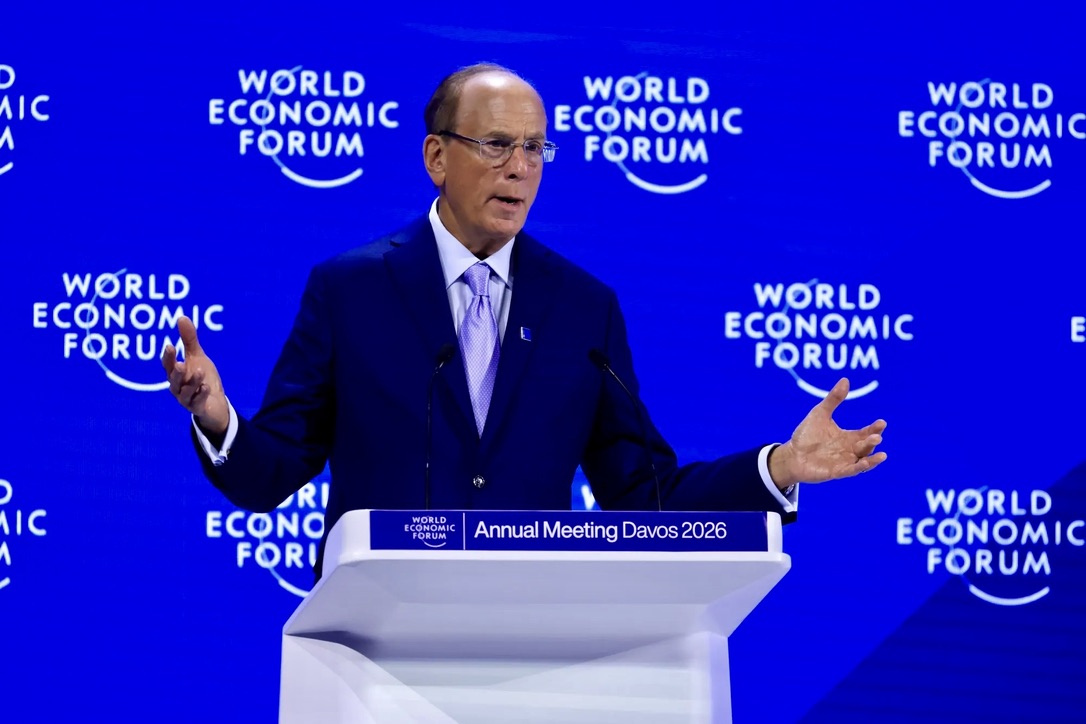
In his speech in Davos in January 2026, he did not mention climate at all, as discussions on that issue moved into the background behind AI and geopolitics.
Criticism of capitalism
In his keynote speech at the World Economic Forum in Davos on 20 January 2026, Fink sharply criticised the modern economic system. He stated that «capitalism is facing a crisis of legitimacy» because huge fortunes have gone to «too narrow a circle of people». Prosperity, he said, cannot be measured solely by GDP growth or corporate capitalisation; it must be felt by the majority of people.
He warned that artificial intelligence threatens to repeat the scenario of globalisation, where the main profits will go to technology giants, while most people will face only the threat of job losses, which will increase social stratification.
Vision of the future: infrastructure and socialism
In 2026, Fink called for not being afraid of government intervention in the economy. He believes that the «evolution of capitalism» requires large‑scale investment in infrastructure and energy, which will require joint efforts by the state and business.
His 2026 annual report is entitled «Growing with Your Country: Thoughts from a Long‑Term Optimist». In it, he urged governments to more actively attract private capital to ensure «technological sovereignty» and modernise infrastructure, which, in the view of critics, brings his position closer to the ideology of state planning prevalent in some socialist systems.