
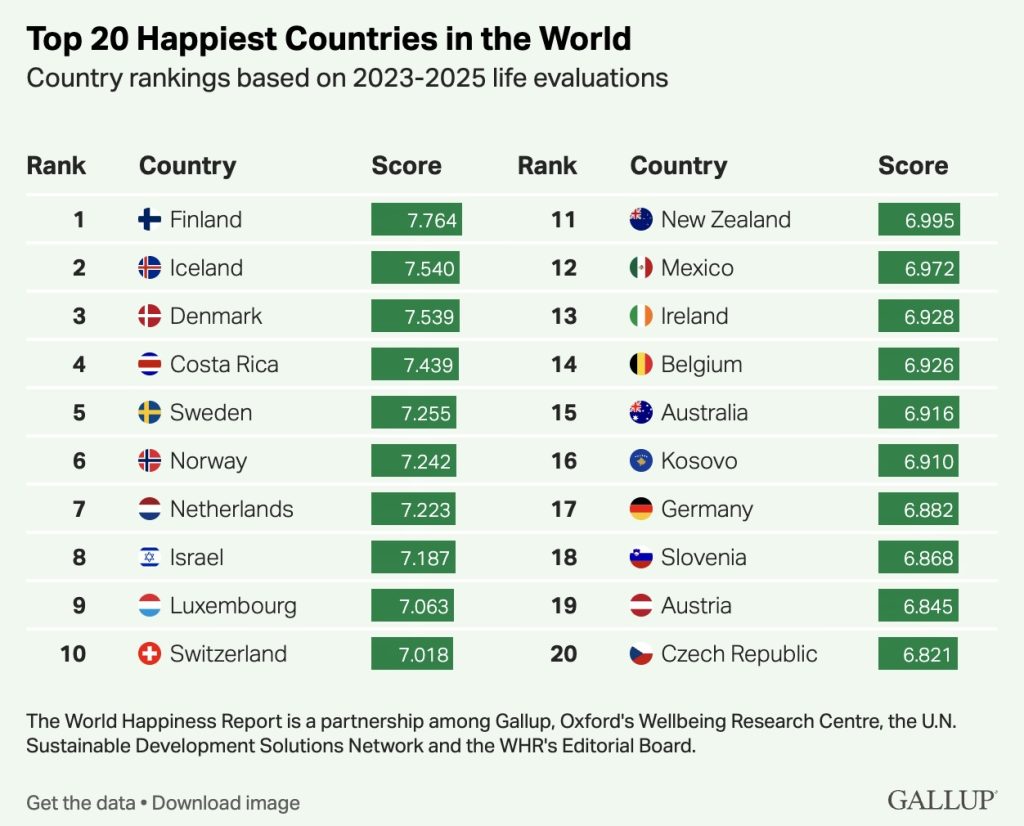
WASHINGTON (Realist English). Finland has been named the world’s happiest country for the ninth consecutive year, according to the 14th edition of the World Happiness Report, compiled from Gallup World Poll data covering more than 140 countries.
However, the rankings have undergone notable structural shifts: Costa Rica has entered the top five for the first time, and regional and generational differences have intensified.
Top 10: Scandinavian Dominance and a Latin American Breakthrough
Northern European countries traditionally lead, occupying five of the top six spots:
- Finland
- Iceland
- Denmark
- Costa Rica (first time in the top five, the highest ranking ever for a Latin American country)
- Sweden
- Norway
- Netherlands
- Israel
- Luxembourg
- Switzerland
The composition of the top ten has changed significantly compared to 2013, when all countries in it were high-income Western economies. Now there are eight of them in the top ten. Long-term trends show a gradual convergence in happiness levels between Eastern and Western Europe — Kosovo (16th), Slovenia (18th), and the Czech Republic (20th) entered the top 20.
Countries That Have Lost Ground
Some high-income countries have notably lost positions:
- Canada — from 6th to 25th place
- Austria — from 8th to 19th
- Australia — from 10th to 15th
- USA — from 17th to 23rd (mainly due to lower ratings among young people)
Where Happiness Has Increased and Where It Has Not
Comparing current life evaluations with the baseline period of 2006–2010 shows that the level of happiness has statistically significantly increased in 79 out of 136 countries (by at least 0.15 points on a 10-point scale) and significantly decreased in 41 countries (by at least 0.11 points).
The most notable growth has occurred in Central and Eastern European countries, where happiness has increased by a whole point or more over 20 years:
- Serbia
- Bulgaria
- Latvia
- Bosnia and Herzegovina
At the same time, happiness levels fell by more than one point in eight countries: Afghanistan, Malawi, Lebanon, Jordan, Venezuela, Botswana, Egypt, Yemen. Most of them are experiencing serious conflicts or instability.
Generational Divide
In most countries, young people (under 25) rate their lives higher today than 20 years ago. This trend was recorded in 85 out of 136 countries. However, there are notable exceptions to this rule:
In the so-called NANZ countries (New Zealand, Australia, Canada, USA) – as well as in Western Europe – happiness levels among young people have decreased over the same period. In the four NANZ countries, the decline averaged 0.86 points.
Overall, in eight of the ten global regions, where about 90% of the world’s population lives, young people have become happier than they were in 2006–2010.
The 14th World Happiness Report captures structural shifts: Northern Europe remains at the top, but long-term growth in Central and Eastern Europe, as well as a decline in happiness among young people in some wealthy countries, point to a changing global landscape.