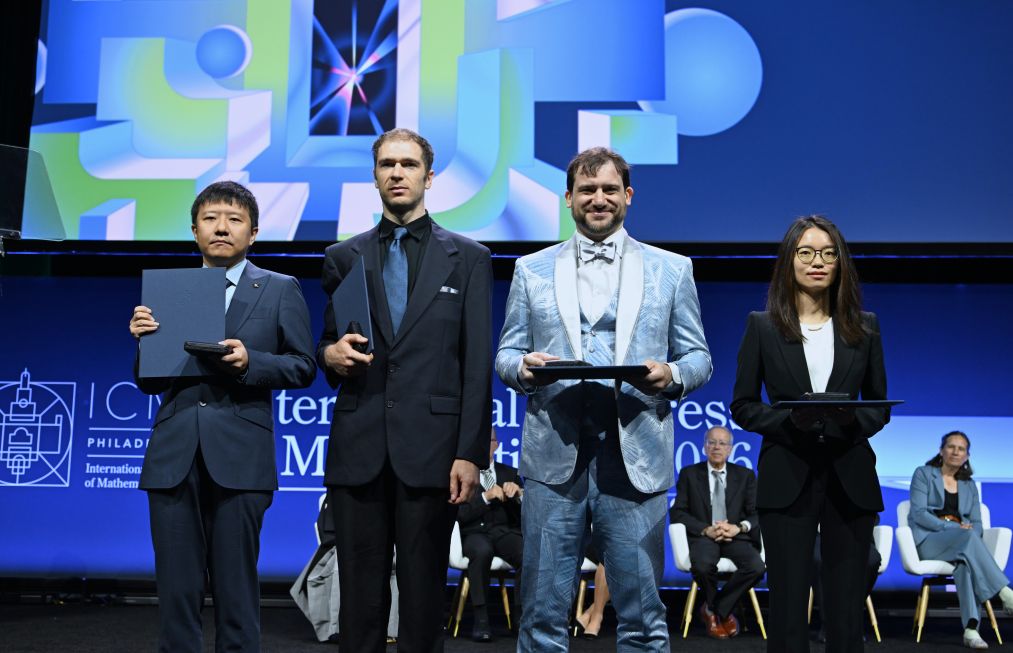
PHILADELPHIA (Realist English). On July 23, at the opening of the International Congress of Mathematicians in Philadelphia, the Fields Medal — the most prestigious award in mathematics, often called the “Nobel Prize of mathematics” — was announced. For the first time in history, its recipients were two citizens of China — Yu Deng and Hong Wang.
This event marked a historic breakthrough for Chinese science. Previously, the only ethnic Chinese Fields Medalist was Shing-Tung Yau, who received the award in 1982, but at that time he held US citizenship. Now, the names of two mathematicians born and raised in China have been inscribed on the list of laureates.
Who They Are: Peking University Graduates
Both laureates are graduates of Peking University’s class of 2007. Chinese media have dubbed them the “platinum generation” of Peking’s mathematics school, continuing the proud traditions of the “golden generation.”
Yu Deng is a 37‑year‑old professor at the University of Chicago. He earned his bachelor’s degree from Peking University, then graduated from the Massachusetts Institute of Technology (MIT), and completed his doctorate at Princeton University in 2015. He specialises in partial differential equations.
Hong Wang is a 35‑year‑old professor at France’s Institut des Hautes Études Scientifiques (IHES) and New York University’s Courant Institute. She also graduated from Peking University, earned a master’s degree from Université Paris‑Saclay, and received her doctorate from MIT in 2019. Wang became only the third woman in the 90‑year history of the award to receive this honour.
What the Prize Was Awarded For: Century‑Old Problems Solved
Both mathematicians were recognised for solving problems that had eluded scientists for over a century.
Yu Deng was honoured for his work in partial differential equations. His main achievement is the solution to Hilbert’s sixth problem, formulated by the eminent German mathematician David Hilbert in 1900. The problem was to derive the behaviour of the whole (macroscopic description of fluids) from the motion of individual particles (microscopic description). Deng, together with colleagues, rigorously proved that the chaotic motion of numerous colliding particles inevitably leads to the equations describing fluid behaviour. This allowed the reconciliation of microscopic and macroscopic physics.
Hong Wang received the prize for her work in harmonic analysis and geometric measure theory. Her main achievement is the solution to the three‑dimensional Kakeya conjecture. This problem was formulated by Japanese mathematician Soichi Kakeya in 1917: if a needle (“pencil”) is rotated in space so that it turns completely, what is the minimum area it sweeps out? Wang and her colleague Joshua Zahl analysed this problem in three‑dimensional space and published their solution in 2025.
As Fields Medalist Efim Zelmanov noted in a media comment: “A significant part of both laureates’ education was obtained in China. Their outstanding achievement is a powerful recognition of China’s fundamental and rapidly growing role in the world of mathematics.”
China’s Reaction: A National Triumph
News of the Chinese mathematicians’ victory instantly became the top topic on Chinese social media. Hashtags such as “Fields Medal” and “First Chinese Fields Medalists” gathered millions of views across platforms from Weibo to Xiaohongshu (RED).
Chinese state media — Xinhua, People’s Daily, CCTV, and others — devoted extensive coverage to the event, describing not only the scientific achievements but also the educational trajectories, personal interests, and the significance of this breakthrough for the country.
Academician Liu Ruozhuang of the Chinese Academy of Sciences, who personally attended the ceremony in Philadelphia, called the event “a dream that the Chinese mathematics community had hoped to realise for decades.”
As Yu Deng himself said after the ceremony: “It is a great honour for me to see my name on the list of the greatest mathematicians I have always admired.” Wang Hong, in turn, recalled learning about Terence Tao’s Fields Medal when she was still a schoolgirl: “I was very excited then. And today I am excited too.”
Alongside Deng and Wang, the prize was also awarded to American mathematician John Pardon (Stony Brook University) and Canadian mathematician Jacob Zymmerman (University of Toronto). Each laureate received a cash prize of 15,000 Canadian dollars.
The Fields Medal is awarded once every four years to young mathematicians (under 40) for outstanding achievements. For China, the victory of Deng and Wang was not merely a scientific triumph but a symbol of the international scientific community’s recognition of the rapid growth of China’s fundamental science and education system.