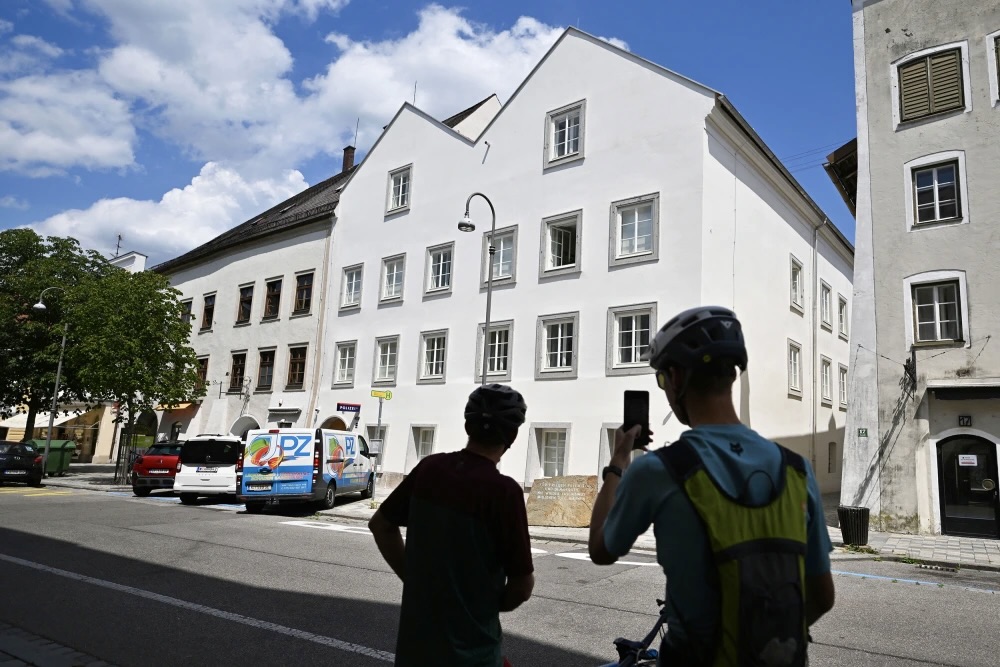
BRAUNAU AM INN (Realist English). The building in the Austrian town of Braunau am Inn where Adolf Hitler was born on April 20, 1889, officially opened as a police station on July 22, 2026.
Authorities hope this will put an end to years of debate over the building’s fate and strip it of its appeal as a pilgrimage site for neo-Nazis.
History of the Building and Years of Controversy
The building at Salzburger Vorstadt No. 15, where Hitler lived for only a few weeks after his birth, was a headache for Austrian authorities for decades. After World War II, the building passed into private ownership of the Pommer family.
From the 1970s, the government leased it in an attempt to prevent its use by far-right groups, and it later housed the charity Lebenshilfe, which supported people with disabilities.
However, in 2011, owner Gerlinde Pommer blocked renovation work, causing tenants to move out and the building to stand empty. She refused to sell the building to the state, leading to lengthy legal battles.
In 2016, the Austrian parliament passed a law allowing the government to compulsorily purchase the building, and in 2017 it passed into state ownership.
Transformation into a Police Station
In 2019, the government announced plans to turn the building into a police station. A competition was held among architects from across Europe. Some €20 million (approximately £17 million) was spent on the renovation.
During the refurbishment, the building, which had previously had a yellow facade, was repainted white. The only inscription on the facade now reads “Police.”
The old spiral staircase and arched entrance hall were preserved. Inside, the building now houses staff from the district police command and police inspectorate.
A memorial stone from the Mauthausen concentration camp, placed earlier on the pavement in front of the building, remains in place with the inscription: “For peace, freedom, and democracy. Never again fascism. Millions of dead serve as a warning.”
Purpose and Public Reaction
At the opening ceremony, Austrian Interior Minister Gerhard Karner said the country was accepting “responsibility” for the “terrible legacy” of the past. According to him, “this house will now become a place of democracy, the rule of law, security, freedom, and human dignity.”
Stefan Mölzoch, head of the Interior Ministry’s history department, explained that “the goal was to prevent any associations with Adolf Hitler by stripping the building of that mystical aura.”
Braunau am Inn Mayor Johannes Waidbacher said that, in his view, the town’s residents had largely “accepted this and can live with it.”
However, the project also drew criticism. The Mauthausen Committee — Austria’s main Holocaust survivors’ group — opposed the decision, arguing that a police station was inappropriate for the site and that more should be done to draw attention to Hitler’s crimes.
Robert Eiter of the Mauthausen Committee said: “Every year at the Mauthausen concentration camp memorial, a ceremony is held where they say, ‘Never again.’ In Braunau, they say, ‘Let’s forget as quickly as possible.'”
Authorities hope that the constant police presence will make the building unattractive to neo-Nazis, who previously brought flowers and wreaths, photographed themselves in front of the house, and even took cobblestones from the pavement as souvenirs. In 2024, four Germans were detained for placing white roses in the window and posing with Nazi salutes.
As Interior Ministry history department head Stefan Mölzoch noted, under the Nazis the building housed a museum dedicated to the Führer cult — now it is to serve as a symbol of the rule of law. However, some historians doubt that a change of signage alone can fully “neutralise” the site.