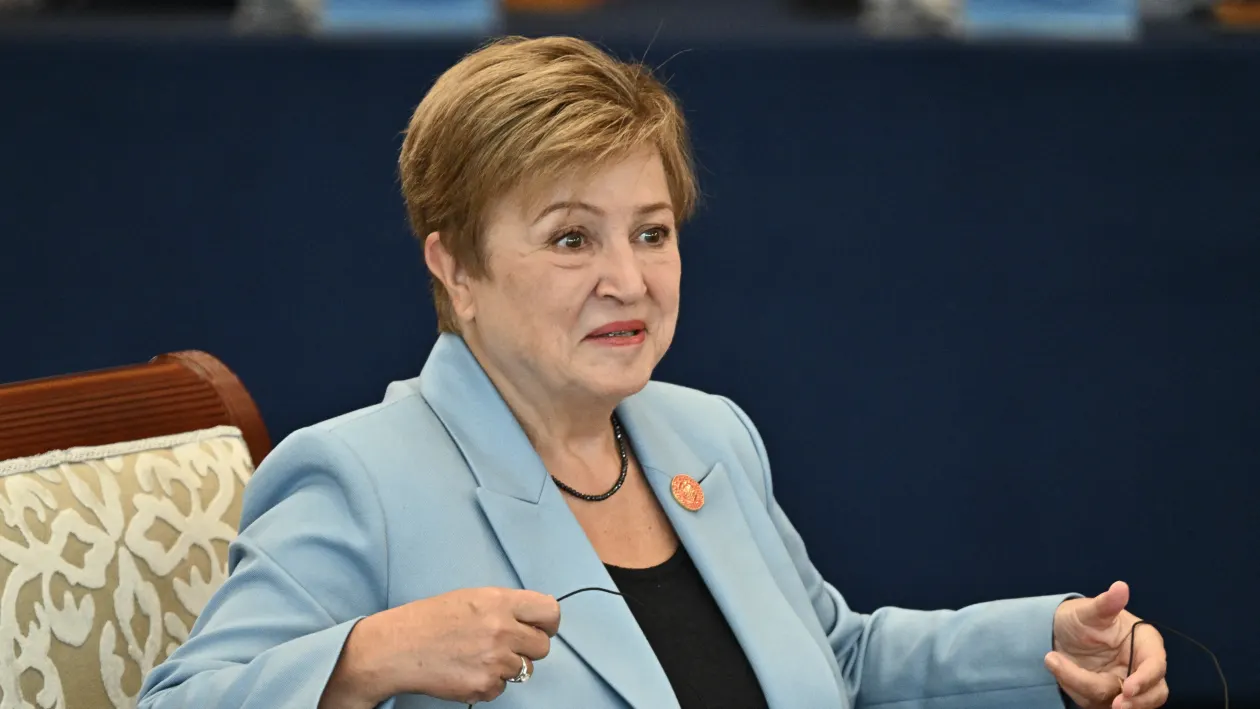
BEIJING (Realist English). China must “accelerate” its transition away from export-driven growth and strengthen support for domestic consumption, or risk deepening global trade frictions, International Monetary Fund Managing Director Kristalina Georgieva said on Wednesday.
“As the second-largest economy in the world, China is simply too big to generate much more growth from exports,” she told reporters. Continuing to rely on export-led expansion, she warned, risks “furthering global trade tensions.”
Georgieva said a faster rebalancing toward consumption would benefit both China and the global economy — and help prevent other countries from taking restrictive measures against Chinese exports. Her remarks come amid rising trade strains with the United States, growing EU scrutiny of Chinese industrial goods, and concerns in Mexico and elsewhere over soaring imports of Chinese vehicles. Beijing’s trade surplus exceeded $1 trillion in the 12 months to November.
Despite this surplus, China’s consumer spending remains subdued, weighed down by a prolonged housing slump and weak household confidence.
Property crisis requires decisive action
The IMF estimates Beijing would need to deploy roughly 5% of GDP over the next three years to “resolutely” address problems in the property sector. Georgieva said the solution lies in tighter fiscal and industrial-policy management, faster completion of pre-sold but unfinished homes, and a willingness to let insolvent developers exit the market.
“We call them zombie firms. Well, let the zombies go away,” she said.
Boosting consumption through social support
IMF analysis suggests that increasing social-spending programmes — particularly in rural regions — could lift consumption by up to 3 percentage points of GDP in the medium term.
Georgieva urged a greater role for market forces, including in high-tech development and in determining the value of the yuan. “What we want to see is a market-based RMB exchange rate that reflects fundamentals,” she said.
The IMF noted that China’s ultra-low inflation compared with trading partners has led to a real exchange-rate depreciation, reinforcing the country’s export strength and widening its current account surplus.
IMF upgrades China’s growth outlook
The fund raised its forecast for China’s 2026 growth to 4.5%, up 0.3 percentage points from October, citing domestic stimulus and lower-than-expected tariffs. Its 2025 forecast was also revised upward to 5%. Inflation is expected to rise modestly to 0.8% next year from near zero in 2025.
Beijing reported 0.7% CPI inflation in November, the highest in nearly two years.
Even with the improved outlook, the IMF said China’s shift toward a consumption-driven model “requires more urgent and forceful” policy support. Chinese leaders are expected to outline next year’s economic priorities at their annual Central Economic Work Conference later this week.
High-level consultations
Georgieva and an IMF delegation concluded a 10-day Article IV mission to Beijing and Shanghai, holding discussions with senior officials including Premier Li Qiang, Vice Premier He Lifeng, central bank governor Pan Gongsheng, Finance Minister Lan Fo’an, and Commerce Minister Wang Wentao.
Georgieva also joined a separate meeting with Li and the heads of nine major international economic organisations, during which the premier voiced confidence in achieving China’s 2025 economic targets and called for deeper cooperation.