

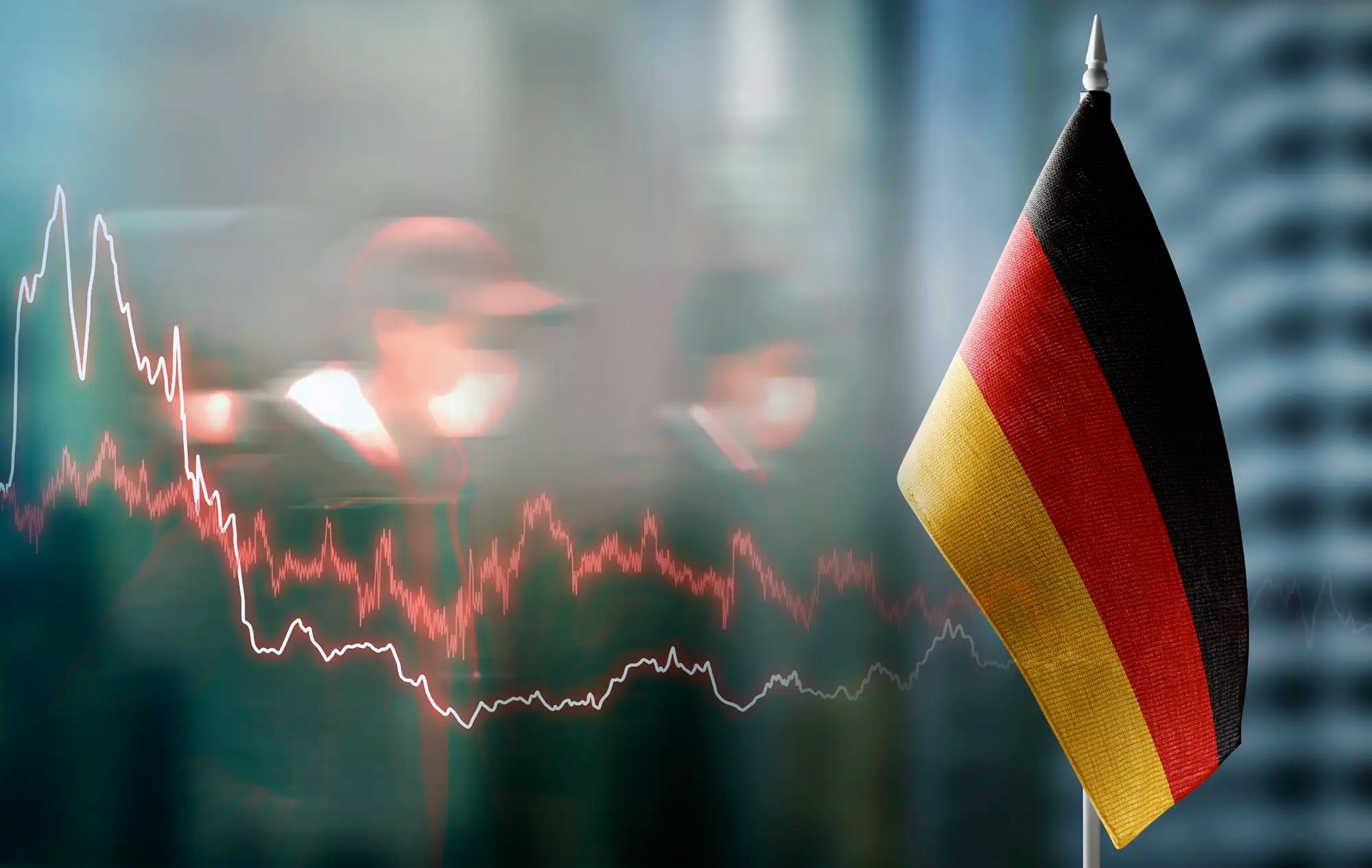
BERLIN (Realist English). The impact of the US war against Iran on energy markets is destroying hopes of a German recovery. According to sources familiar with the matter, the German government is ready to cut its growth forecast from 1% to 0.5% this year.
Such a downgrade would leave Europe’s largest economy on the brink of a fourth consecutive year of effective stagnation, as the surge in energy prices cancels out the effect of a €1 trillion spending impulse financed through new debt.
“The economic development in Germany lost noticeable momentum in the first quarter against the backdrop of the conflict in the Middle East,” the German economy ministry warned earlier this week (April 15–16, 2026).
The modest growth forecast this year will be driven mainly by “the impulse from public spending,” while private investment, exports and domestic consumption stagnate, a government insider said.
‘Difficult economic situation’
On April 13, Chancellor Friedrich Merz warned that the economy would feel the impact of the US war against Iran “for a long time to come.” He also announced a €1.6 billion package of short-term measures to ease rising fuel prices.
“We find ourselves in a very difficult economic and political situation given the large number of crises and wars around the world,” Merz said.
Commerzbank chief economist Jörg Krämer told the Financial Times that it was “increasingly likely” that 2026 “will be another lost year in terms of growth.”
Adjusted for the higher number of working days this year, his updated forecast stands at just 0.3% (in 2025, on a working-day adjusted basis, it was 0.4%).
“This is basically a black zero,” Krämer said.
Although 2025 marked the first increase in GDP since 2022, the level of economic activity was still below the 2022 level and barely higher than before the start of the Covid-19 pandemic in early 2020.
‘Stagnation is the new normal’
“Stagnation is the new normal,” said Clemens Fuest, head of the Munich-based Ifo Institute. “We have long been used to the expectation that growth will resume at some point, but unfortunately this can no longer be taken for granted.”
Fuest noted that rising energy costs exacerbate deep-rooted problems, including a shrinking workforce, limited productivity growth and ballooning bureaucracy.
Government insiders have voiced concern, and in some cases a sense of helplessness, over external shocks – first US tariffs, now high energy prices – which repeatedly derail plans to revive growth and complicate difficult welfare state reforms.
One insider said the problem was not just persistent uncertainty but also the sheer unpredictability of global events. This is weighing on private investment decisions and consumer sentiment, they added, with inflation at least temporarily likely to rise above the ECB’s medium-term target of 2%.
€1 trillion stimulus does not save the day
Before the Iran war began, economists had hoped that Merz’s €1 trillion spending push over the next decade – to improve Germany’s armed forces and its ailing infrastructure – would kick-start a broad recovery.
However, Goldman Sachs economists estimate that the increase in government spending will add just 0.5 percentage points to GDP this year.
The sharp rise in energy prices and economic uncertainty since the start of the war in late February hit an economy that was still reeling from the 2022 shock following the start of the special military operation in Ukraine, Fuest noted. “Germany’s energy-intensive industry is still weakened by the earlier strains,” he said.
Chemical industry collapses to 2004 levels
Production in the chemical and pharmaceutical industry – one of the backbones of German industry – has fallen to levels last seen in late 2004 and has been sidelined for the past three years, according to Bundesbank data.
“The situation is serious, and it has not improved since the beginning of the war in the Middle East,” Henrik Meincke, chief economist of the German Chemical Industry Association, told the Financial Times. “Companies are already closing production sites as they are struggling with low capacity utilisation and high margin pressure.”
Bankruptcies at 20-year high
In the first quarter of 2026, the number of bankruptcies in Germany jumped to the highest level in more than 20 years, exceeding the levels seen during the 2009 global financial crisis. On a seasonally adjusted basis, the number of unemployed has risen in 41 of the last 46 months and is now 30% higher than before the start of the pandemic in early 2020.
Not everyone has given up hope
Not all economists have written off 2026 completely.
“If the government is able to deliver its fiscal package, the stimulus will be so big that it will be reflected in higher consumption and employment,” said Christian Schulz, chief economist of Allianz Global Investors.
Additional statistics
In January 2026, industrial production fell by 0.5% compared with December and by 1.2% year-on-year. The largest declines were recorded in energy-intensive sectors: production of metal goods, pharmaceuticals, computers and optics fell by 7–12%.
Germany’s leading economic institutes (DIW Berlin, Ifo, Kiel Institute, IWH, RWI) in their joint spring 2026 forecast more than halved their GDP growth estimate – from September’s 1.3–1.4% to 0.6% in 2026. The forecast for 2027 was also lowered from 1.4% to 0.9%.
The German government, for its part, expects growth of just 0.5% in 2026 (down from 1% previously). According to the Bundesbank’s estimate, real GDP likely stagnated in the first quarter of 2026 on a seasonally adjusted basis.
The German Chamber of Commerce and Industry (DIHK) had earlier expected GDP to fall by 0.3% in 2026, indicating no signs of recovery. Commerzbank estimates growth adjusted for working days at just 0.3% – a “black zero,” in the words of chief economist Jörg Krämer.
The key driver of inflation is energy: energy prices rose by 7.2% year-on-year – the first increase since December 2023. According to Eurostat, energy prices in the eurozone as a whole rose by 4.9% after falling by 3.1% the previous month. Brent crude has exceeded $112 per barrel, while gas prices in the EU have almost doubled since the start of the conflict.