
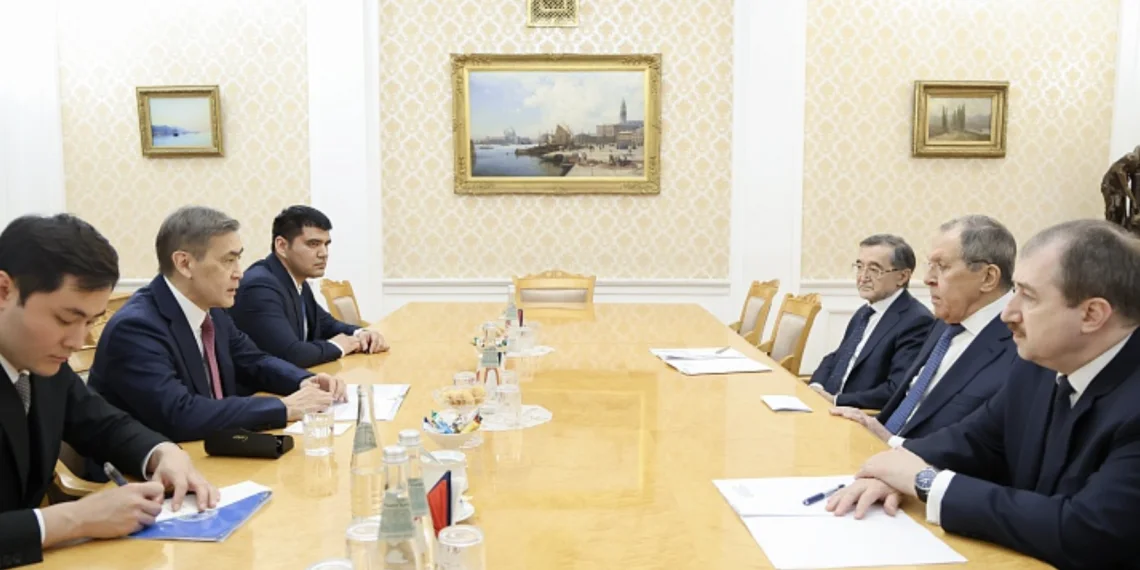
MOSCOW (Realist English). Russian Foreign Minister Sergey Lavrov held talks with Shanghai Cooperation Organisation (SCO) Secretary-General Nurlan Yermekbayev, stressing the need to strengthen the bloc’s role amid rising geopolitical tensions.
Lavrov described the meeting as timely, noting that the SCO marks an anniversary this year. He said the priority is not only to organise events around the milestone, but also to implement key agreements already approved by member states and reflect them in the organisation’s legal framework.
He reaffirmed Moscow’s support for the SCO Secretariat in executing decisions adopted at the highest level.
Lavrov also addressed the broader international context, arguing that global instability is testing both states and multilateral institutions. “The SCO looks достойно in this turbulent ocean,” he said, adding that Russia would oppose attempts to weaken the organisation’s influence in Eurasian affairs.
According to the Russian minister, external powers have intensified their engagement in Central Asia and across Eurasia, while Western institutions such as NATO and the European Union are experiencing internal strains. He suggested that some Western countries are attempting to project their crises onto non-Western organisations.
Lavrov highlighted what he described as the SCO’s “unique position”, combining security, economic and infrastructure cooperation within a single framework. He pointed to projects in logistics, trade and regional connectivity, including the concept of a Greater Eurasian Partnership, as areas where the organisation could expand its influence.
The talks come as the SCO faces growing pressure from overlapping conflicts involving its members. The organisation has already responded to the escalation in the Middle East. In a statement issued on March 2, member states expressed concern over military strikes on Iran and called for a peaceful resolution through dialogue, while urging the United Nations to act to preserve international security.
Russia has taken a cautious diplomatic stance on the Iran conflict. Security Council Secretary Sergei Shoigu said Moscow remains in contact with Gulf countries and is proposing diplomatic solutions. At the UN Security Council, Russia and China abstained from a vote condemning Iran’s actions, while a Russian draft resolution calling for de-escalation without assigning blame was blocked by the United States.
China, another key SCO member, has combined diplomatic backing for Tehran with economic support, while avoiding direct military involvement. India has also endorsed de-escalation efforts through platforms such as the SCO and BRICS.
Other regional actors have signalled willingness to mediate. Pakistan has offered to host talks between Washington and Tehran, while Kazakhstan has maintained neutrality and proposed its territory as a venue for negotiations.
At the UN Security Council, Russia, China and France reportedly blocked a resolution that would have authorised the use of force to reopen the Strait of Hormuz, underlining divisions among major powers over how to respond to the crisis.
At the same time, internal challenges within the SCO are becoming more pronounced. Experts note that several member states are directly involved in ongoing conflicts, including Russia and Belarus in Ukraine-related tensions, Iran in confrontation with the United States and Israel, and Pakistan in regional disputes.
The convergence of these conflicts is testing the SCO’s ability to function as a platform for collective security.
The organisation’s future role will depend on whether it can translate political coordination into concrete mechanisms for crisis management — or remain a forum for dialogue amid an increasingly fragmented international order.