
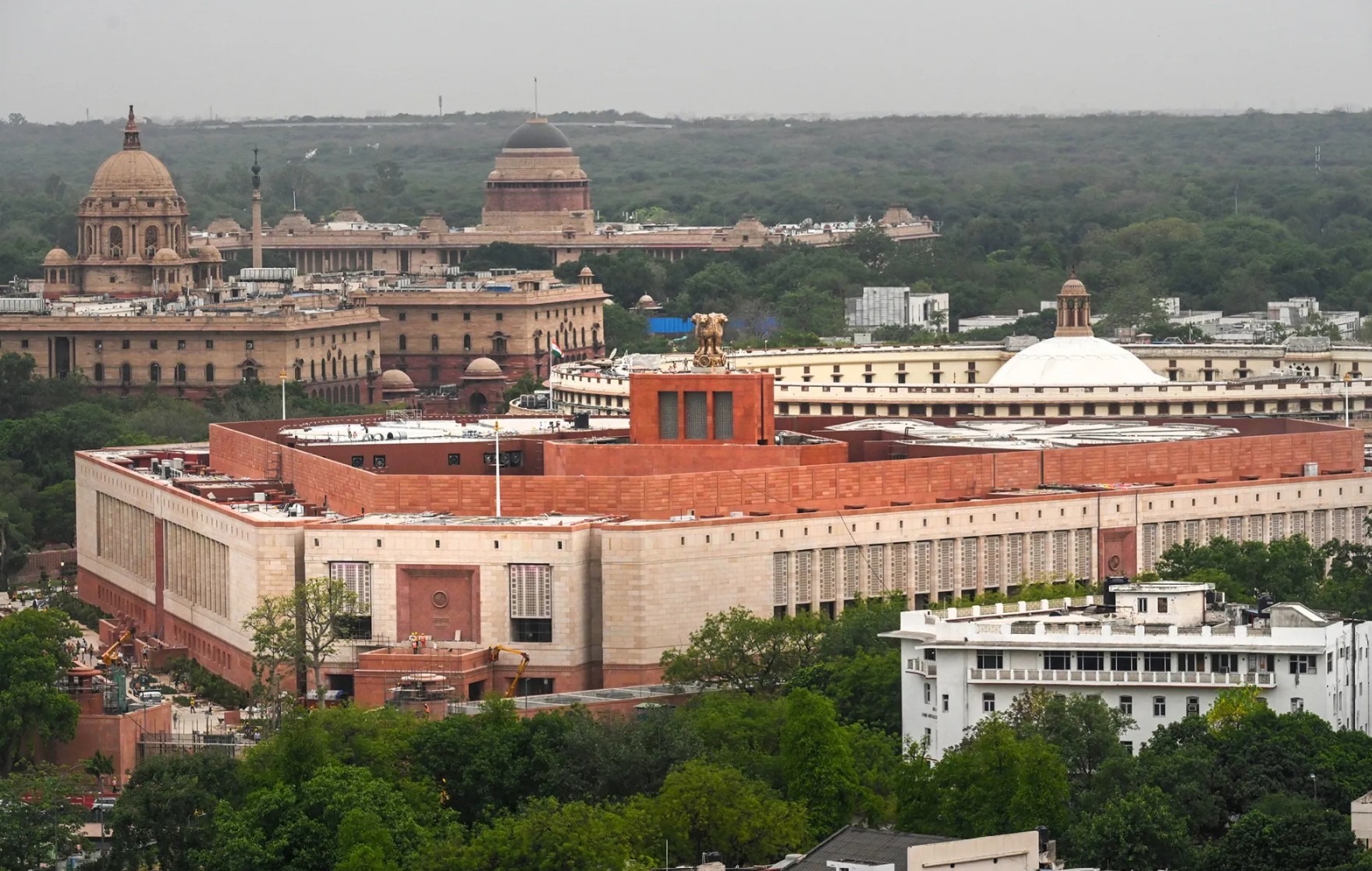
NEW DELHI (Realist English). The government of Narendra Modi is preparing to reintroduce a constitutional amendment that would increase the Lok Sabha (lower house of parliament) from 543 to 850 seats and simultaneously launch a mechanism for a 33% quota for women. After the vote failed in April, the cabinet is counting on a shift in the positions of regional parties and hopes to cross the 361-vote threshold with a minimal margin of 15–18 votes.
A package of three bills: expansion, delimitation and quota
The proposed legislative package includes three interrelated documents. The constitutional amendment (131st) increases the number of seats in the Lok Sabha from 543 to 850 (815 from states, 35 from union territories) and unblocks delimitation based on 2011 census data rather than waiting for the post-2026 census. The delimitation law creates a commission headed by a Supreme Court judge to redistribute seats and redraw constituency boundaries. Amendments to union territory laws extend the 33% women’s quota to the legislative assemblies of Delhi, Jammu and Kashmir, and Puducherry.
The main political calculation: the Women’s Reservation Act 2023 was passed, but its entry into force was tied to “census and delimitation,” which effectively postponed it until 2031 or later. The government is now trying to “unfreeze” delimitation based on 2011 data so that the quota can actually take effect by the 2029 general elections.
The April arithmetic: why it failed and what has changed
On April 17, during the vote on the constitutional amendment, 298 votes were cast “for” and 230 “against.” A constitutional amendment requires two-thirds of the votes of members present and voting, with the total number of voters being no less than 361. The government fell 54 votes short.
The ruling National Democratic Alliance (NDA) holds 298 seats. The situation could change in the following ways: 20 rebel Trinamool Congress MPs and 1 Akali Dal MP give about 319 votes; with the support of the DMK (22 seats), the NCP (Sharad Pawar, 8 seats) and the YSRCP (4 seats) — up to 353.
Key compromise: the government proposes a “50% increase in seats for each state” instead of redistribution based solely on population. This is an attempt to reassure southern states, especially Tamil Nadu, which fear that delimitation by population would give more seats to northern states and reduce the influence of the south. The NCP (Sharad Pawar) has signaled that it may support the bill on condition of a “uniform 50% increase.”
Opposition position: quota supported, delimitation rejected
The opposition “INDIA” bloc (about 180 seats) takes the position of supporting the women’s quota while resolutely opposing the “linking of delimitation to the quota.”
The Congress and other parties accuse the government of using the quota as a “smokescreen” to advance delimitation, which would change the distribution of power between north and south. Sonia Gandhi stated directly: “The issue is delimitation, not women’s reservation — that is the real problem.” The government, in turn, insists that without an increase in the number of seats, implementation of the quota would lead to the “recall” of existing seats from male MPs, which would provoke stronger resistance.
Electoral calculation: women voters and the 2029 elections
The urgency with which the government is pushing this issue is closely tied to electoral considerations. In the 2024 general elections, women’s turnout (65.8%) exceeded men’s (65.6%) for the first time.
An increase in the number of seats means more free seats for nominating women candidates without the need to “recall” seats from incumbent male MPs. Schemes targeting women beneficiaries (Ujjwala, Lakhpati Didi and others) have already given Modi an advantage among women voters in some states. The NDA is in power for a third term and faces pressure from voter fatigue; the women’s quota is a highly recognizable political narrative.
Procedural window: a session can be convened at any time
The summer session of parliament was adjourned on August 13 but was not formally closed by presidential decree. More than 90 days have now passed without dissolution (the previous record was 87 days in 2008). This means the government can resume the session by giving just 2 days’ notice, instead of 14 days for a new session. The Congress criticized this as “delaying dissolution to wrangle votes.”
The Modi government views the women’s quota as a political lever to overcome the “ceiling” of 361 votes. The “50% for each state” strategy is aimed at splitting the opposition, particularly at attracting the NCP (Sharad Pawar) and the DMK.
However, a fundamental contradiction remains: the quota is consensus, delimitation is conflict. If the government fails to convince enough southern parties that “expansion does not mean reduction,” the bill could fail again. The next key window is the moment the government officially announces the convening of a special session.