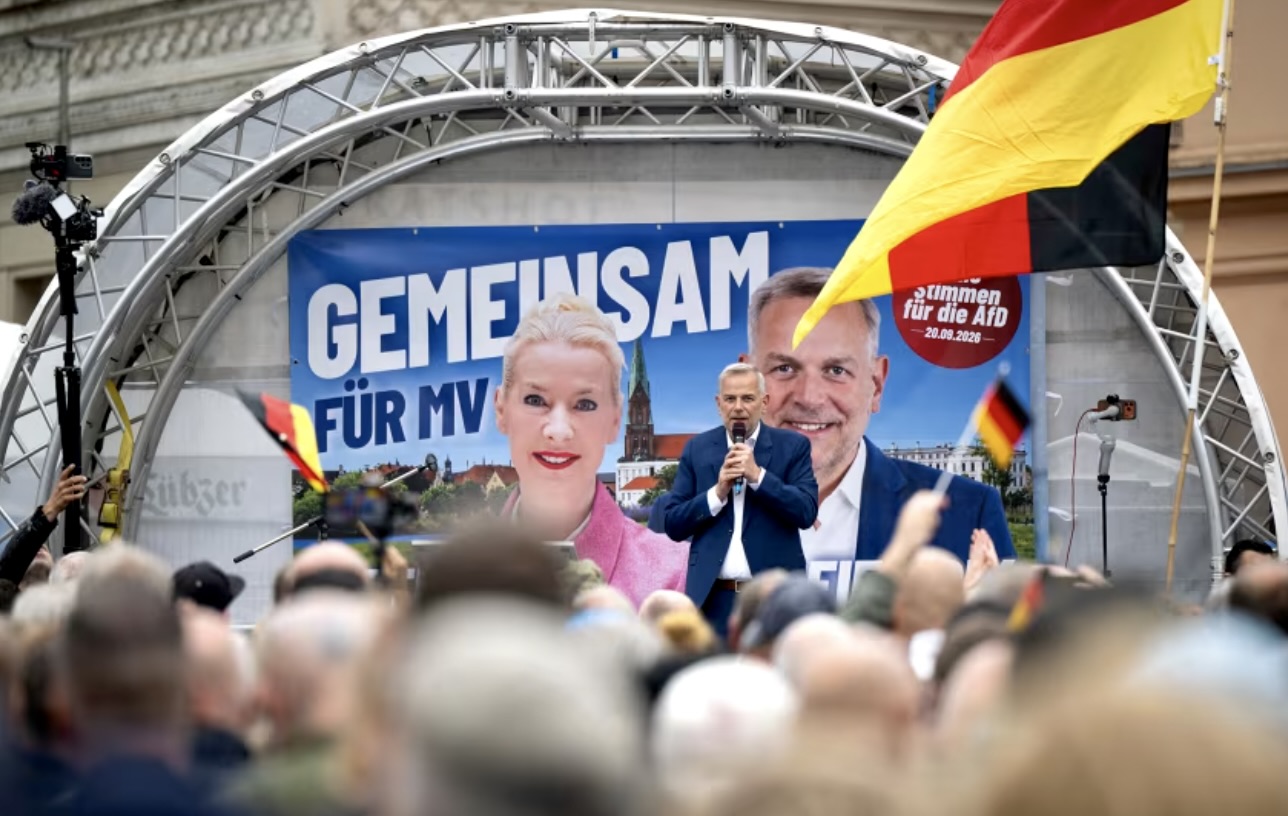
BERLIN (Realist English). The historic success of the Alternative for Germany (AfD) in the regional elections in Saxony-Anhalt, where the party won 43.8% of the vote, resulted not in the consolidation of European right-wing forces, but in a deepening split among them.
As CNN notes, the AfD victory was enthusiastically welcomed only by part of the European right-wing spectrum — Geert Wilders of the Dutch Party for Freedom, Viktor Orbán of Hungary’s Fidesz, and Santiago Abascal of Spain’s Vox.
The leading right-wing parties of France, Italy, and the United Kingdom preferred not to publicly support their German colleagues.
Reasons for Isolation: The Nazi Past and the ‘Russian Factor’
The break between the AfD and France’s National Rally (RN) occurred back in May 2024 after scandalous statements by then-leading AfD candidate Maximilian Krah about the Waffen-SS. “Among the 900,000 SS men there was a high percentage of criminals, but not all of them were,” he said, which provoked a sharp reaction in Paris.
Marine Le Pen reacted unequivocally at the time: “The AfD goes from provocation to provocation. It is no longer time to distance ourselves. It is time to formalize the break.” Since then, the RN has consistently refused to resume cooperation, seeking to present itself as a force that can be entrusted with power ahead of the 2027 presidential elections.
The second factor is the AfD’s position on Russia. The German party opposes arms supplies to Ukraine and supports lifting sanctions on Moscow, which repels those European right-wing forces that either remain committed to the transatlantic course (such as Giorgia Meloni’s Brothers of Italy) or consider such sympathies politically toxic (such as Nigel Farage of Britain’s Reform Party). Meloni directly called disagreements with the AfD “irreconcilable.”
Who Remains an Ally: From Orbán to Trump
The circle of AfD partners is narrowing. In the European Parliament, the party leads the Europe of Sovereign Nations (ESN) group — the smallest and most radical, which also includes Éric Zemmour’s French Reconquête, Bulgaria’s Revival, and Slovakia’s Republican Movement. In July, the European Parliament initiated an investigation to determine whether the ESN complies with the fundamental values of the EU.
In addition, the AfD maintains close ties with Donald Trump and receives public support from Elon Musk. Viktor Orbán also remains one of the few European leaders openly supporting the German right: Alice Weidel visited Budapest in February 2026, which was supposed to symbolize “the AfD’s exit from political isolation.”
However, this support does not compensate for the break with key players. The German right remains isolated amid the fact that, according to El País, far-right parties are already part of governments in six EU countries and lead in polls in four, including Germany.
Italy: The Exception That Proves the Rule
The only notable exception to the trend of isolation was the AfD’s partnership with the Italian party Future Nazionale, whose leader Roberto Vannacci held a joint rally with AfD representative Marc Jongen in the city of Orvieto on September 20.
Vannacci, a retired general, introduced Jongen with the words: “‘Alarm! Alarm!’ everyone was saying, but as you can see, he has no shaved head or tattoos… He is an outstanding professor of philosophy with a brilliant career.” Jongen, in turn, stated: “Italy and Germany must learn to walk hand in hand without dissolving into the anonymous entity of the EU.”
However, Future Nazionale is a party positioned to the right of Meloni’s coalition, not part of it. This cooperation rather emphasizes the AfD’s isolation from mainstream right-wing forces than overcomes it.
Distance or Engage?
Within the European right-wing camp, a subtle but fundamental disagreement remains. For the RN and Brothers of Italy, distancing from the AfD is not a moral choice but an electoral strategy: they seek to leave political marginality and position themselves as “parties of government.”
For the AfD, by contrast, radicalization is a way to mobilize its core electorate. Grégoire Rou of Chatham House notes that the AfD “has not shed its radical factions” the way the RN is trying to do. This asymmetry of strategies makes rapprochement unlikely in the foreseeable future.
The AfD’s success in eastern Germany has exposed a paradox: the stronger the party becomes inside the country, the deeper its isolation abroad. European right-wing forces are not prepared to pay the price of solidarity with a force whose historical baggage and pro-Kremlin vector threaten their own electoral prospects.
For the AfD, this means that growing popularity does not convert into international influence — at least for now. What will happen first: will the AfD soften its positions for the sake of allies, or will allies change their attitude toward it under pressure from their own voters? For now, the balance of forces favors the former.