Realist: news and analytics

Русский / English / العربية

  • News
  • Russia
  • Caucasus
  • Opinion
  • Interviews
  • Experts
No Result
View All Result
Realist: news and analytics
  • News
  • Russia
  • Caucasus
  • Opinion
  • Interviews
  • Experts
No Result
View All Result
Realist: news and analytics

Munich Security Conference opens amid warnings of a weakening global order

MSC report says alliances are under strain as leaders confront rising geopolitical pressure and eroding trust.

   
February 10, 2026, 07:52
Security & Defense
Taiwan rejects US push to relocate semiconductor supply chain

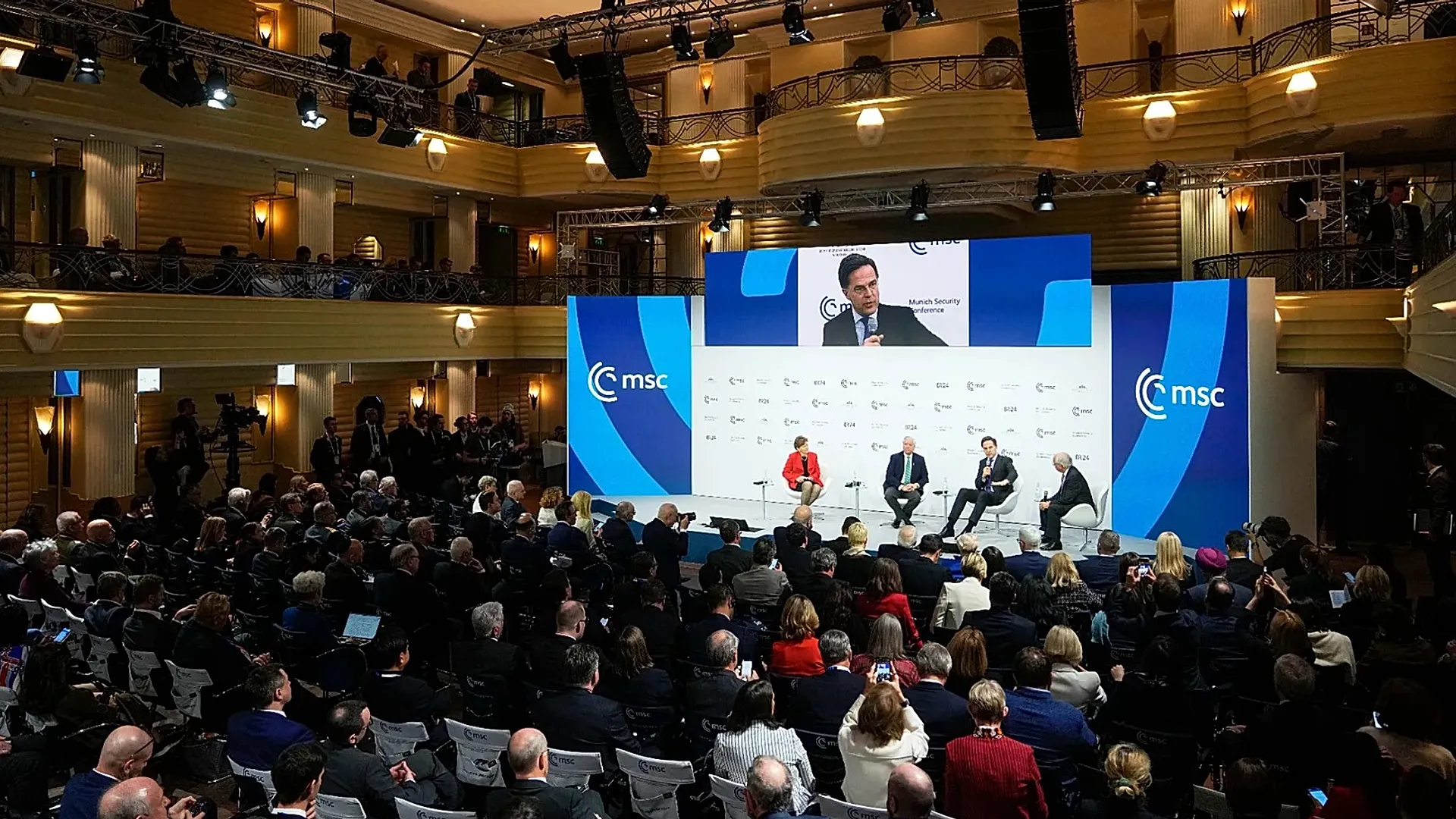
MUNICH (Realist English). World leaders gathering this week at the Munich Security Conference are being met with a stark warning: the international order is under growing strain, alliances are becoming more fragile, and geopolitical tensions are accelerating.

The conference, taking place from 13 to 15 February, is expected to bring together around 65 heads of state and government, along with some 450 representatives from politics, academia and the defence industry. In the foreword to the newly released 2026 Munich Security Report, MSC chair Wolfgang Ischinger writes that “rarely in the conference’s recent history have there been so many fundamental questions on the table at the same time”.

The report argues that the world has entered what it describes as an era of “wrecking-ball politics”, marked by far-reaching political, economic and security upheaval. It warns that incremental reforms are increasingly being replaced by radical approaches that openly challenge — or seek to dismantle — existing systems.

A central focus of the report is the United States, which it portrays as both a historic architect of the post-war international order and, increasingly, a driver of its transformation. More than eight decades after that order was established, the report says, it is now “under destruction”, as Washington reassesses its approach to international institutions, rules-based trade and long-standing alliances.

Europe is depicted as particularly exposed to this shift. Long reliant on US security guarantees, European states now experience the transatlantic relationship as unstable, oscillating between “reassurance, conditionality and coercion”. The report argues that while American engagement remains vital, it can no longer be taken for granted.

US Secretary of State Marco Rubio is expected to attend the conference, while the participation of Vice President J.D. Vance was initially announced before being cancelled. Vance’s speech at last year’s conference, widely described as a “reckoning with Europe”, drew sharp criticism from several European leaders.

Germany’s delegation will be led by Chancellor Friedrich Merz, with NATO Secretary General Mark Rutte and European Central Bank President Christine Lagarde also expected to attend. US officials have rejected the report’s suggestion that Washington is undermining alliances, insisting instead that the US is seeking to strengthen NATO while pressing European allies to raise defence spending.

Beyond geopolitics, the report highlights a growing erosion of trust in political systems, particularly in Western democracies. It argues that many voters increasingly see political leaders as defenders of an unresponsive status quo, fuelling support for more radical, confrontational movements. This dynamic, the report suggests, is reshaping domestic politics across Europe and beyond.

The analysis also covers Russia’s war on Ukraine, hybrid threats to Europe, and rising uncertainty in the Indo-Pacific, where doubts are growing about long-term US commitments amid China’s expanding influence. At the same time, the report notes that the current disruption may open space for overdue changes, including higher European defence spending and new partnerships in trade, security and technology.

Whether these shifts will ultimately produce a more stable international system remains unclear. As leaders convene in Munich, the report concludes, many fear that a looser global order could end up favouring the largest and most powerful states — leaving smaller countries more exposed in an increasingly contested world.
Europe
Previous Post

Taiwan rejects US push to relocate semiconductor supply chain

Next Post

UN awaits details on US payment of nearly $4bn in overdue dues

Related Posts

NATO chief says US leadership made alliance stronger
Security & Defense

NATO chief says US leadership made alliance stronger

27 March, 2026
Experts doubt China will join US nuclear talks soon
Security & Defense

Experts doubt China will join US nuclear talks soon

25 March, 2026
Actor and martial artist Chuck Norris dies aged 86
Security & Defense

Taiwan fears US weapons use in Iran could aid China

21 March, 2026
Putin calls Crimea reunification a historic choice
Security & Defense

China mass-produces chip-scale atomic clock for military use

19 March, 2026
US sees Chinese projects in Latin America as potential military assets
Security & Defense

US sees Chinese projects in Latin America as potential military assets

18 March, 2026
Trump warns NATO over Hormuz as Iran war enters day 18
Security & Defense

Trump warns NATO over Hormuz as Iran war enters day 18

18 March, 2026
Most Popular
Most Popular
Europe loses LNG cargoes to Asia amid Middle East war

Iran rejects US ceasefire plan, outlines five conditions

26 March, 2026

TEHRAN (Realist English). Iran has rejected a U.S. proposal aimed at ending the ongoing conflict, insisting that any ceasefire will...

Iran war exposes global reliance on fragile energy routes

Iran war exposes global reliance on fragile energy routes

23 March, 2026

LONDON (Realist English). The war involving Iran has exposed the global economy’s dependence on vulnerable fossil fuel supply routes, intensifying...

Actor and martial artist Chuck Norris dies aged 86

Taiwan fears US weapons use in Iran could aid China

21 March, 2026

TAIPEI (Realist English). Taiwan has raised concerns that extensive US use of long-range cruise missiles in the war involving Iran...

Strait of Hormuz disruption sends shockwaves through global trade

Strait of Hormuz disruption sends shockwaves through global trade

16 March, 2026

LONDON (Realist English). Escalating military tensions around the Strait of Hormuz are rapidly disrupting global shipping and energy markets, as...

Opinion

Star Wars without fiction: how space became the next battlefield

Star Wars without fiction: how space became the next battlefield

27 January, 2026

MOSCOW (Realist English). “Star Wars” stopped being science fiction long ago. Unfortunately, over ten thousand years of civilisation, humanity has...

Armenian monastery Dadivank

Dadivank: The Legacy of Christ’s Apostles in Artsakh

17 December, 2025

YEREVAN (Realist English). In Artsakh, before the ethnic cleansing and forced deportation – simply put, genocide – carried out by...

An unusual phenomenon at the Church of the Holy Savior in Shushi

An unusual phenomenon at the Church of the Holy Savior in Shushi

3 November, 2025

YEREVAN (Realist English). In the distant year 1979, as a third-year university student, I used to visit the Church of...

War with Iran seen as inevitable, Armenia warned of looming regional storm

War with Iran seen as inevitable, Armenia warned of looming regional storm

21 September, 2025

YEREVAN (Realist English). The war with Iran is drawing ever closer. And once again, this pulls Armenia into a zone...

All rights reserved.

© 2017-2026

  • About Us
  • Mission and Values
  • Contact Us
  • Privacy Policy

Follow Realist English

No Result
View All Result
  • News
  • Russia
  • Caucasus
  • Opinion
  • Interviews
  • Experts

Русский / English / العربية