

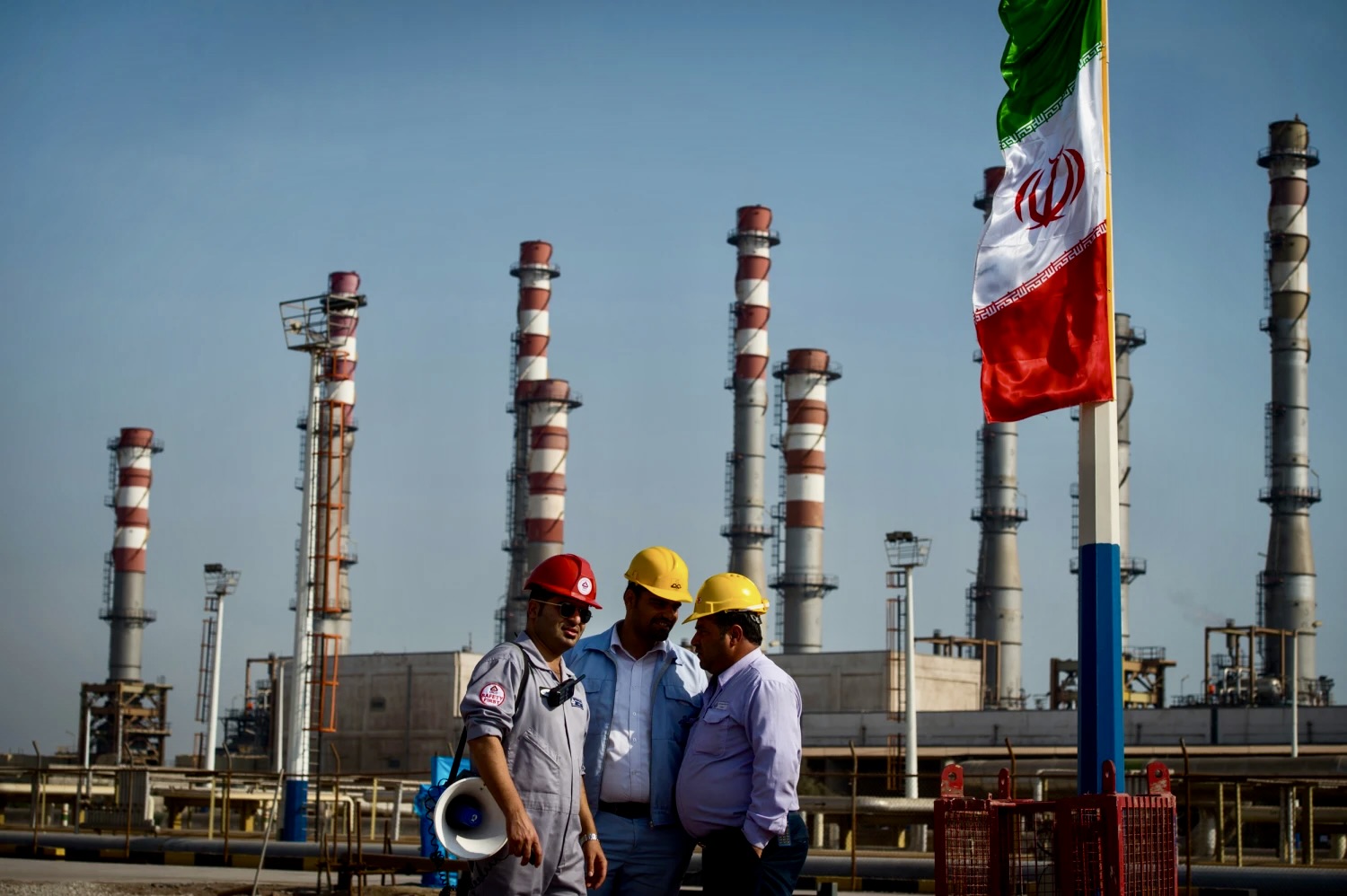
TEHRAN (Realist English). Iran’s oil and gas industries, the backbone of its economy, are under unprecedented pressure from the US naval blockade.
Production is falling, export flows are virtually cut off, onshore and offshore storage is filling up, and experts warn that if production is not stopped, fields face irreversible damage.
The gas sector is also under immense strain, risking leaving the country without light and heat.
Oil industry: figures and current situation
Iran is among the world leaders in hydrocarbon reserves: fourth in proven oil reserves (about 158 billion barrels, roughly 9.3% of the world total) and second in gas (34 trillion cubic metres). Before the war, Iran steadily produced 3.2–3.3 million barrels of oil per day (plus condensate – another 1.3 million b/d). In March 2026, according to OPEC, production fell to 3.06 million b/d due to mounting sanctions pressure and the blockade.
However, a deeper problem lies elsewhere. According to the US Energy Information Administration (EIA), Iran’s oil production peaked in 2017 at 3.8 million b/d. Since 2018, after the US withdrawal from the nuclear deal and the reimposition of sanctions, production has fallen by 40% and never recovered. Rystad Energy analysts expect production to remain at around 3.2 million b/d in 2026, but these forecasts could be revised at any moment.
Exports and storage: 90% of oil went to China, now nowhere
Before the war, Iran exported about 1.7 million barrels per day (roughly 3.5% of world supply), with the vast majority – about 90% – going to China, mainly through independent refineries (so‑called “teapots”). Chinese state-owned companies refrained from buying sanctioned oil.
The blockade has virtually brought exports to a halt. Iran desperately needs money – oil exports account for about 60% of budget revenues.
Storage is filling up rapidly. According to various estimates, by the end of April, up to 170 million barrels of Iranian oil are in “maritime limbo” – as floating storage on tankers.
Onshore tanks on Kharg Island – Iran’s main export terminal, through which 90% of Iranian exports pass – are more than half full, and analysts estimate that within weeks the storage facilities could become completely full.
The paradox of the situation: production volumes have fallen only slightly, but there is nowhere to ship the output.
‘Shutting in’ production impossible
The reason Iran cannot simply “turn off the tap” lies in the specifics of production. A sudden halt to water injection into the reservoir could lead to a drop in reservoir pressure, water intrusion into wells, and an irreversible decline in field productivity. Resuming production after a long shutdown would require billions of dollars in investment, which Tehran currently does not have.
Gas sector: paradox of abundance
Iran has the world’s second‑largest proven gas reserves – 34 trillion cubic metres (after Russia) – yet for a number of reasons this “gas superpower” can neither satisfy its own growing demand nor its export ambitions.
Production figures: dry gas production in 2024 reached a record 263 billion cubic metres. Growth was driven by the commissioning of new phases of the giant South Pars field, which Iran shares with Qatar. However, this is still insufficient.
Consumption: Iran is the world’s fourth‑largest gas consumer, using it in the power sector. Due to huge subsidies and very cold winters, demand rises sharply in winter. For many years, Iran has been forced to halt exports to avoid leaving its population without heat.
Exports: The main channel is the pipeline to Turkey (up to 9.6 billion cubic metres per year). However, gas supplies to Turkey are intermittent. Iran also supplies small volumes to Armenia and Azerbaijan, often under barter arrangements.
LNG projects have remained on paper for decades because sanctions prevent access to Western technology. The only low‑capacity liquefaction plant is under construction, and its start‑up was expected in 2026, but due to the war those plans are in serious doubt. Russian companies are participating in the development of gas projects, but liquefaction technologies remain out of reach. The war and blockade have put a cross on any plans to rapidly increase gas exports.
Forecasts and expert opinions: oil collapse imminent
The US Treasury estimated Iran’s daily losses from the blockade at $170 million. This applies not only to oil exports but also to the need to import gasoline, as domestic refineries do not meet demand. As of the end of April, the Kharg Island terminal is on the verge of being full.
- According to the American Petroleum Institute (API), US commercial oil stocks fell by 1.79 million barrels against an expected increase of 0.3 million. Gasoline stocks fell even more – by 8.47 million barrels.
- Experts at Columbia University believe that oil production can be temporarily reduced without fatal consequences, since Iran has experience in shutting down and restarting wells. However, a far more serious problem is gas: a reduction in oil production will hit associated gas – a key source of energy for Iran’s own needs.
- The director of the expert council of the Russian publication “Energy and Economy” also notes that Iran will not be able to become a major LNG exporter in the foreseeable future for political reasons, even if it wanted to.
Immediate effect on the world market: the reduction in Iranian exports of about 1.5–1.7 million b/d, combined with losses from the Strait of Hormuz blockade, creates a deficit and pushes prices up. According to the IEA, total losses in March amounted to 10.1 million b/d, and another 2.9 million b/d are expected in April. This imbalance has already pushed Brent above $110 per barrel.