TEHRAN (Realist English). The United States and Iran are exchanging massive air strikes for the second consecutive day, pushing the already fragile ceasefire established on April 8 to the brink of complete collapse. The escalation was triggered by the crash of a US AH-64 Apache helicopter over the Strait of Hormuz, which Washington blamed on Tehran.
US President Donald Trump has threatened to “bomb Iran to hell” if the Islamic Republic does not immediately sign a peace agreement, stating that the country “will pay the price.”
From the Downed Apache to the “Third Wave”
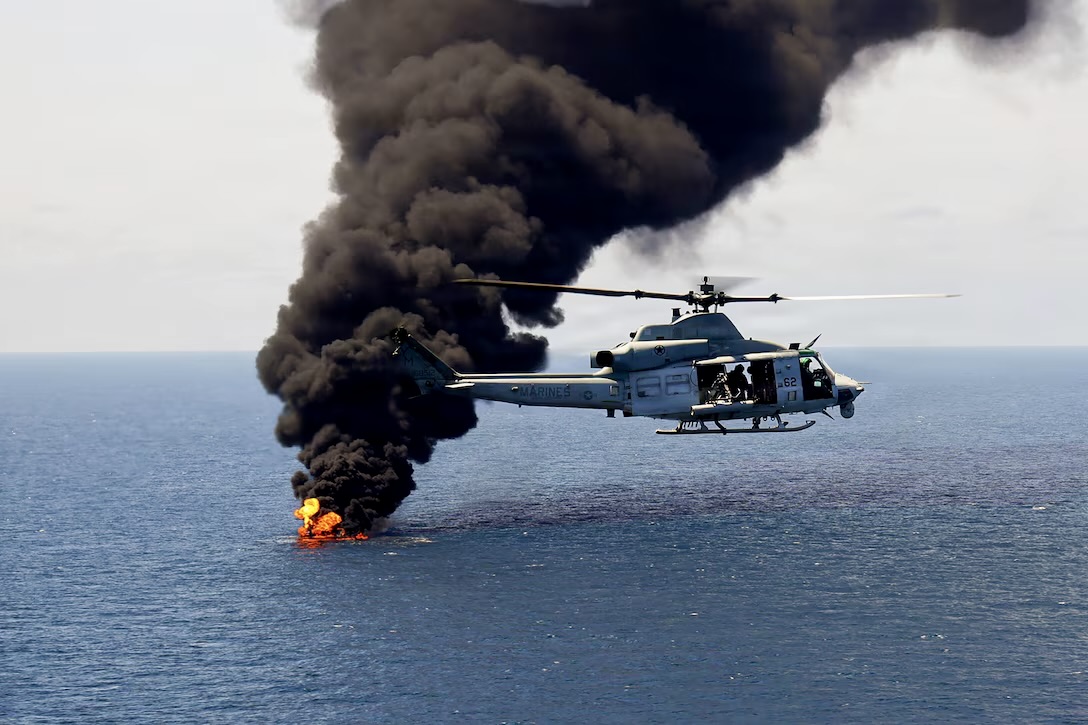
Trigger incident (June 8–9). On June 9, Trump accused Iran of shooting down a US AH-64 Apache attack helicopter over the Strait of Hormuz with an Iranian Shahed drone. Two crew members were rescued. Iran has neither confirmed nor denied its involvement, warning that forces operating off Iran’s coast are under “constant risk.”
First wave of US strikes (June 10). On the night of June 10, US forces carried out three waves of strikes against targets on Iran’s southern coast. Targets included naval bases in Sirik and Jask, air defense facilities in Bandar Abbas, and missile batteries on Qeshm Island. Trump said the US fired 49 Tomahawk cruise missiles at targets in Iran.
Iran’s response (June 10). The Islamic Revolutionary Guard Corps (IRGC) claimed strikes on the US Fifth Fleet headquarters in Bahrain, the Muwaffaq Salti air base near Al-Azraq in Jordan, and the Ali Al Salem base in Kuwait. Iranian military officials reported attacking 21 US targets, including hangars with F-35 fighters in Jordan. Authorities in Bahrain and Kuwait reported intercepting missiles and drones. Jordan said it intercepted five Iranian missiles over Al-Azraq.
“Third wave” (June 11). On June 11, US Central Command (CENTCOM) announced additional “self-defense strikes” against several targets inside Iran. Iranian military intelligence and surveillance systems, communications facilities, and air defense sites across Iran were hit. According to Trump, US forces fired another 49 cruise missiles. Iranian media reported explosions in six areas of the country.
Iran’s response (June 11). The IRGC again launched retaliatory strikes, claiming to have hit 18 US military installations in the Middle East, including US air bases in Kuwait and Bahrain, as well as the US Fifth Fleet headquarters in Bahrain. Iran also claimed repeated strikes on the Al-Azraq air base in Jordan. Air defense systems were activated in Kuwait and Bahrain. Kuwait temporarily closed its airspace.
Targets and Scale of Strikes
US targets. US forces are primarily striking air defense systems, radars, drone control centers, and military intelligence and surveillance assets. According to Axios and The Wall Street Journal, all targets are concentrated in southern Iran, near the Strait of Hormuz, with civilian infrastructure not being hit. However, Iran has accused the US of striking reservoirs supplying drinking water to 10 villages, calling it a “war crime.”
Iran’s claims. Iranian officials claim to have attacked 18 US targets, including F-35 fighter hangars. Washington has denied these claims: according to US officials, Iran launched several missiles and drones, “nearly all were intercepted,” and there have been no casualties or confirmed damage at US bases.
Blockade of the Strait of Hormuz
Following the US strikes, Iran’s Supreme Joint Military Command announced the complete closure of the Strait of Hormuz to all types of vessels, including commercial ones, and warned it would open fire on any ship attempting to transit the strait. Iranian media reported that fire was opened on two US ships. CENTCOM denied these reports, stating that despite Iran’s threats, commercial vessels continue to pass through the strait. Trump earlier claimed that US forces, in a secret operation, had escorted “more than 200 commercial vessels” and “more than 100 million barrels of oil” through the strait. The US president also openly admitted for the first time that the US Navy has been escorting vessels through the strait for the past month.
Positions of the Parties
Donald Trump. The US leader accused Iran of stalling negotiations. “They have been dragging their feet too long on a deal that would have been great for them, and now they will have to pay for it,” Trump said. In a Fox News interview, he threatened: “If they don’t sign the deal, we will bomb them to hell.” Trump also claimed he personally spoke with senior Iranian officials, and they asked him to stop the bombings. Iran has denied these reports.
Iran. Foreign Minister Abbas Araghchi warned that Iran’s armed forces “will not leave any attack or threat unanswered.” Foreign Ministry spokesman Esmail Baghaei accused the US of committing a “deliberate war crime” and a “gross violation of human rights.” Iran’s Ambassador to the UN, Amir Saeid Iravani, stated that “no sustainable agreement can be reached through threats, intimidation, or the use of force.”
Role of Mediators
Despite the rhetoric, diplomatic efforts continue. A Qatari delegation arrived in Tehran to negotiate a resolution of differences. UN Secretary-General António Guterres warned of the risk of sliding into “full‑scale war.”
Economic Consequences
The new round of escalation immediately impacted global energy markets. Brent crude jumped nearly $3, exceeding $94 per barrel. Previously, Iran had already blocked about 20% of global oil and gas supplies through the strait.
Thus, the exchange of strikes between the US and Iran, which began with the Apache helicopter incident, has quickly escalated into a mutual military campaign. The US is systematically striking Iranian air defense and intelligence systems, while Iran retaliates by attacking US bases in the region.
Despite Trump’s public statements about an “imminent deal” and Qatari diplomatic efforts, the negotiation process has effectively frozen. Each new attack raises the risk of a complete collapse of the ceasefire and a return to full‑scale hostilities.