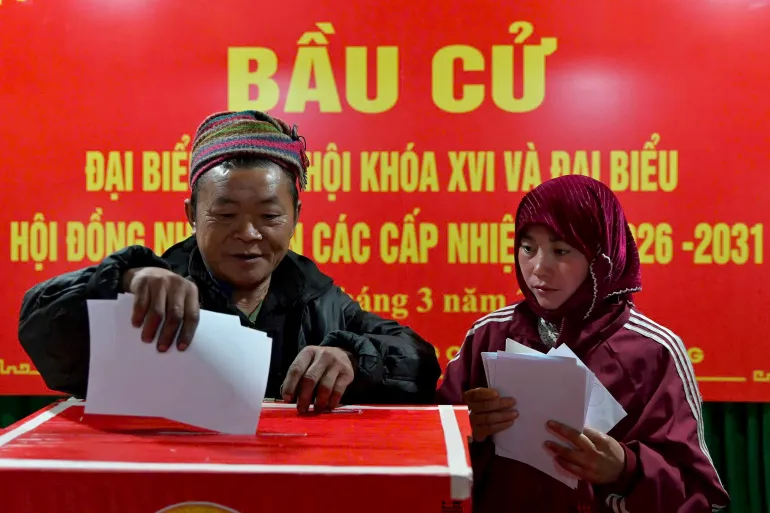
HANOI (Realist English). Voters across Vietnam headed to polling stations on Sunday to elect members of the National Assembly, the country’s top legislative body, in elections widely expected to reinforce the dominance of the ruling Communist Party.
More than 73 million people are eligible to vote in the election, which takes place every five years and will determine the 500 members of the National Assembly as well as representatives to local councils for the 2026–2031 term.
According to Vietnam’s national election council, nearly 93 percent of the 864 candidates standing in the election are members of the Communist Party, while about 7.5 percent are independent candidates — slightly lower than the 8.5 percent recorded in the previous election in 2021.
The Communist Party has governed the Southeast Asian nation of around 100 million people for decades and currently holds about 97 percent of seats in the National Assembly.
Voting underway across the country
Polling stations opened across the country on Sunday morning, with voting expected to continue until 7 p.m. local time. Final results are anticipated to be announced by March 23.
In the capital Hanoi, red-and-yellow banners decorated streets and public buildings as voters arrived early to cast their ballots.
Some voters expressed optimism that the new parliament would support ongoing economic reforms.
“I hope the leaders chosen after this election will bring important changes that will help the country develop further,” said Nguyen Thi Kim, 73, speaking to reporters at a polling station in Hanoi.
Vietnam’s rapidly growing economy has undergone significant reforms in recent years under the leadership of Communist Party General Secretary To Lam.
Limited political competition
Despite the nationwide vote, the National Assembly largely functions to approve decisions already shaped by the Communist Party leadership.
Many key policies and major state projects are determined by senior party officials before being formally ratified by lawmakers.
As a result, some voters say they do not expect the election outcome to significantly affect their daily lives.
“I don’t think who wins will really change anything for me,” said a Hanoi resident who identified herself as Huyen.
Next steps after the election
The newly elected National Assembly is expected to hold its opening plenary session in early April.
During that meeting, lawmakers will likely formally approve senior state leadership positions — including the president and prime minister — based on nominations previously made by the Communist Party.
At the party’s congress in January, To Lam was confirmed as general secretary, the most powerful position in Vietnam’s political system, and the party also selected the 19 members of its Politburo, the country’s top decision-making body.
Speaking after voting in Hanoi, Lam said the election was intended to “select the most respected representatives who will continue guiding the country’s development.”
For some younger voters, the election also carries symbolic importance.
“I know the top leadership positions are already decided,” said 18-year-old first-time voter Nguyen Kim Chi. “But I still hope my vote matters.”