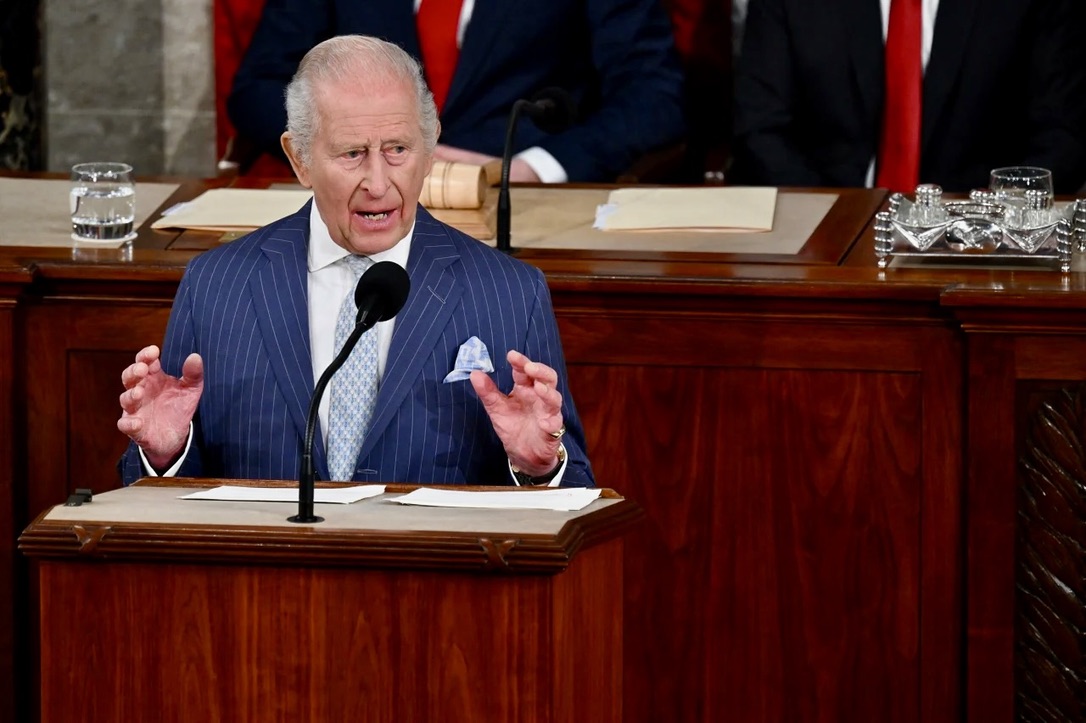
WASHINGTON (Realist English). On 28 April, King Charles III of the United Kingdom addressed a joint meeting of the U.S. Congress for the first time in 20 years.
In his speech, the British monarch emphasised the unity of the two countries, praised NATO — an alliance repeatedly criticised by President Donald Trump — and faintly signalled disagreements over Iran and Ukraine. However, he completely avoided mentioning the Jeffrey Epstein scandal, despite strong appeals from members of Congress.
‘Solidarity after the shooting and memory of Elizabeth II’
Charles III began his address by referring to the shooting at the White House Correspondents’ Association dinner on 25 April. “Such violent acts will never succeed,” the king said, expressing solidarity with the United States.
“We stand united in our commitment to uphold democracy, to protect all our people from harm, and to salute the courage of those who daily risk their lives in the service of our countries.” He also remembered his mother, Queen Elizabeth II, who was the last British monarch to address the U.S. Congress.
‘Checks and balances’: a hint at Trump?
A particularly enthusiastic round of applause greeted the section of the speech devoted to the principle that “executive power is subject to checks and balances.” Speaking about the influence of English common law and the Magna Carta on the American Bill of Rights of 1791, Charles noted: “The U.S. Supreme Court Historical Society has calculated that Magna Carta is cited in at least 160 Supreme Court cases since 1789, not least as the foundation of the principle that executive power is subject to checks and balances.”
Members of Congress began applauding before he even finished the sentence.
NATO, Ukraine and Iran: polite disagreements
The king could not directly criticise Trump’s policies, but his messages were sufficiently transparent. He praised NATO, recalling that after the 9/11 terrorist attacks, the United States became the first (and so far only) country to invoke Article 5 of the Washington Treaty on collective defence.
“We answered the call together – as our people have done for more than a century, shoulder to shoulder, through two World Wars, the Cold War, Afghanistan and moments that have defined our shared security,” Charles said, implicitly contrasting his words with Trump’s recent criticisms of NATO allies.
The king also mentioned “Russia’s unprovoked aggression” against Ukraine and called for continued support for Kyiv, although Trump halted most military aid in 2025. The sole mention of Iran was fleeting: the monarch dropped the word “conflict” in the Middle East but did not elaborate, even though the US‑Israeli war with Iran has created serious friction between London and Washington. British Prime Minister Keir Starmer refused to provide substantial military assistance, for which Trump publicly criticised the UK.
‘Loudest laughter’: jokes about independence and a hostage
Charles allowed himself a few ironic passages. He began with a quote from Oscar Wilde: “We have really everything in common with America nowadays, except, of course, language!” – drawing modest laughter.
He then related an ancient tradition of the British Parliament, whereby before the monarch’s speech one MP is sent to Buckingham Palace as a “hostage” to guarantee the sovereign’s safety. “These days, we look after our ‘guest’ rather well – to the point that they often do not want to leave! I don’t know, Mr Speaker, if there were any volunteers for that role here today…” The House appreciated the joke more warmly than the linguistic one.
The loudest laugh came when the king remarked that his state visit was not part of some “cunning rearguard action” against American independence. He then reminded his audience that the Declaration of Independence was adopted only 250 years ago – “or, as we say in the United Kingdom, just the other day.”
White tie, tails and tiara: the first white‑tie dinner in 19 years
On the evening of 28 April, a state dinner in honour of the king and Queen Camilla was to be held at the White House. The dress code was “white tie”, the highest form of diplomatic etiquette. The last such dinner was held in 2007 for Queen Elizabeth II (under George W. Bush). Neither Barack Obama, Donald Trump (in his first term) nor Joe Biden hosted such formal events.
For men, this meant a black tail coat, a waistcoat and a white bow tie. For women, full‑length evening gowns and – for royalty – a tiara.
Epstein scandal: promise broken
Despite expectations, Charles III did not directly address the survivors of Jeffrey Epstein. Democratic Congressman Ro Khanna sharply criticised the monarch for this omission, telling CNN: “It’s very disappointing because the British ambassador told me to my face that he would. And the fact that he didn’t have the decency to acknowledge the survivors who were in this building really shows a lack of introspection and accountability.”
The only passage that could be interpreted as a nod to the issue was the king’s remark: “In both of our countries, it is the very fact of our vibrant, diverse and free societies that gives us our collective strength, including to support victims of some of the ills that, so tragically, exist in both our societies today.”
Khanna also criticised the British ambassador, Christian Turner, for “misleading” him by suggesting the speech would contain a direct reference to the victims. “I think he shouldn’t misrepresent things to members of Congress and I’m very disappointed that he did that,” the congressman said.
Royal aides explained that Charles is the symbolic head of the judiciary, and since his brother Prince Andrew is under investigation by British authorities in connection with Epstein, the monarch cannot speak on the matter so as not to prejudice the outcome of justice.
Crack in relations
The four‑day state visit, timed to coincide with the 250th anniversary of US independence, was intended to strengthen the “special relationship” between the two countries and demonstrate the strength of the trans‑Atlantic alliance. US‑British relations are going through one of the most difficult periods in recent history, driven not merely by personal antipathy between leaders but by fundamental disagreement over whether to participate in a military conflict.
The key cause of the friction was Starmer’s refusal to provide military assistance. He prohibited the use of British military bases in Cyprus and the Indian Ocean (Diego Garcia) for strikes on Iran, arguing that this would violate international law. Although London later agreed to allow the use of facilities for “limited defensive purposes” and supported minesweeping in the Strait of Hormuz, the damage was done.
Disagreements between the allies manifested themselves on almost every aspect of the Iran conflict – from the necessity of starting the war in the first place, to questions of including Lebanon in the ceasefire, to Iran’s imposition of transit fees through the strait.