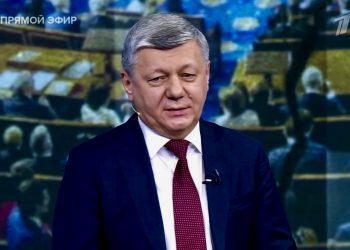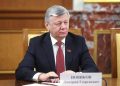


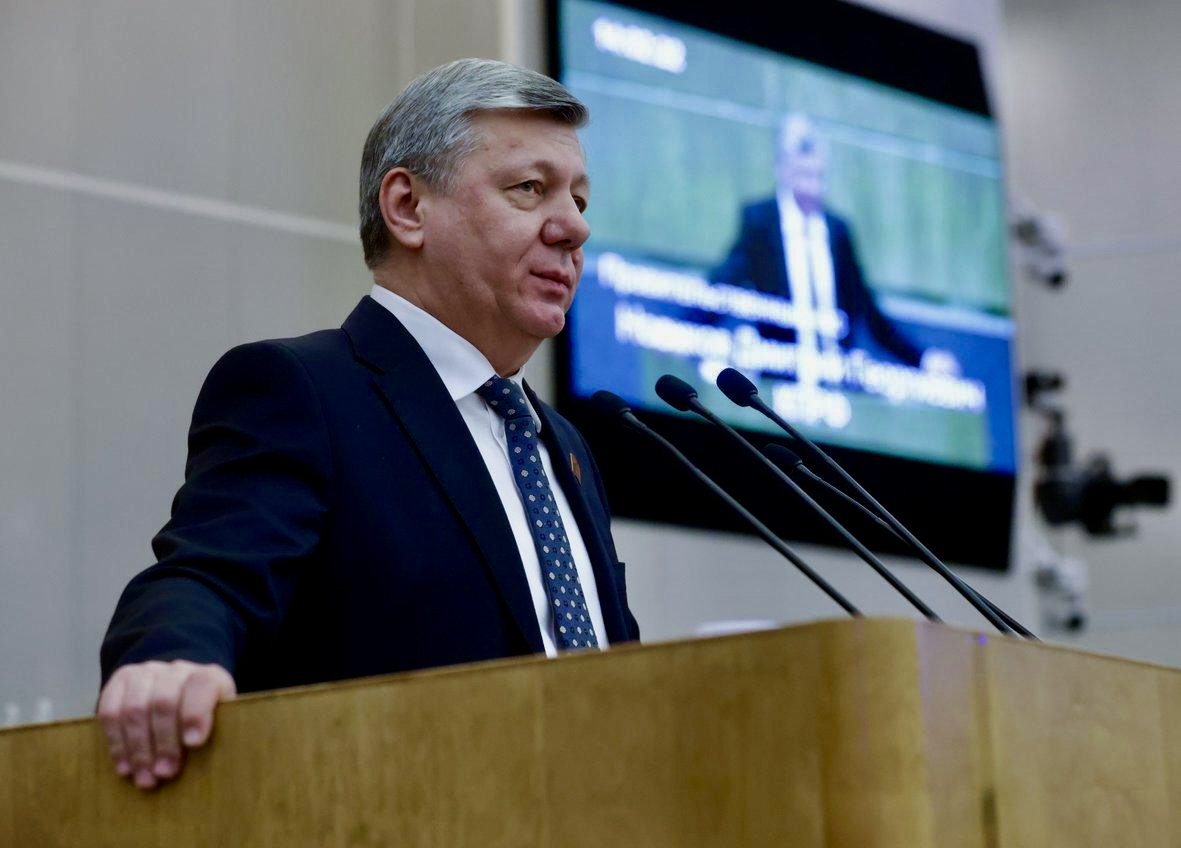
MOSCOW (Realist English). Deputy Chairman of the CPRF Central Committee, First Deputy Chairman of the State Duma Committee on International Affairs Dmitry Novikov, who stood at the origins of the creation of the “Krasnaya Liniya” TV channel and the CPRF Central Committee’s Centre for Political Studies, shared his experience of transforming party agitation in an interview with Realist English, spoke about the development of these projects, and explained why the Communist Party does not rely on any single communication channel.
Over 600 contracts and 60 million potential viewers
Answering a question about the projects he helped create, Novikov noted that both projects were launched more than ten years ago, their ideas “matured and began to be implemented simultaneously,” and each has proven successful.
“Krasnaya Liniya has already gathered a large audience. Step by step, we concluded contracts with cable operators, often small ones — with 3–5 thousand subscribers. Today, we have more than six hundred contracts with companies that deliver the signal to viewers. Among the most significant additions is inclusion in the Rostelecom package,” the deputy said.
According to him, more than 60 million Russians can watch the channel on their television sets. Krasnaya Liniya also has a website and a mobile application. Viewing figures, according to measurements, are “very good” both across the country as a whole and in the new regions.
Centre for Political Studies and “Krasnaya Tribuna”
The Centre for Political Studies is also developing in parallel. In March 2026, two training streams were held under new programmes. The “Krasnaya Tribuna” project continued, aimed at established party members — heads of regional party media, secretaries at various levels, and Communist deputies.
“Krasnaya Tribuna is focused on mastering oratory skills and the ability to convey our collective position. A wide range of people conduct classes — party members and non‑party members, university teachers and politicians,” Novikov noted.
No choice between old and new media
The key thesis of the interview: the CPRF does not intend to choose a single “winning” means of agitation.
“In the course of discussions, including at plenums of the Central Committee, we came to the conclusion: the CPRF will not choose one ‘winning’ means of agitation. We must use all methods of conveying our position. Each communication medium has its own characteristics and its own audience,” the deputy chairman of the Central Committee emphasised.
Novikov recalled that there were times when it seemed necessary to throw all forces into the blogosphere. However, with the start of the special military operation, internet access became difficult in front‑line areas, and “the importance of the printed word grew significantly.”
Particular demand for the party newspapers Pravda and Sovetskaya Rossiya arose during the period when the Donetsk and Lugansk People’s Republics joined Russia.
Why the printed word is trusted more
According to Novikov, the printed word is trusted more than the spoken word.
“When you write a text, you think it over, verify it, focus your attention. An oral speech is not always prepared so carefully. As they say, manuscripts don’t burn. It’s no accident that the proverb says: ‘What is written with a pen cannot be cut out with an axe.’ People will judge you for a long time by what you have written — your literacy, intelligence, style, and way of thinking,” he explained.
The politician also mentioned that when Krasnaya Liniya was being created, the question arose of completely moving into the television project and abandoning leaflets and newspapers. “No, and again no!” Novikov replied. According to him, good posters that convey a position through the language of images are also valuable — they can now be placed not only on bulletin boards but also on the internet.
Social networks: no fake engagement, only real people
Novikov stated that the CPRF is very effective on social networks, and the central link of this work is the CPRF Central Committee Commission on Internet Technologies headed by Marat Muzaev. He also noted the interesting experience of Nikolay Bondarenko in Saratov.
At the same time, the party fundamentally does not engage in fake engagement.
“You can have 100 thousand Telegram subscribers, but if your materials have gathered a dozen reactions in a week, you are dealing not with real subscribers but with bots. This self‑deception does not interest us. The point of politics is to work with real people, not with bots. Bots will not come to vote, will not go out to distribute newspapers, will not become observers at polling stations,” he emphasised.
According to Novikov, there were those who proposed other approaches, but this was rejected. The party leader Gennady Zyuganov supported the approach based on working with a real audience.
On the struggle for power and the meaning of party work
Novikov also recalled the main goal of the party.
“Parties are created to struggle for power. If a party forgets this and turns into an interest club, it loses its original meaning. As a party, it withers and dies. To implement its programme, a party needs to gain the levers of power. Therefore, you struggle to have as many supporters as possible. For this, you use a broad palette of means,” the deputy summarised.
The Centre for Political Studies has become a crucial link in the training of CPRF cadres. Novikov is not only the founder of the Centre for Political Studies but also its permanent curator. He regularly speaks to students, presents diplomas to graduates, and emphasises the special role of systematic political education in training party cadres. At the opening of the 59th intake, he stated: “To know the theory of Marxism‑Leninism means to understand the laws of social development. To convey it intelligibly and convincingly to people means to ensure our political victory.”
He also notes that the knowledge gained during training helps in the development of party branches and in promoting the party’s positions on the internet using artificial intelligence technologies.
The 61st intake (October 2025) brought together Communists and Komsomol members from 25 regions of Russia. The Centre’s activities have helped form a circle of opinion leaders who skillfully express themselves in the blogosphere.
Classes are conducted by party members and non‑party members, university teachers and politicians. Training combines lectures and practical exercises, field trips (visiting the Lenin State Farm, the Victory Museum on Poklonnaya Hill), trainings, and participation in public actions.
The need to create the Centre for Political Studies was outlined in a report by Gennady Zyuganov at the 13th Plenum of the CPRF Central Committee in June 2012. Less than a year later — in February 2013 — the necessary decision was made by the 15th Party Congress. Thus, both projects — the TV channel and the Centre — were created in the same period. The Centre for Political Studies has been operating since 2013.
Since 2015, Krasnaya Liniya has been actively entering cable operator packages. The main goal of the project is to become a source of information and a discussion platform for thinking people who care about the development of Russia and the world.
The audience of Krasnaya Liniya is thinking people aged 25 to 45 (or up to 55). The channel’s content consists of 80% of its own productions: documentaries, special reports, political talk shows, interviews with scientists, politicians, economists and public figures, and news programmes.
Special attention is paid to topics that, according to the creators, are ignored or distorted by federal media: housing and communal services, social problems, criticism of the authorities, and opposition activities. Party leaders regularly appear on the channel.