YEREVAN (Realist English). Armen Davtyan — a renowned Armenian linguist, Sumerologist and poet. He is the author of the “Armenian-Sumerian Dictionary” and several monographs on the deciphering of cuneiform texts. In an interview with Realist English and the Basis News media platform, Davtyan stated that, in his conviction, Sumerian and Armenian are not merely related but are the same language.
“The True Shepherd of Heaven”: a common astronomical code
In his conversation with a correspondent, Davtyan explained that the Sumerians’ ideas about their forefathers and patriarchs are no different from Armenian ones and have not changed over millennia. He drew attention to an astronomical parallel: in Greek tradition, the constellation is called Orion, while in Armenian texts it is named “Hayk” (Հայք). Among the Sumerians, the same constellation bore the name “True Shepherd.”
According to the linguist, by the word “shepherd” the Sumerians understood a spiritual shepherd, because in that era secular and spiritual power were united. “The shepherd was simultaneously king, spiritual pastor, and secular ruler,” Davtyan said.
“And in the sky this ruler was called the ‘True Shepherd of Heaven,’ which corresponds to the Orion-Hayk constellation among the Sumerians.”
The researcher also noted that in later astrological texts, instead of this constellation, the God-forefather, the patriarch, who embodies the Orion-Hayk constellation, is depicted.
The Armenian people — the chosen people of Aratta
According to the Sumerologist, the Armenian people are the people of Aratta, who are “called separated from the stall of signs, separated from others, exalted above others and washed with living water.” “This is unambiguous, and interpretations here cannot be twofold,” he stressed.
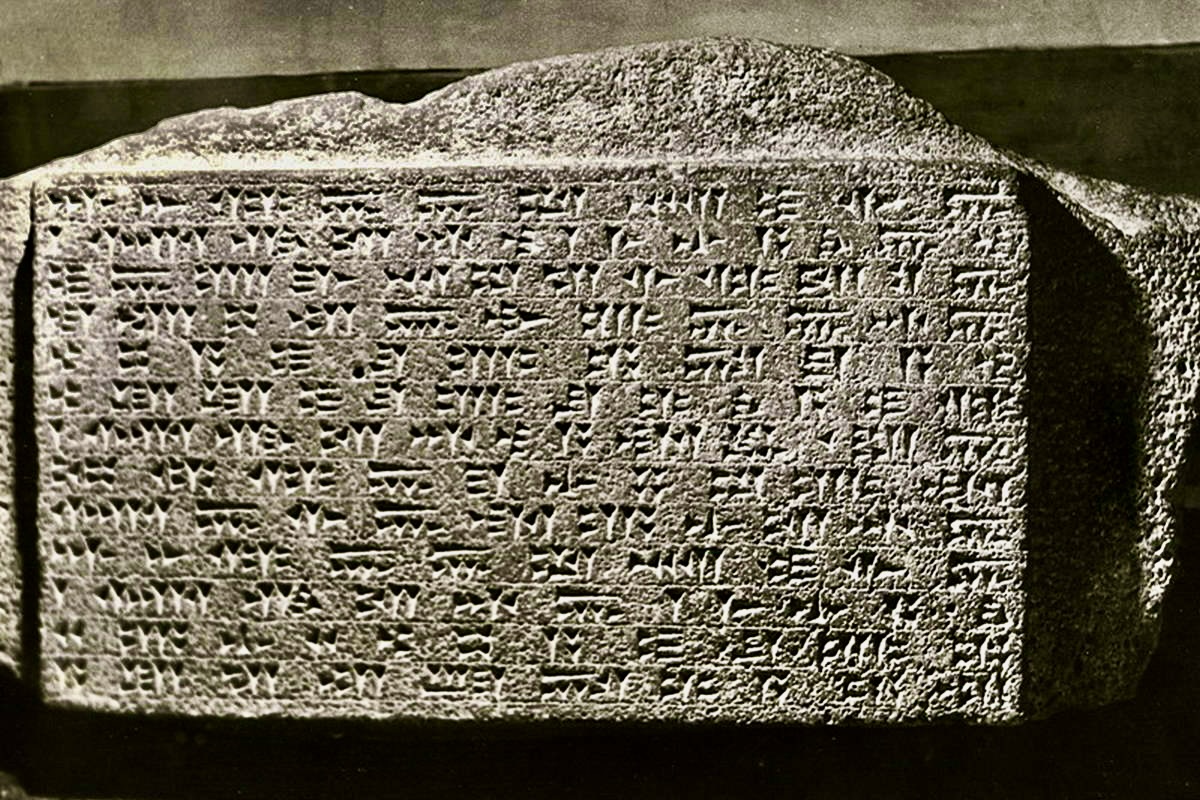
The scholar also analyzed the Sumerian cuneiform symbols designating the God-patron of the country of Aratta. “Three ideograms — ‘dingir’ (god), ‘dumu’ (son) and ‘zid’ (true) — superimposed on each other form the god ‘Dumuzid,’ which means ‘god — true son,’” the linguist explained.
“He is the God-patron of the country of Aratta, and in the sky he corresponds to the Orion-Hayk constellation.” Davtyan added that in myths, the king and ruler of Aratta is considered a chosen people.
“The people of Aratta, who are exalted above other peoples, stand before the flood; unlike other peoples, they not only stand but are exalted, being chosen thanks to the gift of observing divine commandments.”
Sumerian and Armenian are the same language
Turning to linguistic matters, Davtyan stated that debates about whether the Sumerians were Armenians have been going on for a long time, but scientific arguments have been deliberately rejected.
“Today the situation is different. Everything that previously contradicted Armenian-Sumerian commonality turned out to be false,” he said. “They said that Armenians do not live in Mesopotamia, that Armenians are newcomers. It turned out that this is not so.”
According to him, today there are hundreds and thousands of Sumerian-Armenian correspondences that cannot be explained by simple borrowings or a linguistic substrate. “These are entire rows of homonyms, synonyms, whole series. One people cannot take from another entire series of synonyms and homonyms,” the linguist asserts. “This means that Sumerian and Armenian can be considered not just related, but one language.”
Main works of Armen Davtyan:
- “Armenian-Sumerian Dictionary” (2014): His key work, containing more than 2,000 words and roots that, in the author’s opinion, are common to both languages.
- “Armenian Star Mythology” (2004): The first scientific work devoted to Armenian astronymy.
- “Sumerian Agricultural Guide in Armenian” (2022): In this book, the author claims that the famous Sumerian cuneiform text “Instructions of the Farmer” (13th century BC) can be read in Armenian. According to his analysis, up to 94% of the words in this text have Armenian roots.
- Monograph on the poem “Lugalbanda in the Mountain Cave”: A work devoted to the translation and astronomical analysis of the Sumerian epic.
The scholar rejects the generally accepted view in science about the isolated status of Sumerian.
Number of coincidences: In addition to 2,000 words in the dictionary, Davtyan claims to have found about 5,000 identical words in Sumerian and Armenian, including common roots, synonyms and speech patterns.
Percentage of coincidence in texts: In one of the analyzed texts, out of 247 words, the researcher found no matches for only 15. The remaining 232 words, according to him, are Armenian, with 45% of them being purely Armenian Indo-European words. Davtyan adheres to the theory that the Proto-Armenian language existed already in the Neolithic era (about 8–7 thousand years BC), which coincides with the flourishing period of Sumerian civilization.
For more than 15 years, Davtyan worked as a referent (assistant) to the President of the Republic of Armenia. Since November 2022, he has been a research fellow in the Department of Historical and Cultural Astronomy at the Byurakan Astrophysical Observatory. He regularly gives reports at scientific and cultural centers. He is a member of the Writers’ Union of Armenia.