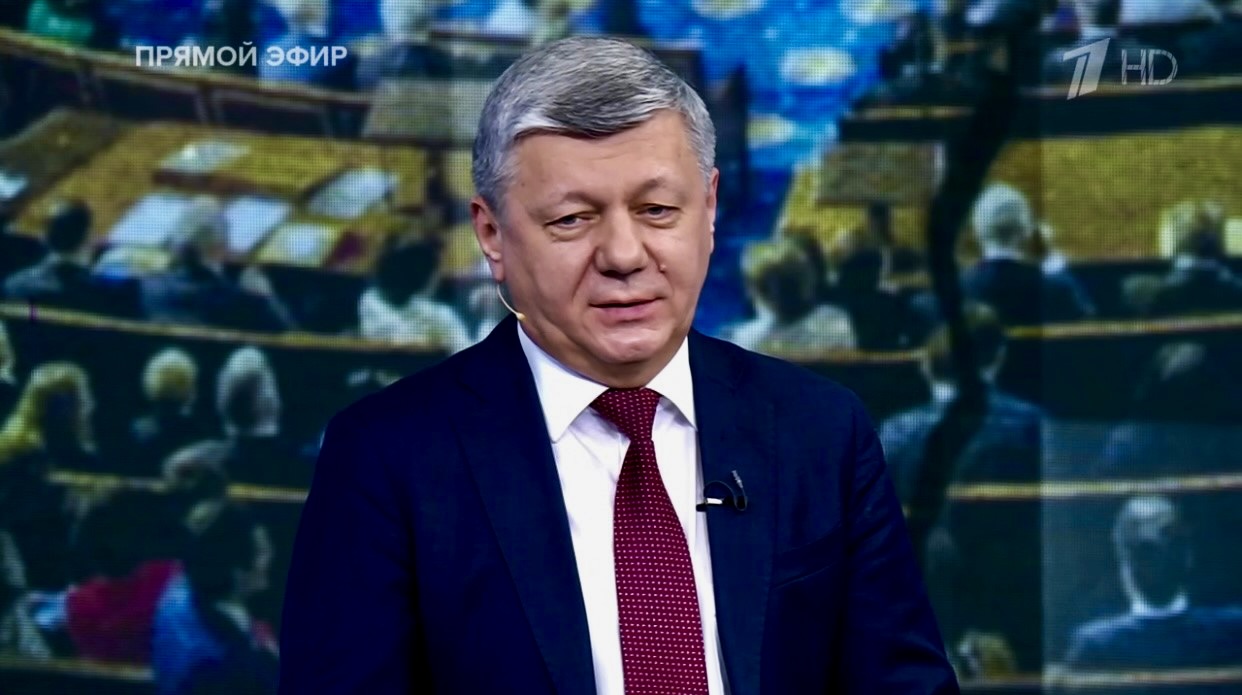
MOSCOW (Realist English). Dmitry Novikov, Deputy Chairman of the Central Committee of the Communist Party of the Russian Federation and First Deputy Chairman of the State Duma Committee on International Affairs, told Realist English in an interview about the methods of the “color revolution” in the USSR and how the Communist Party was revived after August 1991.
“The attack on socialism came from within the CPSU.”
According to Novikov, by the time he came of age, much had already changed in the country. Mikhail Gorbachev came to power, and the Soviet system began to be undermined.
“Any observer could see that the attack on socialism was taking place with the participation of those who had great influence in the CPSU and its Central Committee,” the deputy said.
Thanks to his teachers, Novikov noted, he received a good historical education and developed the habit of evaluating not the form but the content of phenomena.
“Yes, the CPSU continued to be called the Communist Party. But upon closer inspection, you discovered that factions had formed within it, even though they were prohibited by the Party Statute. Quite officially, platforms appeared: Marxist, democratic. In essence, this was already factional activity,” he explained.
Gorbachev was leading the country into a dead end.
The First Secretary of the CPSU Central Committee, Gorbachev, in the parliamentarian’s opinion, was already leading the country into an obvious dead end and was certainly not a consistent communist. Then people who embarked on the path of fighting the “treacherous line of Gorbachev-Yakovlev-Shevardnadze” began to make themselves known.
Gennady Zyuganov stated his position, supported by Valentin Chikin, editor-in-chief of “Soviet Russia.” Many paid attention to the position of CPSU Central Committee Secretary Yegor Ligachev, Marshal Sergei Akhromeev, and many others.
With the creation of the Communist Party of the RSFSR, major leaders who opposed the collapse became more visible. It was then that Ivan Polozkov, elected first secretary of the CP RSFSR, gained wide fame, and a wave of vicious slander immediately fell upon him.
“Forcing an image of him as a semi-literate person was absolutely dishonest,” Novikov stressed. “But the ‘democratic’ media did exactly that, and extremely aggressively.”
Methods of the “color revolution” in the USSR
According to Novikov, even then it was a matter of using the methods of color revolutions. To prepare an anti-Soviet coup, a campaign was launched to blacken the Soviet past, and then the leaders of the CPSU who defended socialism and Soviet power.
“Both Ivan Polozkov and other party leaders became victims of unbridled slander. They were stigmatized as retrogrades, conservatives, enemies of perestroika,” the deputy said.
It was then that the country first encountered extremely dirty political technologies. A full-fledged discussion was replaced by vilification of opponents.
“Andrei Sakharov shamelessly violated all the rules of procedure at the Congress of People’s Deputies. At the same time, his disrespect for his fellow deputies was presented as if Sakharov himself was the victim of an ‘aggressively obedient majority,’” Novikov noted.
“Communists behave more honestly.”
The events of that time, according to the parliamentarian, illustrate that communists behave much more honestly than their opponents, showing perseverance and principle. Having gone through a wave of lies and attacks, the party was revived after Yeltsin’s ban. Gennady Zyuganov, Yuri Belov, Valentin Kuptsov, Ivan Melnikov, Vladimir Kashin, Yuri Maslyukov, Anatoly Lukyanov, Valentin Varennikov, Viktor Ilyukhin, Sergei Reshulsky and many others took part in this great work.
Answering the question of whether the confrontation between Gorbachev and Boris Yeltsin was a form of color revolution, Novikov said: “At that time, the term ‘color revolution’ was not yet known. But many characteristic methods were already being used. And the events of August–September 1991 should be qualified precisely as such. They were the peak of a color revolution that lasted several years. Under the guise of a popular protest against the State Emergency Committee, the destruction of the USSR was being prepared.”
The ban on the CPSU and Gorbachev’s position
The defeat of the State Emergency Committee gave Yeltsin a free hand, the deputy recalled. It came down to decrees banning the CPSU.
“Gorbachev’s lack of resistance to these processes directly exposes him. After all, he was both the leader of the party and the president of the country! How could he agree to the ban on the CPSU? The illegality of Yeltsin’s decrees was obvious! By the way, a little later this was confirmed by the Constitutional Court of Russia,” Novikov stressed.
He called it meanness that Gorbachev, who loved to talk about the rule of law, did not protect the rule of law and did not shield his own party from an illegal ban. The same applies to the fate of the USSR: in the referendum of March 1991, Gorbachev formally spoke in favor of the Union, but in December of the same year he did nothing to preserve a single country, simply agreeing with the conspirators in Belavezha.
“I wrote my application when the party was being banned.”
Novikov said that his application to join the CPSU was written precisely at the moment of the ban. “If everything superficial is leaving, one must join the party and help transform it on consistently communist principles,” he explained. At the same time, those who loudly preached about democracy and pluralism took the path of prohibition.
“They didn’t care about pluralism and freedom of speech,” the deputy said.
The people who stormed Soviet power under the banners of democratization showed their dictatorial character from the very first days, confirming it in October 1993 by shelling parliament.
“The swift ban on the Communist Party in 1991 prevented me from joining its ranks. That was done later, when we revived the party,” Dmitry Novikov concluded.
Brief chronology of the collapse
Coming to power in 1985, Gorbachev initiated a series of reforms that ultimately undermined the foundation of the Soviet state. Yeltsin, elected president of the RSFSR, became Gorbachev’s main political opponent and a key figure in the liquidation of the USSR.
On December 8, 1991, at the government residence “Viskuli” in Belovezhskaya Pushcha, the heads of Russia (Boris Yeltsin), Ukraine (Leonid Kravchuk) and Belarus (Stanislav Shushkevich) signed an agreement on the cessation of the existence of the USSR.
The signing of the Belavezha Accords was contrary to the results of the All-Union referendum held in March 1991, in which about 70% of citizens voted to preserve the USSR. Later, in 1996, Yeltsin expressed regret over signing the Belavezha Accords, but it was too late.
On December 25, 1991, Gorbachev resigned as president of the USSR, and the next day the Supreme Soviet adopted a declaration on the cessation of the existence of the Soviet Union. 15 new independent states appeared on the world map.
The exact number of victims of civil wars and economic problems in the post-Soviet space has still not been established.