
Realist: news and analytics

Русский / English / العربية

  • News
  • Russia
  • Caucasus
  • Opinion
  • Interviews
  • Experts
No Result
View All Result
Realist: news and analytics
  • News
  • Russia
  • Caucasus
  • Opinion
  • Interviews
  • Experts
No Result
View All Result
Realist: news and analytics

Germany, Poland, France and Britain: who will replace America in Europe

Amid Donald Trump’s hostile rhetoric, his threats during the Iran war, and demands that Europeans take primary responsibility for their own defense by 2027, the continent is forced to hastily restructure its security architecture. According to NATO Secretary General Mark Rutte’s forecasts, Russia could be ready for military action against the alliance within the next five years.

     
April 13, 2026, 13:06
Opinion
Germany, Poland, France and Britain: who will replace America in Europe

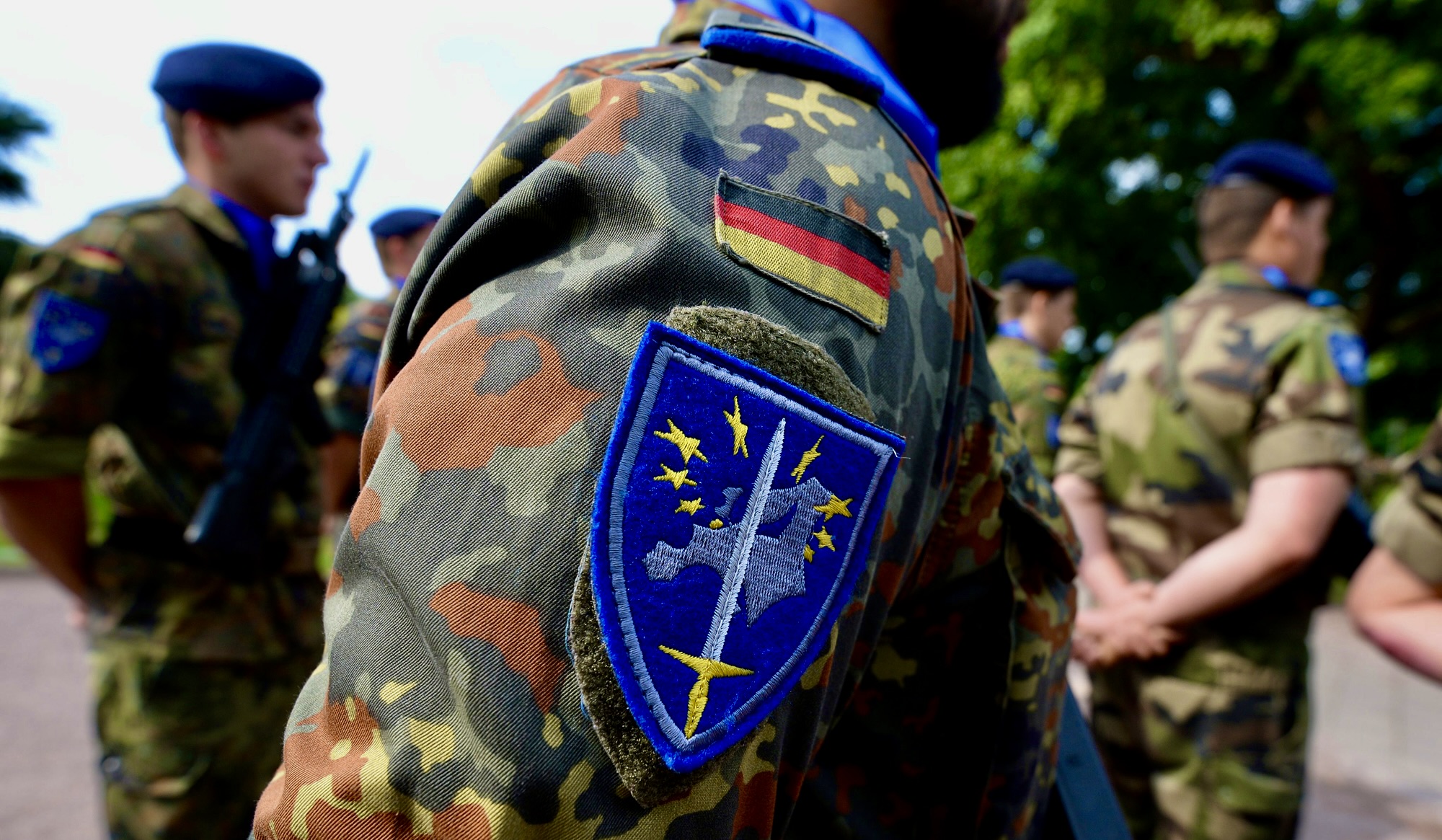
German soldier at the Eurocorps. Photo: deutschland.de

NEW YORK (Realist English). Analysts Ethan Kapstein and Jonathan Caverley argue in an article for the American analytical journal Foreign Affairs that European security in the coming years will depend not on decisions made in Brussels, but on the actions of four key states — Germany, Poland, France and the United Kingdom.

The European Union faces an unprecedented challenge: the traditional reliance on US military power has cracked. President Donald Trump has repeatedly demonstrated hostility toward European allies, and his actions during the Iran war have undermined confidence in American security guarantees. As Reuters reported, US officials informed European partners back in December 2025 that they must assume primary responsibility for the continent’s defense by 2027.

Time is running out, bureaucracy is slow

The authors, experts from Princeton University and the International Institute for Strategic Studies, warn that processes of pan-European coordination are too slow. New EU institutions and programs, including the European Defence Fund ($4.6 billion per year) and the SAFE program ($175 billion in loans), face numerous obstacles.

Even flagship projects such as the Franco-German-Spanish Future Combat Air System (FCAS) fighter program are bogged down in disputes between Paris and Berlin. France wants a light carrier-based fighter capable of carrying nuclear weapons, while Germany wants a heavy long-range workhorse capable of penetrating Russian air defenses.

Four key players

According to the experts, Europe’s real security will rest on the decisions of four frightened and self-interested states.

Germany — the main engine

Abandoning decades of pacifism, Berlin now has the world’s fourth-largest defense budget (after the US, China and Russia). Planned military spending of $750 billion over the next four years will underpin European defense.

However, German procurement is increasingly focused on national manufacturers (Rheinmetall, whose market capitalization has grown tenfold since 2022), reducing orders for other EU countries. Germany will have to take on the uncomfortable role of “standard-setter” previously played by the United States.

Poland — the forward shield

Warsaw spends 4.5% of GDP on defense and buys weapons from any supplier capable of delivering quickly. Priority is given to South Korea and the United States, which are willing to license production in Poland.

European suppliers, by contrast, often refuse such cooperation. The Polish army must slow an initial Russian advance to give allies time.

France — the nuclear argument

Paris possesses the EU’s only sovereign nuclear deterrent, as well as experienced expeditionary forces, an aircraft carrier, and nuclear-powered submarines. The French army is the most capable of rapidly deploying forces to the eastern front. However, a precarious political situation and tattered public finances leave little room for sharp increases in military spending. France continues to actively export weapons (notably Rafale fighters to India) rather than buy them from neighbors.

The United Kingdom — an external ally

London has retained its nuclear deterrent and deployable forces despite financial difficulties. Crises in Ukraine and the Middle East, as well as the weakening of US ties with NATO, are bringing Britain closer to Europe and especially to France (nuclear cooperation is under discussion).

However, Brussels and London have yet to agree on the UK’s participation in new EU defense initiatives. Experts call for easing the return of the “sovereignty-obsessed” neighbor to European defense structures.

National interests instead of integration

The authors emphasize that European defense over the next decade will be built not on Brussels’ integration efforts but on the largely unilateral actions of the four powers. By 2029, Germany alone plans to spend about $189 billion annually on defense — roughly the same as Russia’s fully mobilized war economy.

According to experts, the combined efforts of Berlin, Warsaw, Paris and London should be sufficient to deter Russia — or, ideally, to make the very idea of an attack impossible.

Ethan B. Kapstein is Executive Director of the Empirical Studies of Conflict Project at Princeton University and an Adjunct Fellow at the RAND Corporation.

Jonathan Caverley is a Visiting Senior Fellow at the International Institute for Strategic Studies and Professor of Strategic and Operational Research at the U.S. Naval War College.


British Armed ForcesCreation of the European ArmyFrench Armed ForcesGerman Armed ForcesPentagonPolish Armed ForcesUS-EU Relations
Previous Post

Fears over Hormuz blockade push oil above $110 per barrel

Next Post

Child poverty in Georgia: 37.8% of children lack basic necessities, 45% lack school supplies

Related Posts

“The fire of World War III is flaring up”: Gennady Zyuganov calls on leftist forces to unite and rise up against capitalism
Opinion

“The fire of World War III is flaring up”: Gennady Zyuganov calls on leftist forces to unite and rise up against capitalism

24 May, 2026
Turkey and Israel on the verge of direct confrontation
Opinion

Turkey and Israel on the verge of direct confrontation

23 May, 2026
NATO Anchors at Hormuz? IRGC Warns of Retaliation
Opinion

NATO Anchors at Hormuz? IRGC Warns of Retaliation

20 May, 2026
Replacing Baathists with Islamists: why Kurds and other minorities in Syria have not seen equality
Opinion

Replacing Baathists with Islamists: why Kurds and other minorities in Syria have not seen equality

19 May, 2026
Russia seeks its place in China’s new transport corridor
Opinion

Russia seeks its place in China’s new transport corridor

17 May, 2026
From Hormuz to Solar Panels: How Iran Accelerated the Global Shift to Renewables
Opinion

From Hormuz to Solar Panels: How Iran Accelerated the Global Shift to Renewables

16 May, 2026
Most Popular
Most Popular
Israel prepares strike on Iran: leak of uranium capture plan causes scandal in Knesset

Israel prepares strike on Iran: leak of uranium capture plan causes scandal in Knesset

22 May, 2026

TEHRAN (Realist English). The diplomatic process between the United States and Iran has entered its final stage, but military rhetoric on...

China and Kazakhstan launch grain hub

China and Kazakhstan launch grain hub

22 May, 2026

BEIJING (Realist English). China and Kazakhstan have agreed to establish a joint grain trading platform aimed at strengthening food security...

Putin and Xi Shape a New Architecture of Cooperation

Putin and Xi Shape a New Architecture of Cooperation

21 May, 2026

BEIJING (Realist English). Russia and China have agreed to further strengthen their comprehensive partnership and strategic cooperation, expand economic ties,...

“Restrictions Alone Are Not Enough — Children Need to Be Engaged”: Paata Amonashvili on Meaningful Alternatives to Gadgets

“Restrictions Alone Are Not Enough — Children Need to Be Engaged”: Paata Amonashvili on Meaningful Alternatives to Gadgets

18 May, 2026

TBILISI (Realist English). Restrictions alone are not enough to overcome children’s dependence on gadgets — children must be offered meaningful...

Opinion

“The fire of World War III is flaring up”: Gennady Zyuganov calls on leftist forces to unite and rise up against capitalism

“The fire of World War III is flaring up”: Gennady Zyuganov calls on leftist forces to unite and rise up against capitalism

24 May, 2026

MOSCOW (Realist English). On May 24, the 3rd International Anti‑Fascist Forum began its work in Moscow. Gennady Zyuganov, leader of the...

Turkey and Israel on the verge of direct confrontation

Turkey and Israel on the verge of direct confrontation

23 May, 2026

MOSCOW (Realist English). Leading researcher at IMEMO RAS and Candidate of Historical Sciences Stanislav Ivanov analyzes the causes and consequences...

NATO Anchors at Hormuz? IRGC Warns of Retaliation

NATO Anchors at Hormuz? IRGC Warns of Retaliation

20 May, 2026

TEHRAN (Realist English). On May 20, the Islamic Revolutionary Guard Corps (IRGC) issued an uncompromising statement: if the United States undertakes...

Replacing Baathists with Islamists: why Kurds and other minorities in Syria have not seen equality

Replacing Baathists with Islamists: why Kurds and other minorities in Syria have not seen equality

19 May, 2026

HASAKAH (Realist English). The overthrow of Bashar al‑Assad and the rise to power in Damascus of radical Islamist groups has not...

All rights reserved.

© 2017-2026

  • About Us
  • Mission and Values
  • Contact Us
  • Privacy Policy

Follow Realist English

No Result
View All Result
  • News
  • Russia
  • Caucasus
  • Opinion
  • Interviews
  • Experts

Русский / English / العربية