

MOSCOW (Realist English). Russian diplomacy in April 2026 has taken a consistent position on two key Middle Eastern crises — the Iranian and Lebanese ones. Moscow welcomed the temporary ceasefire between the United States and Iran but expressed scepticism about the progress of the talks.
On the Lebanese conflict, Russia condemned Israeli actions, called for immediate de-escalation and reaffirmed its support for Lebanon’s territorial integrity. Against this backdrop, Russian-Iranian relations over the past year have reached the level of a comprehensive strategic partnership, cemented by a 20‑year treaty.
Reaction to US-Iran talks
Russian diplomacy has moved from cautious optimism to a blunt acknowledgment of a lack of progress in the settlement between Washington and Tehran.
On April 8, Russian presidential spokesman Dmitry Peskov said that Russia had “received with satisfaction the news of the two‑week ceasefire”, calling it an important step. From the very beginning of the conflict, Moscow has urged the parties to move towards a peaceful resolution.
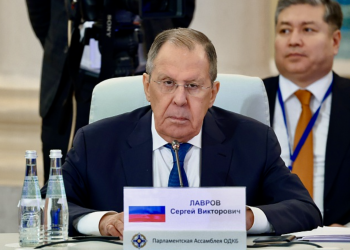
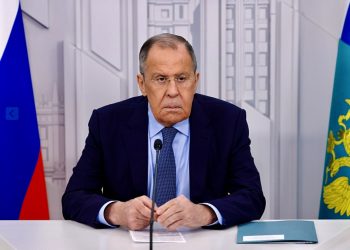
On April 15, Russian Foreign Minister Sergei Lavrov, at a press conference in Beijing together with China, called on the US and Iran to put forward “realistic and fair goals” in the talks.
On April 20, in a telephone conversation with his Iranian counterpart Abbas Araghchi, Lavrov stressed the need to maintain the ceasefire within the originally agreed parameters.
However, already on April 13, Peskov stated that the talks in Islamabad had “ended without result”. And on April 21, Lavrov stressed that Moscow sees no real results yet, only “threats, promises, assurances”, and recalled the “trap of false promises” using the example of the 2015 nuclear deal, from which the Americans themselves withdrew.
Reaction to the war in Lebanon
On the Lebanese crisis, Russia’s position was more concrete and critical of Israeli actions.
On April 9, Russian Foreign Ministry spokeswoman Maria Zakharova strongly condemned the Israeli attack on Lebanon, which led to numerous civilian casualties. On April 11, the Russian Foreign Ministry demanded an immediate halt to strikes on Lebanon and to hostilities in the zone bordering Israel.
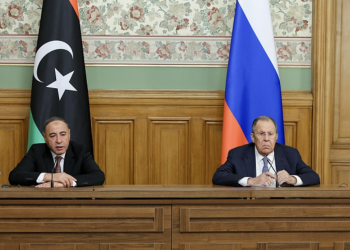
At a meeting with the Lebanese ambassador on April 13, Russian Deputy Foreign Minister Georgy Borisenko expressed serious concern over the continuation of hostilities and reaffirmed Russia’s unwavering position in support of Lebanon’s sovereignty, unity and territorial integrity.
On April 17, Zakharova welcomed the ceasefire agreement between Israel and Lebanon, expressing hope that it would create conditions for sustainable de‑escalation. Russia’s ambassador to Lebanon, Alexander Rudakov, had already stated at the end of March that Russia was making diplomatic efforts to prevent further escalation.
Russian-Iranian strategic partnership: economy, energy, logistics
Against the backdrop of the Middle Eastern crises, relations between Moscow and Tehran over the past year (April 2025 – April 2026) have reached an unprecedented level. The key event was the signing and entry into force of the Treaty on a Comprehensive Strategic Partnership between presidents Vladimir Putin and Masoud Pezeshkian on January 17, 2025 in Moscow (it came into force on October 2, 2025). The 20‑year document cemented the allied nature of the relationship and coordination within the UN, BRICS and the SCO.
Economy and trade. On May 15, 2025, the Free Trade Agreement between the EAEU and Iran entered into force, covering about 90% of goods. In the first three months, Russian-Iranian trade turnover grew by 35%, and Russian exports by 50%. Over the nine months of 2025, growth was 8.2%. Interregional cooperation is actively developing: Moscow, St Petersburg, Tatarstan and other regions are implementing dozens of projects.
Energy. A strategic cooperation agreement has been concluded providing for the possibility of supplying up to 55 billion cubic metres of Russian gas to Iran per year. In 2025, it was planned to start with a volume of up to 1.8 billion cubic metres via Azerbaijan. Russia has also committed to finance the construction of a new nuclear power plant in Iran; cooperation on the Bushehr NPP continues.
Logistics. The priority is the development of the International North‑South Transport Corridor (INSTC). In November 2025, the first freight train from Russia to Iran was launched along the eastern branch (via Kazakhstan and Turkmenistan) — the journey time was 13 days. Work is actively underway on the missing link of the western branch, “Rasht-Astara”: an appendix to the engineering surveys has been signed, and more than 100 km of land have been acquired. Russia, Iran and Azerbaijan have agreed to speed up the project’s implementation and to digitise customs procedures.
Military and cultural cooperation. Military interaction is expanding, but details, according to the Iranian side, are not disclosed. The partnership treaty includes provisions on joint exercises, exchange of delegations and personnel training. In 2025, Russian Culture Week was successfully held in Iran; in 2026, Iranian Culture Days (Week) are planned in Russia. More than 9,500 Iranian students are studying in Russia.
Instead of a conclusion
The past year has seen the transformation of Russian-Iranian relations into a full‑fledged strategic partnership. Key results include: the long‑term treaty defining the allied nature of the relationship has entered into force; the FTA with the EAEU has given a powerful boost to trade (growth of a third); the energy alliance (gas and nuclear) lays the foundation for Iran’s energy security; the INSTC is moving into an active implementation phase; Moscow and Tehran are acting in a coordinated manner on the international stage, especially on issues related to Iran.