

YEREVAN (Realist English). On 13 May, Turkish authorities decided to lift long-standing restrictions on bilateral trade with Armenia. Goods moving through third countries (primarily via Georgia) can now directly list Armenia as their final destination.
This move, which Yerevan has rushed to call an “important step towards the development of full-fledged relations”, in reality opens a wide road for Turkish goods into the Armenian market.
According to expert estimates, Turkey’s vastly more powerful and cheaper industry is capable of undermining local producers and ultimately finishing off what remains of Armenia’s manufacturing sector.
Statistics: trade with a catastrophic imbalance
Even with closed borders and a ban on directly listing the country of destination, Armenian-Turkish trade turnover already shows an extremely unfavourable imbalance for Armenia.
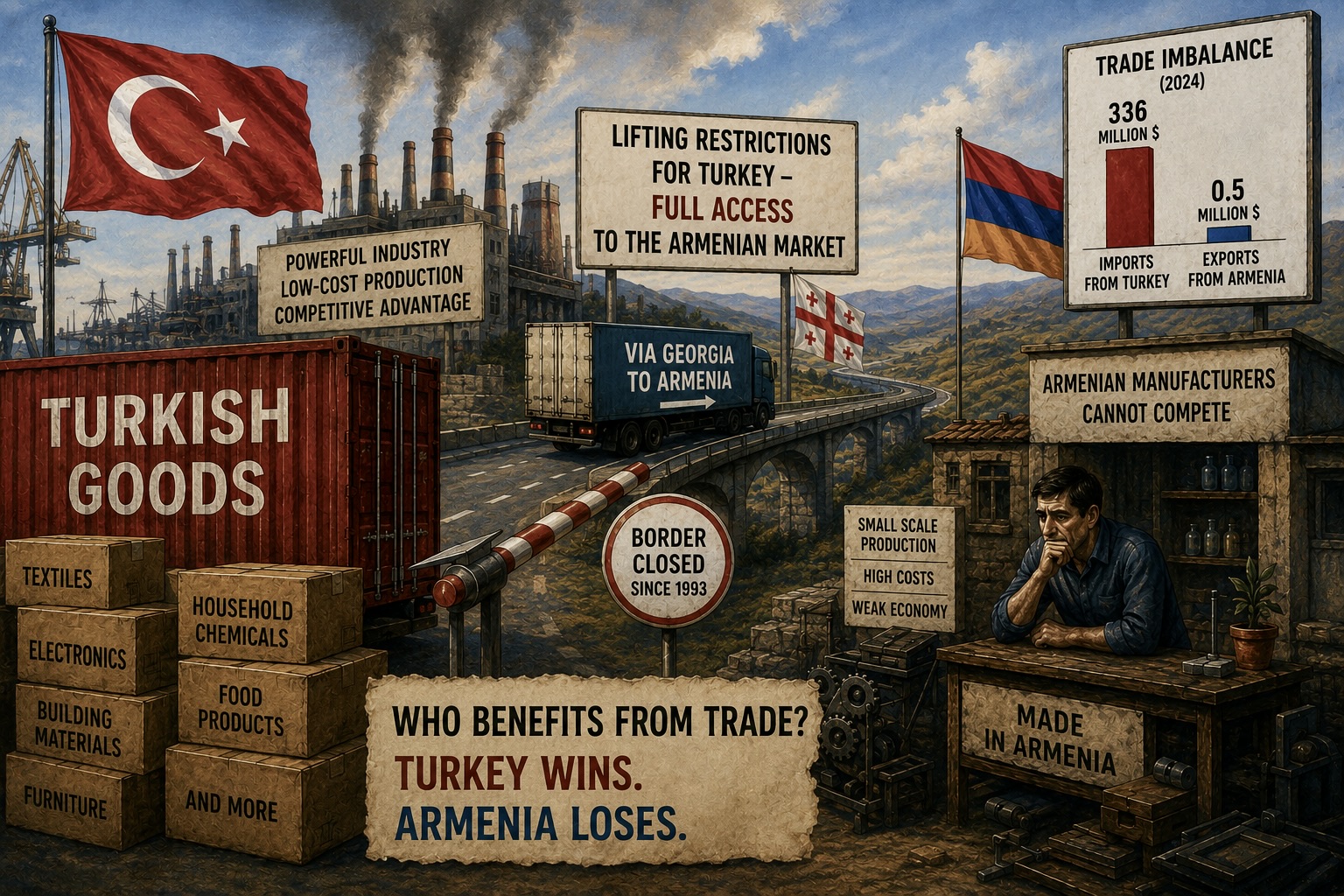
At the end of 2024, imports from Turkey amounted to $336 million, while Armenian exports barely reached $0.5 million.
Throughout 2025, according to some data, Turkey supplied goods worth $368 million to Armenia.
Armenian Economy Minister Gevorg Papoyan forecasts that potential trade turnover could grow to $700–800 million per year.
However, this growth will be almost entirely driven by an increase in Turkish imports, while Armenian producers will be unable to compete.
Why Armenia loses: cheap Turkish dominance
Turkey’s key advantage lies in its significantly more powerful and diversified economy. Unlike Armenia, which has been undergoing a process of deindustrialisation for decades, Turkey has efficient agriculture, a developed light industry, mechanical engineering, and a chemical sector.
Turkey benefits from relatively low labour costs and well-developed production across a wide range of goods — from clothing to complex machinery. Armenian capital is considerably weaker than Turkish capital and is unlikely to withstand such competition.
Political scientist Vahe Davtyan warned even before the official opening of trade that Armenia “is not capable of maintaining balanced economic relations with Turkey. It does not have the potential for this. And it will be difficult to do so in the near future, given the country’s intensive deindustrialisation and the dominance of the trade and services sectors in the economy’s structure.”
Consequently, the opening of direct trade flows will lead to an “intensive penetration of Turkish goods into the Armenian market, which could threaten local industries already struggling with competitiveness”. According to experts, the situation will become even more acute if Turkish trade and economic expansion turns into a full-fledged geostrategic instrument.
Ankara is in no hurry to open the border
It is important to understand that the lifting of customs restrictions is only part of the process. The actual land border between the two countries has remained closed since 1993, and goods physically continue to pass through Georgia. Ankara links the full opening of the border to progress in talks between Yerevan and Baku, as well as to the domestic political situation in Armenia itself.
This tactic, which many experts describe as a strategy of “managed opening”, allows Turkish goods to enter the Armenian market unhindered, while simultaneously leaving the Armenian government in the position of a supplicant forced to take into account the conditions of both Ankara and Baku. The result is a paradoxical situation: Turkey gains virtually full access to the Armenian market while retaining leverage for economic and political pressure.
The unrestrained praise of “historic steps” by Armenian officials looks at best naïve and at worst reckless towards their own producers.
Government promises to support local enterprises — Minister Papoyan has already stated that the government will assist them and, in the future, allow them to “reorient production” — appear unrealistic given the chronic budget deficit and rapidly growing public debt.
The only real benefit mentioned by Armenian officials is possible access to Turkey’s Mediterranean ports. However, this benefit would primarily simplify logistics for importers of Turkish goods and for Turkish exports themselves. This would only accelerate the displacement of remaining domestic production by cheaper Turkish alternatives.
For Turkey, this deal is an obvious win. Ankara gains a new, virtually defenceless export market, strengthens its economic and political influence in the South Caucasus, and retains additional instruments of pressure.
For Armenia, however, this “progressive” development carries serious risks of a final loss of production sovereignty. From the outset, the deal appears to benefit Turkey far more than Armenian industrialists.