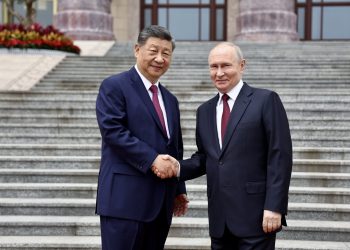


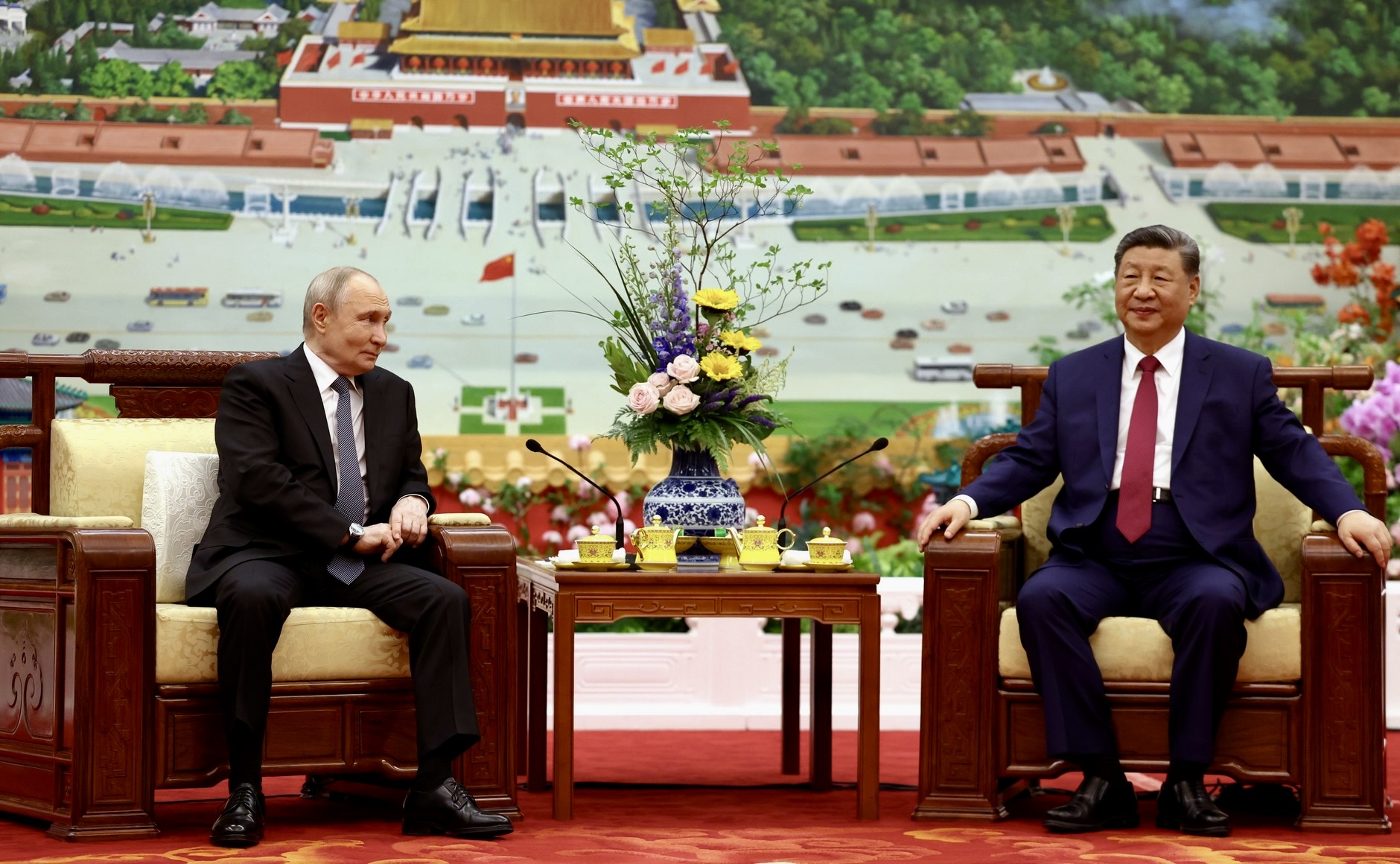
BEIJING (Realist English). Russia and China have agreed to further strengthen their comprehensive partnership and strategic cooperation, expand economic ties, and deepen coordination on international affairs. This was announced by Russian President Vladimir Putin and Chinese President Xi Jinping following talks in Beijing.
Following the meeting, the two leaders signed a joint statement on the further development of Russia–China relations, along with a package of intergovernmental, interagency, and corporate agreements. According to Putin, around 40 agreements were signed, aimed at expanding cooperation across multiple sectors.
Xi stated that relations between Moscow and Beijing have reached a “historic peak” and now represent a model of interaction between major powers.
“For 30 years, our relations have withstood the test of time and continued to rise to new heights. Today they stand at the historic peak of comprehensive partnership and strategic cooperation,” the Chinese leader said.
Xi also stressed that China and Russia remain committed to the principles of non-alignment, non-confrontation, and not targeting third countries.
Particular attention during the talks was given to economic cooperation. According to Xi, bilateral trade has exceeded $200 billion for the third consecutive year, while trade volume during the first four months of 2026 increased by around 20% despite difficult external conditions.
Putin stated that total bilateral trade reached nearly $240 billion in 2025.
“Virtually all Russian–Chinese export and import transactions are now conducted in rubles and yuan. In essence, we have built a stable system of mutual trade protected from external influence and negative trends in global markets,” the Russian president said.
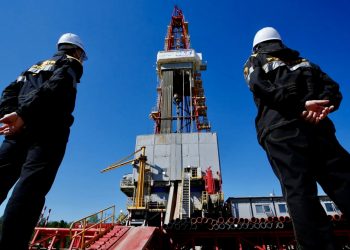
Energy remains one of the key pillars of cooperation. Putin confirmed Russia’s readiness to continue supplying oil, natural gas, and coal to China. Discussions also covered nuclear energy projects, renewable energy development, and cooperation in critical minerals and metals.
However, no breakthrough was achieved on the expected Power of Siberia 2 pipeline project. The two sides confirmed that discussions would continue, but no final agreement was announced.
Special emphasis was also placed on high technology and industrial cooperation. Russia and China agreed to deepen cooperation in digital economy projects, artificial intelligence, technological innovation, and industrial production.
According to Putin, joint projects are already underway in automobile manufacturing, metallurgy, chemicals, biotechnology, pharmaceuticals, aerospace, and space industries.
Moscow and Beijing also declared their intention to strengthen transport and logistics cooperation, including the development of trans-Arctic routes and the Northern Sea Route.
In the humanitarian sphere, the two leaders announced the launch of Russia–China Years of Education. The program includes hundreds of events, such as scientific conferences, student exchanges, and joint educational initiatives.
On international issues, Putin and Xi reaffirmed common positions on key global matters. Xi criticized unilateral actions and manifestations of hegemony, warning of a possible return to the “law of the jungle” in international relations.
Putin, in turn, stated that Russia and China would continue coordination through organizations such as the Shanghai Cooperation Organization (SCO), BRICS, the G20, the World Trade Organization, and other international institutions.
The two sides also adopted a joint declaration on the development of a multipolar world and a new type of international relations.
The Beijing talks took place amid intensifying geopolitical competition involving the United States, China, and Russia, giving the visit additional strategic significance.
The symbolic dimension of the meeting proved no less important than its practical outcomes. Within a single week, Xi Jinping hosted first Donald Trump and then Vladimir Putin, highlighting Beijing’s growing role as a center of global diplomacy.