

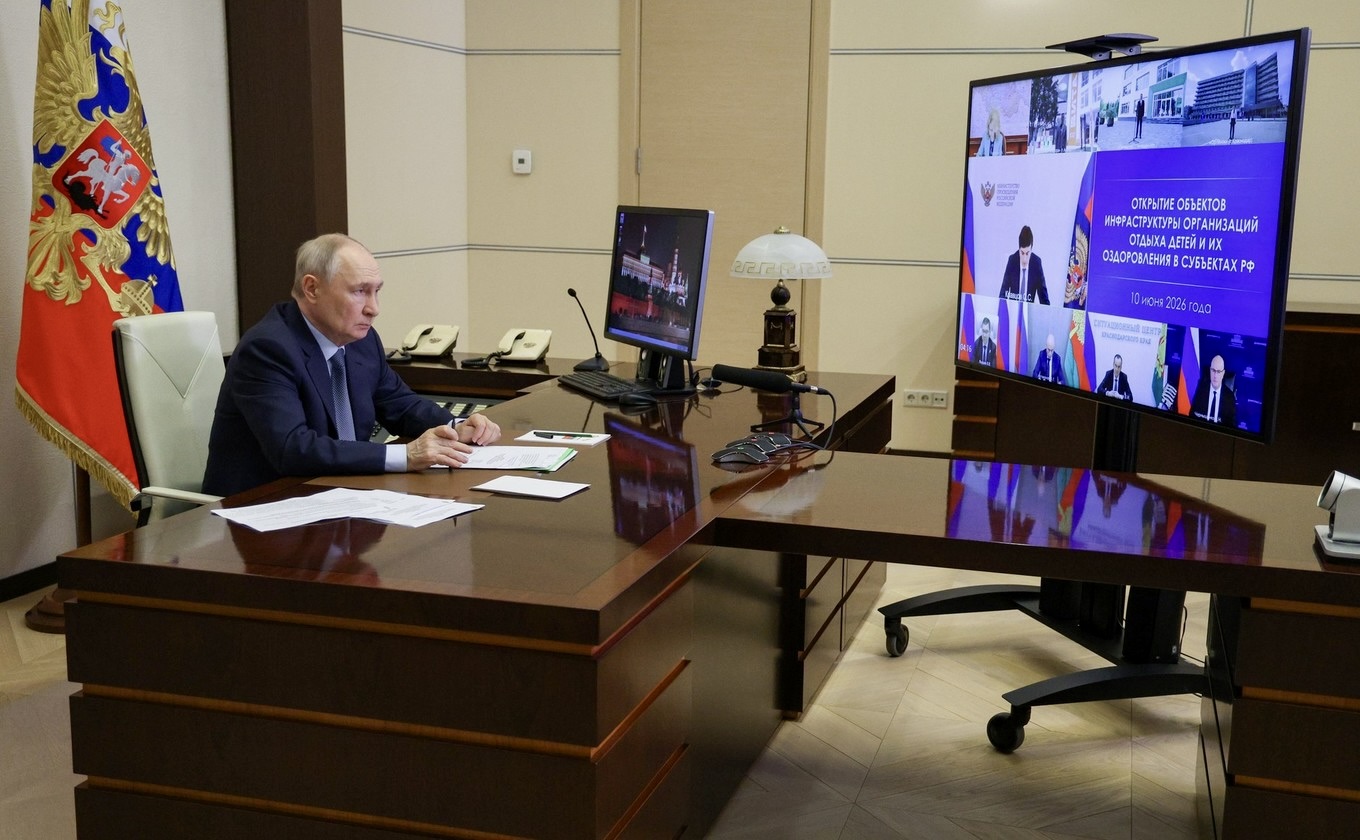
NOVO-OGARYOVO (Realist English). President Vladimir Putin held a videoconference with members of the government to discuss the development of investment activity and social support measures for families with children.
The head of state heard reports from ministers and business representatives and gave a number of instructions on modernizing mechanisms to stimulate capital investment.
Family Tax Benefit: Over 1.6 Million Applications in 10 Days
Opening the meeting, Vladimir Putin recalled that from June 1, working parents raising two or more children with low per‑capita income (less than 1.5 times the regional subsistence minimum per family member) can reclaim part of the personal income tax (PIT) they have paid – effectively reducing the rate to 6%. Both parents can receive the payment if they are officially employed.
“I consider this decision absolutely fair. It is in line with the logic and spirit of our entire demographic and social policy,” the president stressed.
Deputy Prime Minister Tatyana Golikova reported that in the first 10 days, more than 1.6 million applications had been received (99.2% through the government services portal). Payments have already been made to 293,000 families covering 680,000 children. The largest payment during this period – 141,200 rubles – went to a family with four children from the Murmansk region.
Putin instructed that citizens be informed as widely as possible about the new support measure.
Furthermore, following the Direct Line session, the mechanism of the single benefit for large families whose income exceeds the subsistence minimum by no more than 10% was expanded. Since May 22, assistance has been granted to more than 21,000 families (over 56,000 children). In total, an estimated 74,000 families raising more than 230,000 children will receive additional support.
Children’s Summer Holidays: 40,500 Camps and 5.75 Million Children
Education Minister Sergey Kravtsov reported that the summer health campaign started on June 1. A total of 40,500 children’s camps will operate (280 more than last year), including 2,000 residential camps. Coverage will exceed 5.75 million children – 100,000 more than the previous year.
All facilities have been inspected by Rospotrebnadzor, the Emergencies Ministry and other supervisory bodies; nationwide drills have been conducted to practice emergency response. This year, a real‑time monitoring system for children’s recreation facilities has been introduced.
On the president’s instruction, a programme to restore and modernise children’s camps is being implemented in the regions. Over four years, 70 regions have taken part; 336 new residential modules have been built, with another 130 planned. Since 2023, 136 facilities have been renovated and 336 new children’s recreation facilities built (residential blocks, sports grounds, stadiums, medical rooms and canteens), creating 160,000 new places. By 2030, more than 200,000 new places are to be added.
New Facilities: Orlyonok, Prometheus and the Private Resort Vita
Three facilities were opened during the meeting:
- An educational technology centre at the Orlyonok children’s centre (Krasnodar Territory). Covering 22,500 square metres, it includes a teaching laboratory block with 25 classrooms, a 300‑seat concert hall, accommodation for 440 people, a swimming pool and a children’s driving training ground. The centre will allow an additional 3,800 children per year (Orlyonok’s total capacity will rise to 19,800). It will be used to train 1,500 primary school teachers.
- The sixth residential module at the Prometheus camp (Lipetsk Region) under the federal modernisation programme. The camp already has a health centre with physiotherapy, a 25‑metre swimming pool, a 1,200‑seat stadium, a driving training ground, a climbing wall and a phygital centre combining sport with cyber‑physical disciplines. After reconstruction, capacity will exceed 1,000 children per shift.
- The new 800‑bed Aurora building at the private Vita children’s resort (Anapa). This will raise the resort’s total capacity to 5,500 children simultaneously and annual coverage to 30,000 children. The resort has been funded for 20 years from its own resources and ticket sales, while enjoying regional tax benefits and preferences.
Krasnodar Territory Governor Veniamin Kondratyev noted that the region supports investors in children’s recreation and thanked the president for his attention to the sanatorium‑resort complex.
From June 21, the 329 graduates of the teacher training college in Starobilsk who suffered from the Ukrainian strike on May 22 will be sent for rest and recuperation at the Smena federal centre. The college’s destroyed facilities are being rebuilt together with the Karachay‑Cherkess Republic, the region responsible for patronage.
The head of state ordered the strengthening of anti‑terrorist security at children’s centres, camps and health resorts.
“Once again, I draw the attention of the heads of special services and all law enforcement agencies to the need to strengthen anti‑terrorist security and security in general across the entire educational, social system and infrastructure,” Putin said, commenting on the terrorist attack in Starobilsk.
The president also criticised European sanctions against children’s recreation organisations in Russia:
“It is nonsense, pure nonsense. One can only guess what effect they expect. From the standpoint of common sense of normal people, this is a manifestation of some kind of stupidity.”
Urban Improvement: 118,000 Territories and 15 Million Votes
Minister of Construction and Housing Irek Fayzullin reported on the implementation of the federal project “Formation of a Comfortable Urban Environment”. Since 2017, 118,000 territories have been improved. The project has been extended to 2030. Over five years, more than 68 million votes have been cast in the nationwide vote; 10,712 territories have been selected, of which 8,505 have already been completed.
This year, the president launched the vote on April 21. Already, 15 million residents have cast their votes. The vote ends on Friday, Russia Day. Fayzullin called on citizens who have not yet made their choice to participate.
The projects deliver economic benefits: 30,000 jobs have been created and more than 7,000 new commercial outlets opened. For example, in Chekalin (Tula Region), after the improvement of Cathedral Hill, a folk culture festival appeared that attracts up to 3,000 guests in a town of fewer than 1,000 people. In Derbent, the tourist flow doubled and the city’s own revenues quadrupled.
In 2026 (the Year of the Unity of the Peoples of Russia), special attention is being paid to projects reflecting the country’s cultural diversity.
Cultural Clusters in the Far East
Culture Minister Olga Lyubimova reported on the creation of cultural and educational museum complexes in Vladivostok, Kemerovo, Kaliningrad and Sevastopol. In Vladivostok, more than 400 children are already studying.
On the president’s instruction, branches of leading creative universities have been opened in the Far East: in 2025, the first 32 students began studying at VGIK (Khabarovsk), 22 at the Shchukin Theatre Institute (Yuzhno‑Sakhalinsk), and 13 at the GITIS branch (Blagoveshchensk). In 2026, around 100 more students will study at these branches.
The Primorye Stage of the Mariinsky Theatre has 30 operas and 26 ballets. During the season, 350 performances were held, attended by more than 200,000 spectators.
Vladimir Putin drew attention to the need to modernise the building of the Moscow State Academy of Choreography. Prime Minister Mikhail Mishustin assured that the instruction would be carried out.
Investment Activity: Challenges and Mechanisms
The main theme of the meeting was stimulating investment activity. Economic Development Minister Maxim Reshetnikov noted that after the high accumulated levels of previous years (investments in 2024 exceeded the 2020 level by 38%, and their share of GDP exceeded 23%), an expected slowdown in investment activity is being observed. The reasons are the high key interest rate, shrinking corporate profits, and the completion of large projects.
“Current monetary policy affects investment. Corporate profits are shrinking because of high interest costs. There are not many opportunities to grow from their own funds, and borrowing is expensive,” Reshetnikov explained.
As non‑monetary measures, the government is implementing:
- Reducing the investment‑construction cycle (permit approval times have been cut by 530 days, construction costs by 14%);
- Amendments to the Labour Code increasing the limit for overtime work (with employee consent and additional pay);
- Labour productivity programmes (covering 17 sectoral programmes, 55 million jobs);
- Development of out‑of‑court dispute resolution and bankruptcy legislation (pre‑bankruptcy rehabilitation);
- Conclusion of special investment contracts and agreements on the protection and promotion of capital investments (75 agreements worth 5.5 trillion rubles, four new ones signed at SPIEF).
Reshetnikov also proposed introducing a “use it or lose it” principle in the electricity sector to make more efficient use of grid capacity.
Business Proposals: Tax Deductions, Equity Financing, Infrastructure
The president heard representatives of business associations.
Alexander Shokhin (RSPP) noted that a strong ruble and high key interest rate are holding back investment. Business is asking for fine‑tuning of the federal investment tax deduction (increase from 3% to 8%), recapitalisation of the Industry Development Fund, resumption of the CPIC (Corporate Programmes to Increase Competitiveness) from 2028, expansion of the stabilisation clause in special investment contracts, and removal of excessive restrictions on concession agreements and PPPs for subsidised regions.
Alexey Repik (Delovaya Rossiya) proposed introducing a “deferred” investment tax deduction: a company invests today and reduces its profit tax in several years’ time, when the project has created an additional tax base. The deduction could be issued in the form of a tax certificate or a digital financial asset that could be used as collateral for a loan.
“At the moment, there are no lost budget revenues. We simply cannot afford them now,” Repik explained.
Government’s Position: Support for Proposals and Concrete Steps
Deputy Prime Minister Alexander Novak reported that investment in fixed capital in the first quarter of 2026 amounted to 6.635 trillion rubles, a decline of 271 billion rubles from the previous year, with the downturn mainly driven by large companies (project completions). He supported the idea of targeted work on 50–100 large investment projects that could be “unblocked” using existing instruments (PPPs, special investment contracts, investment protection agreements). Novak called the idea of a deferred tax deduction acceptable and in need of further discussion with the Finance Ministry.
Finance Minister Anton Siluanov noted that the federal investment tax deduction mechanism is already gaining traction: 5.2 billion rubles was used in the first quarter of 2026 (compared with 2.5 billion a year earlier). For the Far East, proposals are being prepared for a more generous investment deduction. He also stressed the importance of developing the financial market, companies’ IPOs and SPOs, and protection of property rights as a basic condition for reducing the “risk premium”.
Vladimir Putin, summing up, described the current situation not as an “investment pause” but as “investment restraint”, driven by macroeconomic policy that is already delivering results – a fall in inflation to 5.2%.
“The situation is generally under control. The measures being taken are delivering the desired results. Therefore, I think we have the right to count on a reduction in the key interest rate and the achievement of other necessary parameters,” the president said.
He instructed presidential aide Maxim Oreshkin, together with the government, to work through the proposals made and prepare relevant instructions.