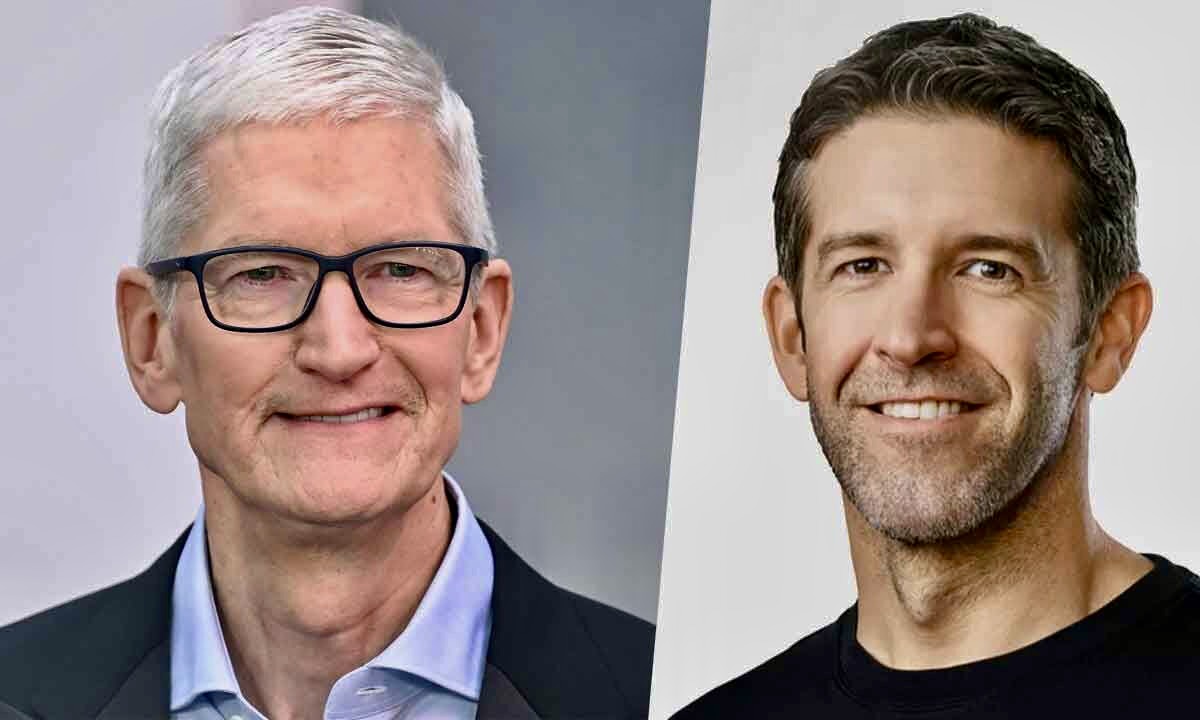
SAN FRANCISCO (Realist English). Tim Cook will step down as Apple’s CEO on September 1, 2026, and will be replaced by hardware chief John Ternus, marking the end of a 15‑year run leading the iPhone maker.
As the company announced on April 20, Cook, who took over from founder Steve Jobs in 2011, will become chairman of Apple’s board of directors.
During his 15 years at the helm, Apple’s market capitalisation grew from $350 billion to $4 trillion (a twenty‑fold increase), while annual revenue rose from $108 billion to $416 billion. Under Cook, Apple released the Apple Watch, AirPods and Vision Pro, and launched services such as iCloud, Apple Pay, Apple TV and Apple Music.
Cook’s departure from the top job makes Ternus only the third Apple CEO in the past 30 years. The Financial Times reported in November that Apple’s board was preparing to name a new chief executive this year.
Ternus, a 25‑year Apple veteran long viewed as Cook’s likely successor, oversees the engineering of its leading products, including the iPhone, iPad and the Mac. Apple shares fell less than 1 per cent in after‑hours trading.
Cook (65) said that Ternus “has the mind of an engineer, the soul of an innovator, and the heart to lead with integrity and with honour”, adding that he was “without question the right person to lead Apple into the future”.
Ternus takes the helm at a challenging time for the iPhone maker as it faces unprecedented political pressure from the Trump administration to shift manufacturing to the US. The new chief executive will also have to guide Apple’s AI strategy as it struggles to harness the technology in its products following a rare series of misfires.
“I am filled with optimism about what we can achieve in the years to come,” Ternus said. “I have been lucky to have worked under Steve Jobs and to have had Tim Cook as my mentor.”
As chairman, Cook will replace Arthur Levinson, who will become lead independent director after 15 years leading the board.
Cook, a close confidant of Apple’s founder, initially took over as interim CEO in 2009 while Jobs was undergoing cancer treatment, before assuming permanent responsibilities in August 2011 shortly before Jobs’s death.
During Cook’s tenure, Apple has grown roughly ten‑fold, selling more than $200 billion worth of iPhones and becoming a services behemoth that generates more than $100 billion a year from businesses such as the App Store, Apple Pay and iCloud.
Though lacking the showy personality and aggressive product focus of Jobs, Cook has widely been hailed for his operational expertise and credited with building out the company’s vast manufacturing network in China and south‑east Asia.
Cook steered the company through the Covid‑19 pandemic and legal and tax scrutiny from antitrust regulators and politicians. Recently, he has had to navigate US‑China trade disruptions under President Donald Trump, securing repeated tariff carve‑outs for the company’s products.
Apple has also released a series of new products under Cook, including the Apple Watch, Vision Pro and AirPods. These additions have diversified its revenue, although the iPhone still accounts for roughly half of sales. An ambitious project to build an Apple car was shelved in 2024.
This strategy has, however, come under closer scrutiny in recent years as relations between Washington and Beijing have soured, leading Apple to look to India as an alternative manufacturing base.
Cook’s continued presence on Apple’s board is likely to calm some investor concerns about Apple’s ability to influence global policymakers, an area where Ternus has less experience.
Cook has proven adept at dealing with the president, making a rare televised appearance in the Oval Office in August to present Trump with a glass and gold trophy. His diplomacy and big commitments to US manufacturing helped stave off the threat of fresh tariffs on its smartphones.
Cook’s departure as chief executive caps a year and a half of high‑profile moves in Apple’s small inner leadership circle, with several of its top executives stepping back from their roles or leaving. These changes mark one of the most consequential leadership transitions in the company’s 50‑year history.
Among the executives who stepped back or left were chief financial officer Luca Maestri, longtime operations boss and Cook protégé Jeff Williams, general counsel Katherine Adams and AI boss John Giannandrea. Senior design executive Alan Dye left in December.
Apple’s top team has been replenished with new chief financial officer Kevan Parekh, operations chief Sabih Khan and general counsel Jennifer Newstead, formerly of Meta, alongside longtime executives such as software chief Craig Federighi and services boss Eddy Cue.
Johny Srouji, senior vice‑president of hardware technologies, on April 20 assumed an expanded role as chief hardware officer, taking over Ternus’s engineering responsibilities.
Ternus’s path
Ternus joined Apple in 2001 and has dedicated 25 years to the company, rising from an entry‑level engineer to head of hardware engineering. He is 50 years old — exactly the same age as Tim Cook was when he took over Apple in 2011. He graduated from the University of Pennsylvania with a degree in mechanical engineering. His first job was as a mechanical engineer at a small technology company called Virtual Research Systems.
In 2013, he became vice‑president of hardware engineering. In 2021, he joined the executive team and was promoted to senior vice‑president of hardware engineering, reporting directly to Tim Cook.
Since 2021, he has overseen the development of Apple’s entire hardware lineup: the iPhone, iPad, Mac, Apple Watch, AirPods and Vision Pro. He is considered a key figure in the revival of the Mac line. Under his leadership, Macs have become more powerful and popular than ever before in their 40‑year history.
He introduced innovations that reduced the carbon footprint of Apple’s products and improved their repairability (for example, using recycled aluminium and 3D‑printed titanium). He played an important role in developing and launching the latest models, such as the ultra‑thin iPhone Air and the relatively inexpensive MacBook Neo.
Ternus is an “engineer to the core”, modest and rarely gives interviews, yet he is highly valued by his colleagues. He is described as a charismatic leader with an impeccable reputation.