CANBERRA / TOKYO (Realist English). Australia has moved to reverse a decline in the number of warships, as its surface combatant fleet stands to fall to its smallest size since World War II.
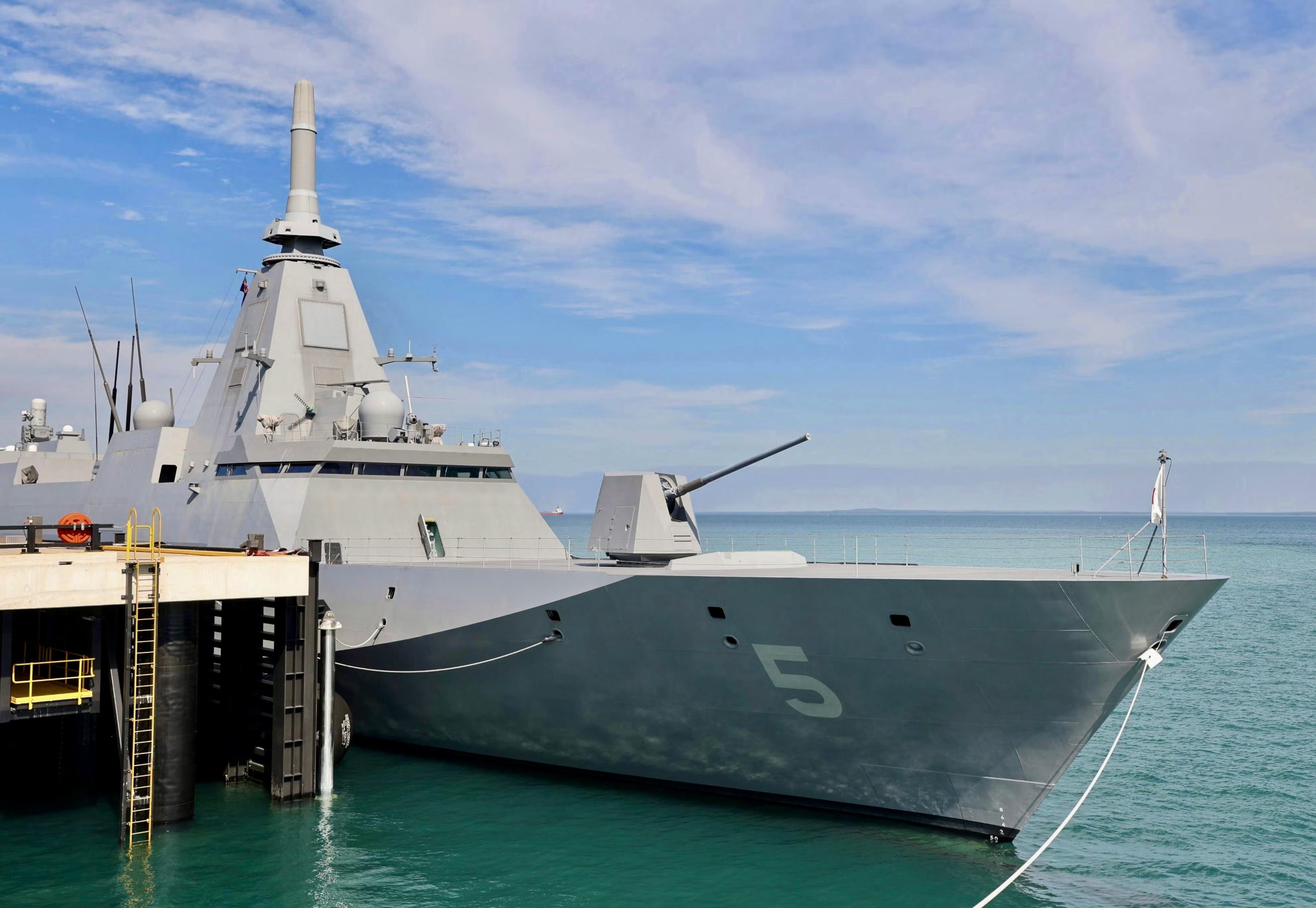
Under Project Sea 3000, Australia and Japan inked a deal to buy three upgraded Mogami-class frigates for the Royal Australian Navy (RAN). The contract was signed by the two countries’ defence ministers aboard JS Kumano in Melbourne earlier in April 2026.
This represents Japan’s largest-ever defence export, a major boost to its shipbuilding industry, and it advances greater strategic alignment between the two countries.
Construction in Japan and Australia
Mitsubishi Heavy Industries (MHI) will construct three 4,800-ton frigates in Japan, with the first to be delivered by December 2029. Another eight frigates will subsequently be built in Western Australia. This shipbuilding effort is slated to cost up to A 20 billion (US 20 billion (US14.4 billion) over the next decade, double the amount indicated two years ago.
Minister for Defence Industry Pat Conroy stated: “This is the fastest acquisition for the Royal Australian Navy in peacetime. We’re working closely with Japanese and Australian industry partners as we acquire one of the most, if not the most, advanced general-purpose frigate in the world.”
‘Game‑changer’ in technology
Rear Admiral Stephen Hughes, the RAN’s Head of Naval Capability, told Defence News: “It’s going to be a game-changer from a capability perspective. The reality is that Mogami is going to allow us to jump a generation in technology in a ship” – not only in its combat system, but how the RAN operates and crews these highly automated ships. Subcontracts are already being awarded, including NEC (for nine types of equipment such as sonars and UNICORN integrated masts) and Rolls‑Royce (for MT30 gas turbines).
These frigates are desperately needed, since the RAN presently has just ten surface combatants – three Hobart-class destroyers and seven Anzac-class frigates. The latter will be replaced by the upgraded Mogami.
Shifting from counting ships to capability
Hughes rejected the notion that the navy’s capability is currently declining. “I think what you’re managing is a transition from a current force which has a certain amount of capability, to a different force with greater capability, different opportunities. And I don’t believe you count the number of ships. It’s about the capability.” He described the upgraded Mogami as larger and far more capable than the Anzac class, plus they will offer greater availability of 300 days at sea annually.
Armament and systems
Their armaments include ESSM Block 2 surface-to-air missiles in a 32-cell Mk 41 vertical-launch system, deck-mounted Naval Strike Missiles, MK 54 lightweight torpedoes and a SeaRAM. Otherwise, these frigates will boast Japanese systems and sensors such as the combat management system, sonar and UNICORN mast. Hughes explained the aim is to have as few Australianised changes as possible, because that “would delay the delivery of the ship.” He added: “We’ve actually picked the best ship with the most compatible capability for the Australian navy’s use.”
Outcome: a combined fleet of 35 frigates
Ultimately, Australia and Japan will end up operating a combined fleet of 35 Mogami frigates.
Defence spending
Japan: In fiscal year 2025–2026, Japan’s defence budget reached 9.04 trillion yen (about $60 billion), breaking the previous record and exceeding 2% of GDP for the first time. Spending has grown more than 56% since 2022, driven by a new National Security Strategy that abandons a purely defensive posture in favour of “building deterrent capabilities.”
Australia: The 2025–2026 defence budget was A$61.0 billion (2.05% of GDP). Under a new National Defence Strategy published in 2026, Australia plans to raise spending to 3.0% of GDP by fiscal year 2033–2034. By 2035, defence spending is projected to double (with the share of procurement rising from about 30% to nearly 50% of the total budget).
Nuclear deterrent potential
Neither country possesses nuclear weapons. However, Australia is an active participant in the AUKUS agreement, which envisions building a fleet of eight SSN‑AUKUS nuclear submarines by the early 2040s, and possibly purchasing up to four used Virginia‑class submarines from the United States (from 2032 onwards).
Personnel strength
Japan: Ground forces number about 150,000 active personnel and 56,000 reservists (total combined strength of all branches reaches 250,000). Manpower shortages, especially in technical fields, remain a major challenge.
Australia: The Australian Defence Force permanent strength reached 62,653 in 2025–2026. Although recruitment figures have improved, they still fall short of targets, and retention remains a critical issue.
Naval forces — Fighters and air defence
Japan (ASDF): Plans to field the world’s third‑largest F‑35 fleet — 105 F‑35A and 42 F‑35B (147 total). It also operates about 200 F‑15J fighters, which are being gradually retired. It is developing a next‑generation fighter as part of the GCAP programme. Efforts focus on acquiring long‑range missiles (including up to 400 Tomahawk cruise missiles), hypersonic weapons, and upgrading Patriot and Type‑03 air defence systems.
Australia (RAAF): Operates 108 combat aircraft: 72 fifth‑generation F‑35A fighters; 24 F/A‑18F Super Hornets; and 12 EA‑18G Growler electronic‑attack aircraft, supported by 7 KC‑30A tankers. Priorities include acquiring long‑range precision munitions (JASSM‑ER, LRASM), strike drones (MQ‑4C Triton, MQ‑28 Ghost Bat), and integrating hypersonic weapons.
Ground forces
Japan: Organisation includes 5 regional commands, 9 divisions (including one armoured division) and 8 separate brigades.
Australia: The army numbers about 30,000 soldiers. It includes Headquarters 1st Division (comprising 1st, 3rd and 7th brigades), Special Operations Command, and Forces Command.
Joint projects and exercises
AUKUS: Australia is a member of AUKUS, and Japan has been invited to participate in “Pillar 2”, which focuses on advanced technologies (artificial intelligence, hypersonics, cyber security). This was seen as a vote of confidence in Japan’s technological leadership.
Joint military exercises: The two countries’ armed forces regularly conduct exercises (Bushido Guardian, Talisman Sabre; in 2025, AUKUS nations and Japan joined to test underwater autonomous communications under AUKUS Pillar 2).
Technological cooperation: Australia and Japan are actively cooperating in warship development and procurement. Japan has removed restrictions on defence exports, using the Mogami frigate agreement to boost its shipbuilding industry.