TEHRAN (Realist English). Three US aircraft carriers are simultaneously operating in the area of responsibility of the US Central Command (CENTCOM) in the Middle East for the first time since 2003, the command reported on Friday, 24 April. This is the largest concentration of US naval power in the region in decades.
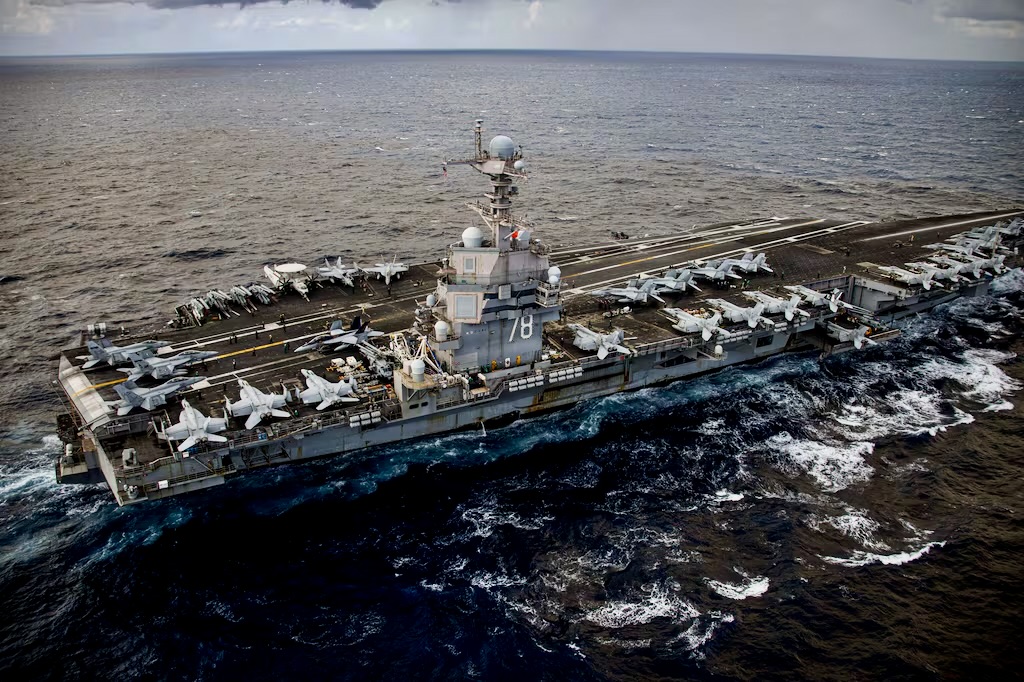
As specified in the CENTCOM statement, the aircraft carriers USS Abraham Lincoln, USS Gerald R. Ford and USS George H.W. Bush are currently in the region’s waters, along with their air wings and more than 15,000 sailors and Marines.
In total, the three carriers carry more than 200 aircraft for various purposes — from electronic warfare aircraft to stealth strike aircraft. These include the EA-18G Growler, F-35C Lightning II, F/A-18 Super Hornet and CMV-22B Osprey.
Aircraft carriers serve as the backbone of US naval power, as they are capable of sustaining air operations without relying on host-nation bases. Each carrier is accompanied by a strike group that includes destroyers, cruisers and logistics support vessels.
According to the command, at least 12 ships are in the region: three aircraft carriers and their accompanying destroyers. No details about specific operations or deployment timelines have been disclosed.
The presence of the carriers comes amid ongoing tensions between the United States and Iran, including disruptions to shipping in the Strait of Hormuz. The United States has imposed a blockade on Iranian ships and ports. In a separate CENTCOM statement for 24 April, it was said that the blockade has already “diverted” 34 vessels.
The blockade began on 13 April. US Defense Secretary Pete Hegseth said at a briefing on 24 April that it would continue “for as long as it takes, whatever President Trump decides.”
The United States has deployed the most powerful military grouping against Iran in the region in the last 23 years.
Naval Forces
Carrier Strike Groups (CSG): One third of all US aircraft carriers are concentrated in the region — the densest such grouping since the 2003 invasion of Iraq. The central element of naval power consists of three carriers:
- USS Gerald R. Ford (CVN-78): The flagship and newest carrier (displacement 100,000 tons, up to 90 aircraft, EMALS electromagnetic catapult), operating in the Red Sea.
- USS Abraham Lincoln (CVN-72): A Nimitz-class veteran, operating in the Arabian Sea.
- USS George H.W. Bush (CVN-77): Arrived on 23 April after a voyage bypassing Africa via the Cape of Good Hope.
Each group includes between 65 and 75 aircraft, three destroyers, cruisers, submarines and support vessels.
Strike Ships and Their Armament:
- Deployed vessels: Over 20 ships, including at least 16 destroyers (e.g., USS Mason, USS Frank E. Petersen Jr.) and up to 12 support vessels. Destroyers and cruisers (Ticonderoga class) provide ballistic missile defence and air defence.
- Tomahawk cruise missiles: One of the main assets. Just three escort destroyers for a single carrier can launch nearly 300 missiles (each carries up to 96) for strikes against Iranian military facilities.
Amphibious and Mine Warfare Forces:
- Amphibious grouping: Thousands of Marines on vessels such as USS Tripoli, which carry helicopters and MV-22 Osprey tiltrotors.
- Mine countermeasures: Three on-duty Littoral Combat Ships (LCS) ensure minesweeping of the strategic Strait of Hormuz.
- Blockade and “global pursuit”: The port blockade has been in effect since 13 April. Thirty-four vessels have been turned back, and naval operations have extended beyond the Persian Gulf into the Indian Ocean (including the interception of the tanker Tifani off Sri Lanka).
Air Forces
Strike Aviation: The air wings of the three carriers total more than 200 combat aircraft. This allows for massive strikes:
- F-35C Lightning II: Fifth-generation stealth fighters for penetrating air defences.
- F/A-18 Super Hornet: Primary carrier-based strike fighters providing air superiority and ground attack capabilities.
- EA-18G Growler: Electronic warfare aircraft to suppress Iranian radars and communications.
Strategic Bombers and Land-Based Aviation:
- Global Strike Forces: Strategic B-52 and B-1B bombers have been deployed (according to some reports, 5 B-1B and 3 B-52), capable of carrying nuclear and precision-guided munitions.
- US Air Force component: Dozens of land-based fighters, including F-15E and F-16, as well as AWACS aircraft (E-2C Hawkeye) and aerial tankers, are deployed in the region.
Special Operations Forces and Ground Troops
Total strength: More than 60,000 US military personnel have been assembled in the conflict zone.
SOCOM strike forces: No fewer than 5,000 special operations forces have been deployed. They are trained to seize key facilities (nuclear centres, ports — including the Kharg oil terminal) and to destroy Iranian missiles. Units of the 82nd and 101st Airborne Divisions are preparing for deployment.
US Marine Corps: The Marine Corps grouping numbers at least 7,700 personnel. It includes Marine Expeditionary Units from the 21st and 31st Expeditionary Units, as well as the 11th Expeditionary Unit (another 4,200 personnel).